A FinCEN ruling, formally an administrative ruling, is FinCEN's written answer to a request about how its Bank Secrecy Act regulations apply to a specific, real situation. It binds FinCEN on those facts, and it has precedential value for others in the same position only if FinCEN publishes it on its website. That puts rulings in the middle of the ladder of BSA sources: below the statute and the regulations in 31 CFR Chapter X, which bind everyone they cover, and above FinCEN's FAQs, interagency guidance and the FFIEC examination manual, none of which has the force of law. Banks need to know where each sits, because a BSA answer often cites three or four of them at once, and they do not carry equal weight. Botminds' BSA/AML Manual Search labels every source it cites, keeps the rule apart from the institution's own procedure, and never lets a proposed rule be the only basis of an answer.
Rule text is quoted from the eCFR as of October 22, 2026. Product examples come from a fictional sample credit union, Norrell Federal Credit Union.
The authority ladder: every source a BSA answer can cite, ranked by what binds
1
Statute
The Bank Secrecy Act, 31 U.S.C. 5311 and following; 12 U.S.C. 1829b
BindsEveryone it covers
2
Regulation
31 CFR Chapter X; the agencies' program rules, such as 12 CFR 21.21 and 748.2
BindsEveryone it covers, with the force of law
3
Published administrative ruling
For example FIN-2020-R001, on CTRs for sole proprietors and DBAs
BindsFinCEN, on the requester's actual facts; others similarly situated may rely on it
4
Unpublished ruling
A ruling sent only to the requester
BindsFinCEN, on the requester's facts only; no precedential value
5
FinCEN and interagency FAQs and guidance
The SAR FAQs of October 9, 2025; CDD FAQs; advisories
BindsNo one, as law; states how the agencies read the rules
6
FFIEC examination manual
The BSA/AML InfoBase, section by section
BindsNo one, as law; instructs examiners
7
Oral advice
A helpline call; an examiner's comment
BindsNo one; no precedential value
8
Proposed rule
The April 2026 AML/CFT program proposal
BindsNo one, until a final rule takes effect
—
The institution's own procedures
The board-approved program and the procedures under it
BindsThe institution itself; examiners test whether they are followed
What is a FinCEN ruling?
It is an administrative ruling issued under 31 CFR 1010.710 to 1010.717, FinCEN's written interpretation of "the relationship between this chapter and each situation for which such a ruling has been requested." A request must be in writing, describe the situation and its material facts, and ask a concise question; FinCEN will not issue a ruling in response to an oral request. A ruling issued on a real, specifically identified situation binds FinCEN for that situation.
The ruling's reach beyond the requester depends on publication. The rule says a ruling "shall have precedential value, and hence may be relied upon by others similarly situated, only if FinCEN makes it available to the public through publication on the FinCEN Web site under the heading 'Administrative rulings'" (31 CFR 1010.715). An unpublished ruling is a private answer. A published one works like a narrow piece of interpretation that anyone with the same facts can cite.
Where are FinCEN administrative rulings published?
On FinCEN's Administrative Rulings page, which lists every published ruling, rescission and grant of exceptive relief by date and type of institution (FinCEN). On October 26, 2026 it held 91 entries, from 1988 to March 15, 2024, 61 of them listed under depository institutions.
FinCEN's published rulings, by the numbers
91
entries on FinCEN's rulings page, 1988 to 2024
61
of them listed under depository institutions
Mar 2024
date of the most recent entry; none in 2025 or 2026 to late October
Rulings can also stop counting. FinCEN may modify or rescind a ruling when statute or regulations change, when a fact in the request proves materially inaccurate, or for other good cause, and "once rescinded, an administrative ruling shall no longer have any precedential value" (31 CFR 1010.716). FIN-2020-R001, on how to complete a CTR for a sole proprietorship or a business operating under a "doing business as" name, shows the cycle: it "replaces and rescinds two rulings: FIN-2006-R003 and FIN-2008-R001," which "were based on the now obsolete FinCEN Form 104" (FIN-2020-R001). Citing either of the older rulings in 2026 would cite nothing.
Are FinCEN FAQs binding?
No. FAQs state how FinCEN, and in interagency FAQs the banking agencies, read the existing rules; they do not change them. The October 2025 SAR FAQs say so on their first page: the answers change no BSA legal or regulatory requirement and set no new supervisory expectation (SAR FAQs, October 9, 2025).
That does not make FAQs optional reading. An FAQ that says the rules never required something, as the October 2025 FAQ on documenting decisions not to file does, tells a bank what examiners should not expect. And the FFIEC manual's SAR section now points examiners to the FAQs as the newest word on the topics they cover. In practice an FAQ is the agencies' stated reading of the rule, and a bank departing from it needs a reason grounded in the regulation itself.
Does supervisory guidance have the force of law?
No, and the banking agencies have put that in their own regulations. The OCC's reads: "Unlike a law or regulation, supervisory guidance does not have the force and effect of law, and the OCC does not take enforcement actions based on supervisory guidance. Rather, supervisory guidance outlines the OCC's supervisory expectations or priorities and articulates the OCC's general views regarding appropriate practices for a given subject area" (12 CFR part 4, subpart F, appendix). The Federal Reserve's appendix to 12 CFR part 262 and the FDIC's to part 302 say the same, and the FDIC's rule adds that its statement "is binding on the FDIC" (12 CFR 302.2).
The rules date from 2021: the OCC's effective March 15, the FDIC's April 1 and the Federal Reserve's May 10 (86 FR 18173). They codified a 2018 interagency statement and remain in force; in 2026 the FDIC added a separate subpart to part 302 on reputation risk, leaving the guidance subpart unchanged.
Can examiners cite guidance violations?
Not as violations. The OCC's rule says examiners "will not criticize (through the issuance of matters requiring attention), a supervised financial institution for, and the OCC will not issue an enforcement action on the basis of, a 'violation' of or 'non-compliance' with supervisory guidance." The FDIC's says the same of supervisory recommendations and matters requiring board attention.
The same sentence keeps a door open: "In some situations, examiners may reference (including in writing) supervisory guidance to provide examples of safe and sound conduct, appropriate consumer protection and risk management practices, and other actions for addressing compliance with laws or regulations." A finding must rest on a law, a regulation or an unsafe practice; guidance can illustrate it. That is why an examiner's criticism of a SAR program cites 31 CFR 1020.320 and may then point to the FAQs or the manual for what good practice looks like.
What each source says about itself
The source: 31 CFR 1010.715
In its own words: "shall have precedential value, and hence may be relied upon by others similarly situated, only if FinCEN makes it available to the public"
The source: 31 CFR 1010.716(c)
In its own words: "Once rescinded, an administrative ruling shall no longer have any precedential value."
The source: SAR FAQs, October 2025
In its own words: Say they change no legal or regulatory requirement and set no new supervisory expectation
The source: OCC, 12 CFR part 4, subpart F
In its own words: "does not have the force and effect of law"
The source: FFIEC and FDIC releases, 2021
In its own words: States that it establishes no requirements of its own; those are in statutes and regulations
Are FFIEC manual procedures requirements?
No. The FFIEC examination manual, including the examination procedures in each section, tells examiners how to assess a bank's program and its compliance with the rules; it creates no requirements of its own. The FFIEC and its member agencies have said so with every release since 2021. Its weight comes from use: it is how examiners scope and test, so a gap against it is a gap an examiner is likely to find.
The manual also ages unevenly, section by section, and in October 2026 its SAR section still told banks to document decisions not to file a SAR, which the 2025 FAQs say no rule requires. The full release history, and where the manual trails newer guidance, is in FFIEC manual updates.
The difference between a FinCEN ruling and guidance
A ruling answers one requester's question about one real situation, and guidance answers everyone's question about a general topic. The differences that matter to a bank are who asked, who is bound, and whether others can rely on it.
A FinCEN ruling, FAQs and guidance, side by side
| Administrative ruling | FAQs and guidance | FFIEC manual | |
|---|---|---|---|
| Who starts it | A requester, in writing, on an actual situation | FinCEN or the agencies, on their own initiative | The FFIEC member agencies, with FinCEN |
| Who it binds | FinCEN, on the requester's facts | No one, as law | No one, as law |
| Who may rely on it | Others similarly situated, if published | Everyone, as the agencies' stated view | Everyone, as the examiner's checklist |
| How it ends | Rescinded or modified by a new ruling | Replaced, updated or withdrawn | Revised section by section |
| How a bank should cite it | By number and date, checking it was not rescinded | By title and date, with the rule it interprets | By section and its date |
What was the FinCEN ruling on beneficial ownership?
Many searches for "FinCEN ruling" in 2025 and 2026 were about the Corporate Transparency Act's beneficial ownership reporting by companies, and the "ruling" people meant was a court's. As FinCEN later recounted, on December 3, 2024 a federal district court in Texas, in Texas Top Cop Shop, Inc., preliminarily enjoined enforcement of the Act nationwide; the Supreme Court stayed that order on January 23, 2025, and the last nationwide order was stayed on February 18, 2025. FinCEN then narrowed the reporting rule itself, by rule rather than by administrative ruling. On March 26, 2025, an interim final rule exempted entities "previously defined as 'domestic reporting companies'" from reporting beneficial ownership information to FinCEN (90 FR 13688). On August 14, 2026, FinCEN adopted it as final with limited changes, also exempting U.S. company applicants (91 FR 52508).
For banks the important distinction is between that reporting rule and their own customer due diligence rule. 31 CFR 1010.230 still requires a bank to identify and verify the beneficial owners of legal entity customers when an account is opened. A teller or new-accounts officer who has read that "FinCEN dropped beneficial ownership" has read the wrong rule, which is exactly the kind of mix-up a cited answer prevents. Every BSA duty a bank still owes is listed with its section in Bank Secrecy Act requirements on one page.
Ranking sources inside one answer: BSA/AML Manual Search
A good BSA answer cites several rungs of the ladder at once and keeps them apart. BSA/AML Manual Search's answer to the sample credit union's cash question puts "what the rule says" in one column, citing 31 CFR 1010.313(b) and 1010.311, the FFIEC manual's CTR section, the structuring definition at 1010.100(xx) and the SAR FAQs of October 9, 2025, each with its date. "What Norrell's procedure says" sits in a second column, with each procedure's version and effective date, and a note where a procedure is older than a source it relies on.
BSA/AML Manual Search puts the rule in one column and the procedure in the other, every source dated
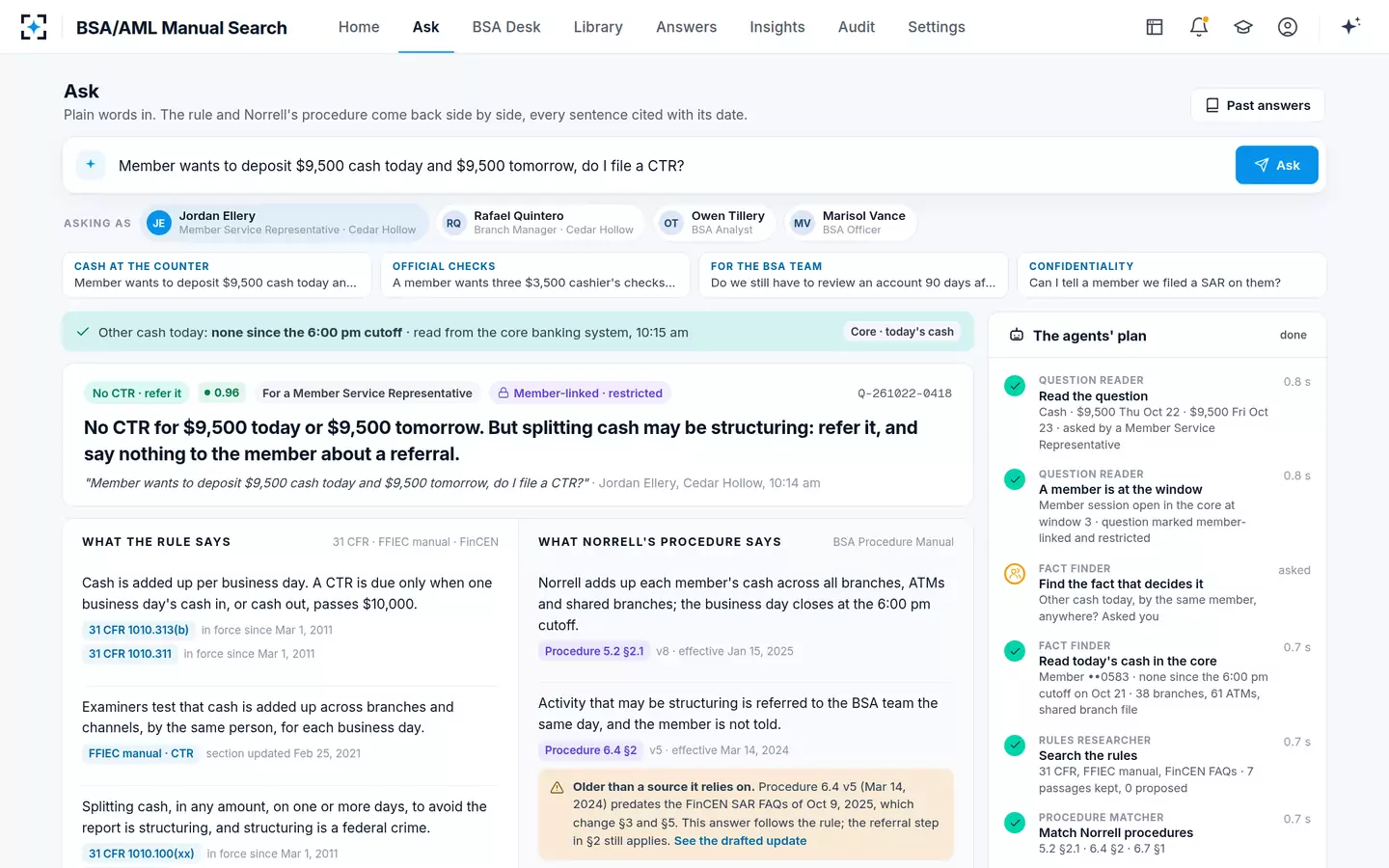
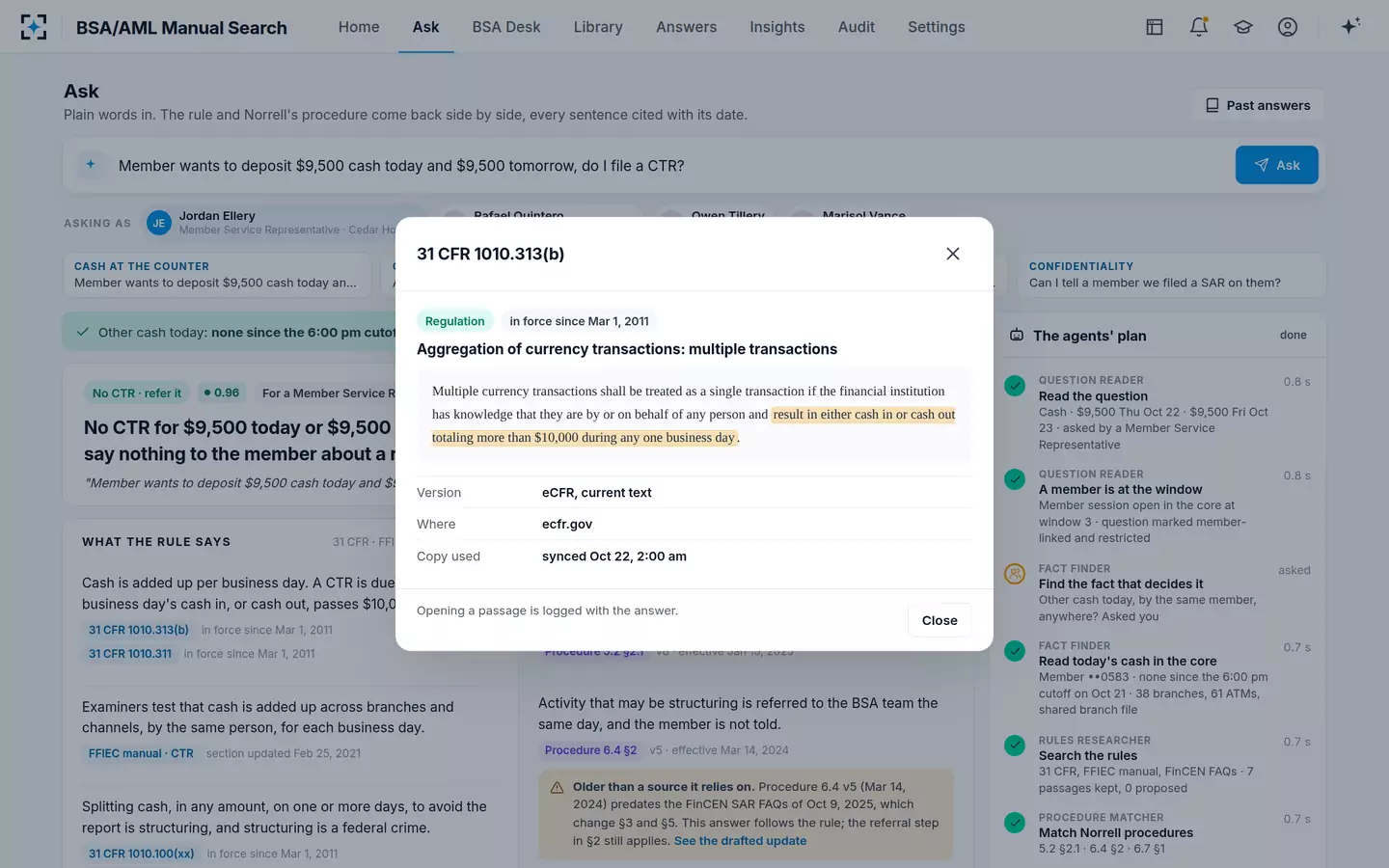
Two settings put the ladder into practice. The rules researcher never relies on a proposed rule alone and never uses superseded text for a new answer, so a rescinded ruling or a withdrawn proposal cannot carry an answer. And a proposed rule, such as the April 2026 program proposal, is shown in the library labelled "not in force." Each citation opens its passage with the version and the copy used, so anyone can check which rung it stands on.
One citation opened: the passage, its status and the copy the answer used
When the sources do not settle a question, the answer is not a guess. It goes to the BSA team's queue, and if the team cannot settle it either, the next step is FinCEN, as described in the FinCEN regulatory helpline or the manual.
Questions people ask
Is a FinCEN ruling the same as a FinCEN guidance document?
No. A ruling answers a written request about one actual situation and binds FinCEN on those facts; it guides others only if published. Guidance, such as an FAQ or an advisory, is issued on FinCEN's own initiative for everyone and has no force of law.
Can a bank rely on a ruling issued to another bank?
Yes, if FinCEN published it and the bank's situation is the same in the respects that mattered. Under 31 CFR 1010.715, published rulings may be relied on by others similarly situated. Check that it has not been rescinded, as FIN-2006-R003 and FIN-2008-R001 were by FIN-2020-R001.
Do FinCEN advisories create obligations?
An advisory describes typologies and red flags and often asks filers to use a key term in SAR narratives; it does not change the SAR rule. The obligation to report suspicious activity comes from 31 CFR 1020.320, and an advisory helps a bank recognise activity that may meet it.
Does guidance from the agencies bind the agencies themselves?
The FDIC's rule on supervisory guidance says its statement on the role of guidance "is binding on the FDIC," and the OCC and Federal Reserve rules commit their examiners not to criticize a bank for "non-compliance" with guidance.
What does an unpublished FinCEN ruling mean for other banks?
Nothing formal. Under 31 CFR 1010.715 a ruling has precedential value only when FinCEN publishes it, so a ruling another institution received privately cannot be cited as authority, even if its reasoning is sound.