The FinCEN regulatory helpline is the service FinCEN's Regulatory Support Section runs for questions about the Bank Secrecy Act and its regulations: the toll-free number 1-800-949-2732, the email address FRC@fincen.gov, and a web form at fincen.gov/contact, which is the channel FinCEN's 2026 notices name. It is useful for interpretation, but an answer given by phone or email is advice, and FinCEN's own rule says oral opinions by Treasury or bank supervisory staff "do not bind FinCEN and carry no precedential value." Only a written administrative ruling, requested on a real situation, binds FinCEN, and it has precedential value for others only when FinCEN publishes it, which it has done nine times since 2015. Most questions a bank or credit union has are answered by the regulation, FinCEN's FAQs and rulings and the institution's own procedures, which is the ground Botminds' BSA/AML Manual Search searches before anyone picks up the phone.
Contact details are as FinCEN's pages showed them on October 26, 2026. Product examples come from a fictional sample credit union, Norrell Federal Credit Union.
Where a BSA question should go, in order
Agent
Search the textFind the passage in 31 CFR Chapter X, FinCEN's FAQs and rulings, and the FFIEC manual, with the date of each.
Never: Rely on a proposed rule alone
Agent
Match the procedureFind the institution's own procedure section and version, and note where it is older than a source.
Never: Blend procedure and rule into one sentence
A person decides
BSA team settles itQuestions the text does not settle, or that turn on a fact nobody has, go to a BSA analyst or the BSA officer.
A person decides
Ask FinCEN's Regulatory Support SectionInterpretation questions the team cannot settle: by web form, email or phone. Write down the answer, the date and who gave it.
A person decides
Request a written rulingA real, unsettled situation with money or risk riding on the answer: a written request under 31 CFR 1010.711, answered with a target of 90 days.
What is the FinCEN regulatory helpline?
It is FinCEN's service for answering questions about BSA obligations, run by the Regulatory Support Section. FinCEN's pages describe it in two places. Its contact page for money services businesses says: "For BSA regulatory questions and interpretations of BSA regulations, please contact FinCEN's Regulatory Support Section at www.fincen.gov/contact" (FinCEN). Its Hot Topics page, which collects "the most common and important questions that are asked of FinCEN's Regulatory Helpline," says: "For more information about the Regulatory Helpline or to seek assistance with your BSA/AML questions, please call 1-800-949-2732 or e-mail FRC@fincen.gov" (FinCEN Hot Topics).
The names overlap. Searchers type "regulatory helpline," "regulatory hotline" and "regulatory support section" for the same service, and FinCEN's current notices use the last: the Minnesota geographic targeting order of August 2026 lists, for further information, "FinCEN's Regulatory Support Section by submitting an inquiry at www.fincen.gov/contact" (91 FR 51588).
How do you contact FinCEN with a question?
Use the web form for a written question, the phone line for a quick one, and a formal letter only when you need a ruling. Each channel gives a different kind of answer.
FinCEN's channels for a BSA question, and what each one gives you
| Channel | How | Use it for | What you get |
|---|---|---|---|
| Regulatory Support Section, web form | www.fincen.gov/contact; subject areas include the Bank Secrecy Act and beneficial ownership | Written interpretation questions | A reply from FinCEN staff: advice, not binding |
| Regulatory Helpline, phone | 1-800-949-2732 | Quick questions, and where to find guidance | Spoken advice: binds no one, leaves no record unless you make one |
| Resource Center, email | FRC@fincen.gov | Questions that need a written trail | A written reply: advice, not binding |
| Administrative ruling request | In writing under 31 CFR 1010.711, to administrative.rulings@fincen.gov | A real situation the rules do not settle | A ruling that binds FinCEN on your facts; precedential for others only if published |
Some questions go to FinCEN by design. The FFIEC manual tells a bank that finds it has exempted customers it should not have to "contact FinCEN's Resource Center to request a determination on whether to backfile unreported currency transactions" (FFIEC manual, Transactions of Exempt Persons). Backfiling decisions belong with FinCEN, not with a search tool or an examiner.
Are FinCEN helpline answers binding?
No. An answer from the helpline, by phone or email, is advice from FinCEN staff. FinCEN's regulation on administrative rulings says so in terms that reach beyond FinCEN itself.
Oral opinions or advice by Treasury, Customs and Border Protection, the Internal Revenue Service, the Office of the Comptroller of the Currency, or any other bank supervisory agency personnel, regarding the interpretation and application of this chapter, do not bind FinCEN and carry no precedential value.
31 CFR 1010.713(a), Oral communications
The same section says FinCEN "will not issue administrative rulings in response to oral requests." A phone answer, however helpful, is something an institution relies on at its own risk, and an examiner reviewing the decision later will look for the basis in the rules, not in a call. The sensible use of a helpline answer is as a pointer: it tells you which rule or guidance FinCEN staff consider relevant, which you then read and cite.
What is a FinCEN administrative ruling, and how long does it take?
An administrative ruling is FinCEN's written interpretation of how its regulations apply to a situation someone has described in a formal request. It binds FinCEN "only in the event that the request describes a specifically identified actual situation," and it has precedential value, so that others similarly situated may rely on it, only if FinCEN publishes it (31 CFR 1010.715). FinCEN's target is to respond within 90 days, and it says it "does not respond substantively to every request for an administrative ruling and reserves the right to decline to provide a ruling to any request" (FinCEN Administrative Rulings).
Published rulings are rare and getting rarer. FinCEN's rulings page lists 91 entries from 1988 to 2024, and only nine since 2015; the most recent is dated March 15, 2024. Of the 61 entries listed under depository institutions, many ask whether a customer's business is a money services business, how a CTR is completed or how an exemption applies, and a group from 2018 concerns beneficial ownership at rollovers and renewals.
FinCEN administrative rulings published, by period
The decline is a practical signal. A bank cannot count on a published ruling appearing for its question, and a ruling on its own request takes months. For most day-to-day questions, the answer has to come from the rules, FinCEN's FAQs and guidance, and the institution's own procedures. How each of those ranks, and what binds, is set out in FinCEN rulings, FAQs and guidance: what actually binds a bank.
Which questions to research before you call FinCEN
Research first any question whose answer is in the regulation, a FinCEN FAQ or the institution's procedure, which covers most counter questions. FinCEN's own Hot Topics page, built from the helpline's most common questions, points callers to published material: CTR aggregation for businesses with common ownership, backfiling and amending CTRs, eligibility for CTR exemptions, and FinCEN's CTR and SAR FAQs.
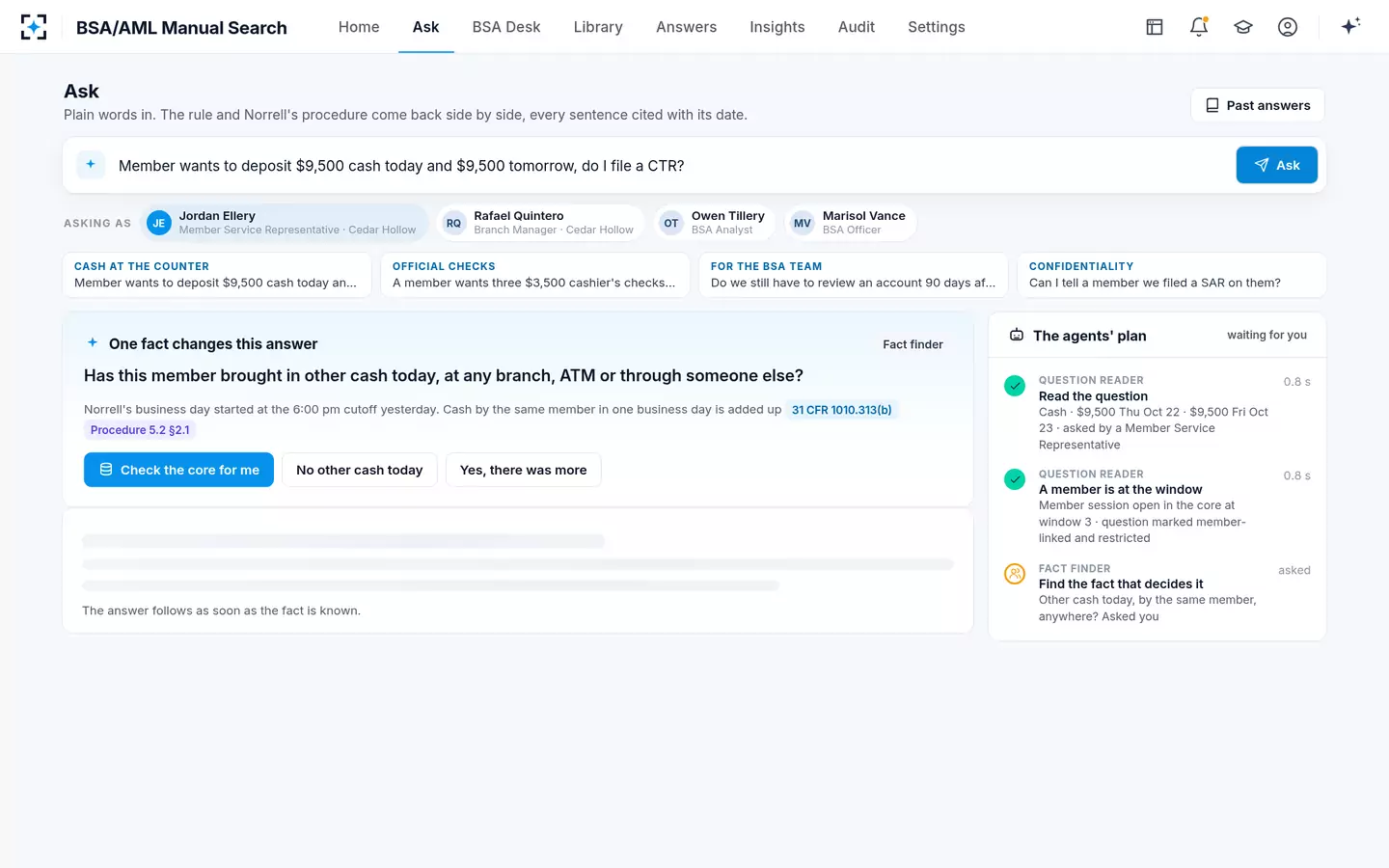
Three kinds of question deserve a call or a written inquiry. Questions where the regulation and the guidance seem to point different ways after a careful read. Questions about a new product or arrangement the rules did not anticipate. And questions the FFIEC manual itself sends to FinCEN, such as backfiling. A question that turns on a fact nobody has yet, such as whether a member brought in other cash that day, is not a question for FinCEN at all; it is a question for the branch.
Asking back the fact first: the question most counter calls are really about
What a ruling request must contain
A ruling request is a formal document. FinCEN's rule lists what it must contain, and a request that does not conform is returned with 30 days to fix it before it is treated as withdrawn (31 CFR 1010.712).
The contents of an administrative ruling request, under 31 CFR 1010.711
- A complete description of the situation
The ruling binds only on the situation described, so describe the real one.
- A complete statement of all material facts
A ruling can be modified or rescinded retroactively if a fact was materially inaccurate or incomplete.
- A concise and unambiguous question
One question, answerable yes or no where possible.
- A certification about investigations and litigation
That the question is not applicable to any ongoing state or federal investigation, litigation, grand jury or other proceeding involving the parties.
- Any information you want withheld from FOIA
Identify it and give the reason; any part of a ruling may otherwise be disclosed.
- A justification, if the situation is hypothetical
Why the situation warrants a ruling even though it has not happened.
- A signature
Of the requester, or of an agent with the authority to make the request.
The certification rules out a common temptation. A question about a customer under investigation, or a decision that may end in litigation, cannot be put to FinCEN as a ruling request. And nothing about a SAR, or anything that would reveal one, belongs in any request or call: 31 CFR 1020.320(e) bars disclosing it.
Write down the answer you were given
Whatever the channel, the institution owns the decision, so it needs a record of the basis: the question as asked, the answer, who gave it, when, and the sources cited. Answers given by phone, inside the institution as much as from FinCEN, leave nothing to show an examiner what staff were told, or why.
Where branch questions are answered by phone or email, nothing structured is usually kept. The question a teller phones in today is often the one another branch asked last month; without a record, the second answer may differ from the first. A short internal log of questions answered, and the passages relied on, is the cheapest control there is, and the training it feeds is described in BSA training requirements, seat by seat.
Where BSA/AML Manual Search fits in the route
BSA/AML Manual Search does the first two steps of the route for every question and keeps the record of all of them. Its agents search 31 CFR Chapter X, the NCUA's rule, the FFIEC manual and FinCEN rulings, FAQs and advisories passage by passage, match the institution's procedures, and answer verdict first with every sentence cited and dated. A question the text does not settle goes to the BSA team's queue with the passages found and the reason the agents stopped, on a 30-minute clock when a member is waiting and four business hours otherwise.
The BSA team's queue in BSA/AML Manual Search: the questions worth a person's time
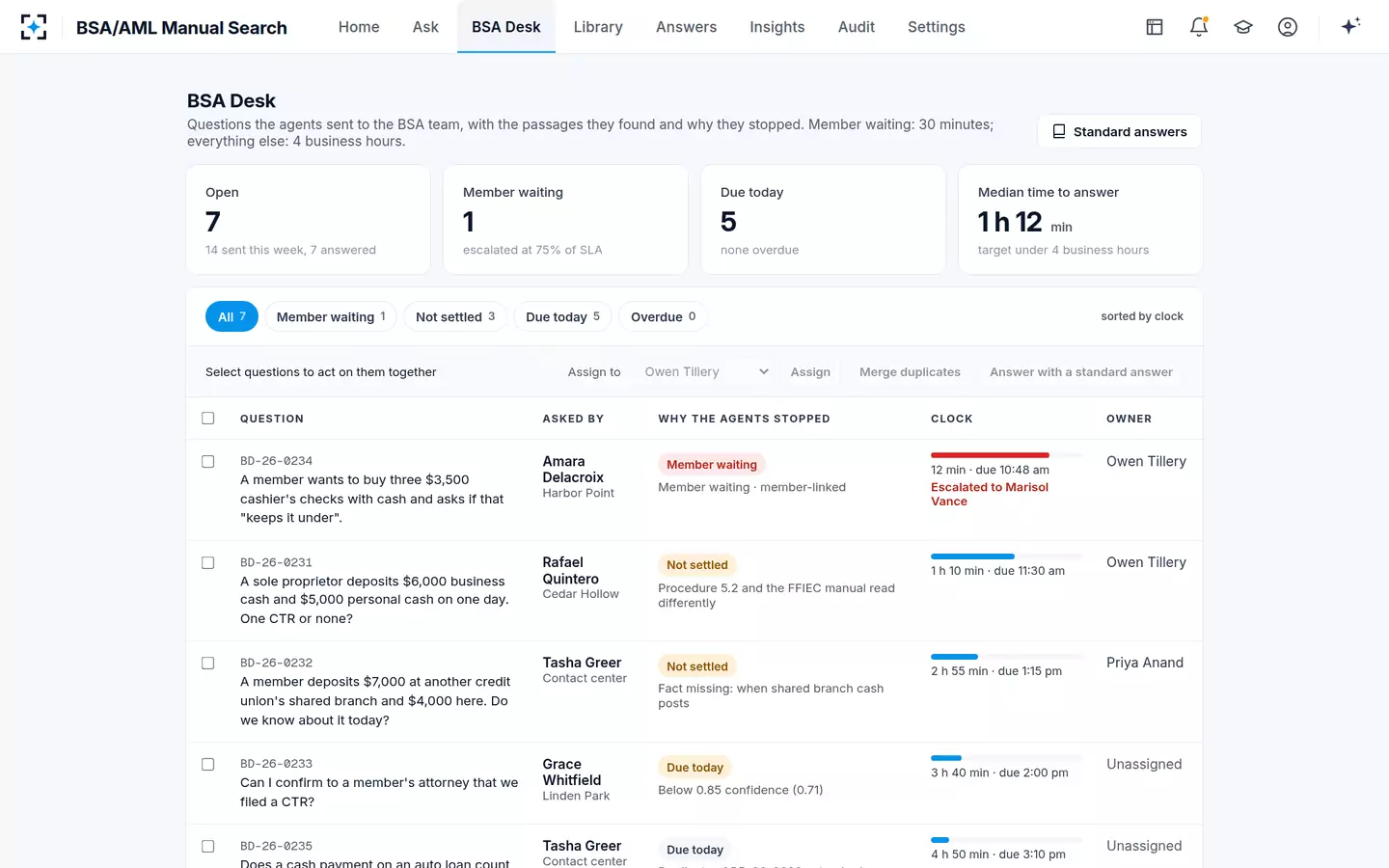
The solution does not call FinCEN or request rulings; a BSA officer decides that. What it changes is what the BSA officer brings to the call: the passages already found, the procedure in force, the institution's earlier answers to similar questions, and a record that will show the examiner what was asked and on what basis. For how a cited answer differs from a chatbot's, see ChatGPT for AML compliance.
Questions people ask
What is the FinCEN regulatory hotline number?
FinCEN's Hot Topics page gives 1-800-949-2732 for the Regulatory Helpline, with FRC@fincen.gov as the email address. FinCEN's current notices direct written inquiries to the Regulatory Support Section's web form at fincen.gov/contact.
What is the FinCEN Resource Center email?
FRC@fincen.gov, the address FinCEN's Hot Topics page gives for BSA/AML questions alongside the helpline number. Administrative ruling requests go to a different address, administrative.rulings@fincen.gov, and must meet the requirements of 31 CFR 1010.711.
Can FinCEN answer questions about a specific customer?
Not through an administrative ruling if the question touches an ongoing investigation or litigation, because a request must certify that it does not. And no channel is a place to reveal a SAR or a referral, which 31 CFR 1020.320(e) forbids. Describe the situation in general terms or ask about the rule.
Does an examiner have to accept what the FinCEN helpline said?
No. Under 31 CFR 1010.713, oral advice from FinCEN, Treasury or bank supervisory staff does not bind FinCEN and has no precedential value. A written record of the advice still documents the basis of the institution's decision, which is what an examiner reviews.
Where can I find FinCEN's published rulings?
On FinCEN's Administrative Rulings page, which lists 91 entries from 1988 to March 2024, filterable by type of institution. Published rulings have precedential value for others similarly situated; a ruling rescinded under 31 CFR 1010.716 no longer does.