The OCC's ACH risk management guidance is OCC Bulletin 2006-39, "Automated Clearing House Activities: Risk Management Guidance". It is still in force for national banks and federal savings associations, with its references to reputation risk removed as of March 20, 2025, and it asks an originating bank to treat every ACH originator as an unsecured credit: underwritten, given an exposure limit, monitored and reviewed. Examiners test that against the FFIEC's Retail Payment Systems examination procedures, which spell out, item by item, what they look for in an originating bank's file. The practical question for an ACH risk manager is whether each test can be answered with a document rather than a conversation. Botminds' ACH Originator Risk Assessment builds that document for each originator as the review happens.
The examples come from a fictional sample bank, Corvane, and its fictional originator Pinecrest Membership Clubs; their figures are sample data from the solution.
Banks should approach ACH credit analysis the same way they evaluate other credit arrangements by considering the proposed activity (such as purpose of the loan), and determining through financial and other analysis how much unsecured credit to extend.
OCC Bulletin 2006-39, Analyzing Originator Creditworthiness and Establishing Exposure Limits
Is OCC Bulletin 2006-39 still in effect?
Yes. The bulletin remains on the OCC's site as current guidance, with one change since it was issued: "References to reputation risk have been removed from this bulletin as of March 20, 2025," the page says, pointing to OCC Bulletin 2025-4, with the removed words shown struck through (OCC Bulletin 2006-39). Everything else stands: the program components, the underwriting standards, the credit-risk controls, the guidance on high-risk originators and third-party senders, and the expectations for audit and board reporting. Since October 30, 2013 it has applied to federal savings associations as well as national banks.
The bulletin was written to supplement the FFIEC's Retail Payment Systems booklet and the Nacha Operating Rules, not to replace them. In practice the three work together: Nacha's rules set what an originating bank must do (limits, return rate lines, fraud monitoring since 2026), the OCC's bulletin describes how a sound program does it, and the FFIEC's examination procedures describe how an examiner checks.
What changed in OCC Bulletin 2006-39 in 2025, and what did not
Struck through as of March 20, 2025: Reputation risk, wherever it appeared in lists of risks
Still in the guidance: Credit, compliance, strategic and transaction risk
Struck through as of March 20, 2025: The reputation-risk rationale for caution
Still in the guidance: The definition, the examples and the stronger monitoring they require
Struck through as of March 20, 2025: Reputation risk as a reason for oversight
Still in the guidance: Due diligence, written agreements, audit rights and limits
Struck through as of March 20, 2025: Nothing
Still in the guidance: Underwriting standards, creditworthiness analysis, exposure limits, prefunding and over-limit approval
What does OCC 2006-39 ask of an originating bank?
It asks for a program, not a form: written policies and procedures, strong internal controls and a risk-based audit, sized to what the bank actually does. For originators specifically, it asks for underwriting standards approved under the board's direction, an ongoing analysis of each originator's creditworthiness, credit and debit exposure limits with approvals before origination begins, monitoring across settlement dates, prefunding where the credit warrants it, and an annual check between lending and ACH operations that the originator's condition has not changed.
It also tells banks to adapt rather than copy: "Banks should use the underwriting standards listed above as guidance, to be adapted as necessary to reflect each bank's specific circumstances and individual risk profile." The adaptation is what an examiner reads. A bank that writes its own tiers, bases, triggers and approval ladder, and can show they were applied, is in a stronger position than one that reprints the bulletin's list.
Two sentences in the bulletin set the tone for what follows in an exam. The first is about ongoing work: "Banks should perform ongoing credit analysis on ACH originators." The second is about onboarding: "During an initial review of originator information, banks typically reject originators that have a history of excessive unauthorized returns, or that do not operate a legitimate business." An originator file that shows the onboarding check and nothing since meets the second sentence and fails the first.
What do examiners look for in ACH? The originator tests, item by item
Examiners look for evidence that each originator is rated, limited, monitored and reviewed, by people independent of operations. The FFIEC's procedures for ODFI responsibilities ask examiners to determine, among other things, whether "The ODFI assigns credit ratings to originators", whether limits are reasonable across all the client's services, and whether "The ODFI adjusts limits for changes in an originator's credit rating and activity levels" (FFIEC IT Handbook, Retail Payment Systems, Appendix A). Each of those can be turned into a file test: a document that answers it without anyone having to explain.
Each examiner test on originators, and the file that answers it
| What the examiner determines | The evidence that answers it | Where it sits in the sample bank's file |
|---|---|---|
| Credit ratings are assigned to originators | Every originator carries an internal rating, dated, from the credit system | Rating and date on the assessment; Pinecrest 5 Pass/Watch, rated February 11, 2026 |
| Credit monitoring is done by competent credit people, independent of ACH operations | The approver sits in credit, not in operations; authority ladder in policy | Treasury credit officer approves; ACH risk manager checks |
| Agreements require periodic financial information | Due dates from the agreement, and statements received against them | Late statements flagged: FY2026 interim 51 days late |
| Limits are based on credit rating and activity levels | The limit's arithmetic from settlement history, and the tier from the rating | Ninety days, peak, returns in flight, tier basis and cap |
| Limits are reasonable against exposure across all services | The client's total exposure to the bank beside the ACH limit | Loan facility, settlement exposure and tier cap on one page |
| A separate limit exists for WEB and other higher-risk entries, as warranted | Entry-class mix from the files; WEB limit or monitoring | Entry classes by settlement day in the file history |
| Limits are reviewed periodically and adjusted for rating and activity | Cadence by tier; history of limit changes with reasons | Off-cycle reviews from triggers; reason code on every change |
| Rising debit returns lead back to the limit | A documented link from the return measure to a review | Bank warning level opens a review; Pinecrest crossed 0.35% on September 2 |
| Entries are monitored against the limit across settlement dates | Accumulated monitoring in the payments hub | Read from the hub; the agents do not replace it |
| Over-limit entries are approved in advance by a credit officer | Exceptions log with approver and time | Prefunding rule above the limit, approved with the limit |
| Originator risk assessments for WEB debits are documented and approved | Assessment with frequency, documentation and approval | Preparer, approver and checker recorded on each assessment |
Two rows deserve attention because they are where files usually fail. The first is the review row: a limit that was reviewed on schedule but never changed, with no reason recorded, reads to an examiner as a review that did not happen. The solution asks for a reason code on every decision, including a decision to leave a limit where it is. The second is the returns row. The FFIEC asks whether rising debit returns lead back to the limit; at the sample bank the link is a setting, a warning level of 0.35% on the unauthorized rate that opens an off-cycle review, and Pinecrest crossed it on September 2, seven weeks before it crossed Nacha's 0.50% line.
Credit analysis, the same way as any other unsecured credit
The OCC's standard is that ACH credit analysis should look like any other credit analysis, which means a credit file, a rating and a decision by someone with authority. The bulletin's underwriting standards ask for an evaluation of creditworthiness "including a comprehensive financial analysis", a background check, documentation, permitted entry classes, limits and over-limit approval. The FFIEC's handbook makes the same point from the examiner's side: ACH customers should be treated as unsecured borrowers subject to the bank's standard credit review (FFIEC, ACH risk management controls).
What the standard exposes is staleness. Pinecrest's limit of $2,000,000 was set in January on its FY2025 reviewed statements. By October its daily debit origination at the peak needed 98% of that limit, its unauthorized return rate was 0.62%, and the interim statements its credit memo called for were fifty-one days late. Each of those facts was in a different system. An examiner who pulls the file needs to see that the bank noticed, which is why the solution's Financials agent flags the missing statement against the due date and puts the request into the plan rather than carrying the old numbers forward.
High-risk originators: what the OCC means and what monitoring follows
The OCC defines high-risk originators by conduct as well as by industry. "High-risk originators include companies engaged in potentially illegal activities or that have an unusually high volume of unauthorized returns," the bulletin says, and it lists examples: online payment processors, certain credit-repair services, certain mail-order and telephone-order companies, illegal online gambling, businesses located offshore and adult entertainment. It adds that such originators "often initiate transactions through third-party senders because they have difficulty establishing a relationship directly with a bank."
For banks that take them on, the bulletin expects stronger systems: monitoring the level of unauthorized returns, spotting variances from expected origination volume, periodically checking that entry class codes are used properly, and watching telephone and internet entries against the bank's risk tolerance. The definition by conduct matters for ordinary clients too. A fitness chain is not a high-risk industry, but by October Pinecrest's internet-authorized debits were producing an unauthorized return rate over Nacha's line. Measured by conduct, its risk had moved, and its tier moved from 2 to 3 with the cut.
Board reporting on the originator book
The bulletin expects the board, or a committee, to receive periodic reports that show whether ACH activity stays inside board-set parameters. Several of its listed items are about the originator book itself: "Metrics and trend analyses related to the composition of the bank's portfolio of originators", "Capital adequacy relative to the volume of ACH activity and the level of risk associated with originators", and "The percentage of the deposit base that is linked to ACH origination activity". A summary of return rates by originator sits beside them, and a footnote says that at a minimum rates should be reviewed at the originator level for all originators.
The originator book a board report should describe, on the sample bank
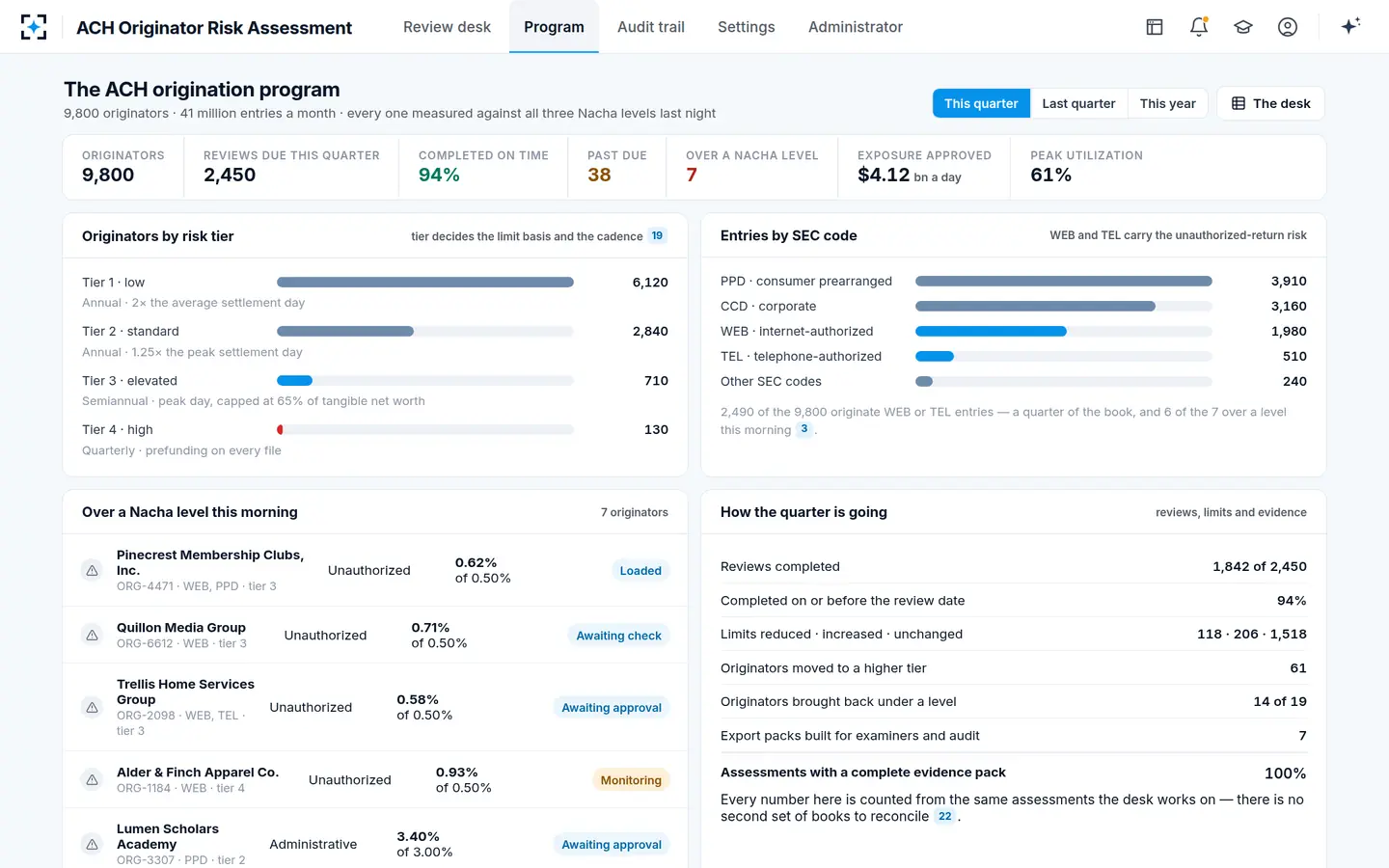
9,800
originators, measured against all three Nacha lines every night
41 million entries a month
2,490
originate internet or telephone debits, a quarter of the book
6 of the 7 over a line
840
in the two highest risk tiers
710 elevated, 130 high
94%
of this quarter's reviews completed on or before their date
Those numbers are only as good as the assessments under them. When the board report and the review desk are counted from the same assessments, there is no second set of books to reconcile; when the report is assembled from a spreadsheet each quarter, the composition of the book is whatever the spreadsheet last held.
The whole originator book, by tier and entry class, measured overnight
The Nacha rules compliance audit is one part of the ACH audit
The OCC treats the annual Nacha rules compliance audit as necessary but not sufficient. The bulletin tells auditors to check that it was completed and then to cover what it does not: growth in volume, new products and systems, underwriting and customer due diligence, and customers' online access. It also names the deficiencies the OCC has seen: "Common deficiencies include inadequate audit coverage, inexperienced audit staff, and a lack of appropriate auditor training."
For originator risk, that means internal audit should be able to sample assessments and see the method, the approvals and the evidence without asking the analyst. The Nacha audit itself is due by December 31 each year, and Nacha samples institutions for attestations each quarter through its Risk Management Portal (Nacha, Risk Management Portal); what that audit should hold is covered in the guide to ACH rules compliance audit evidence.
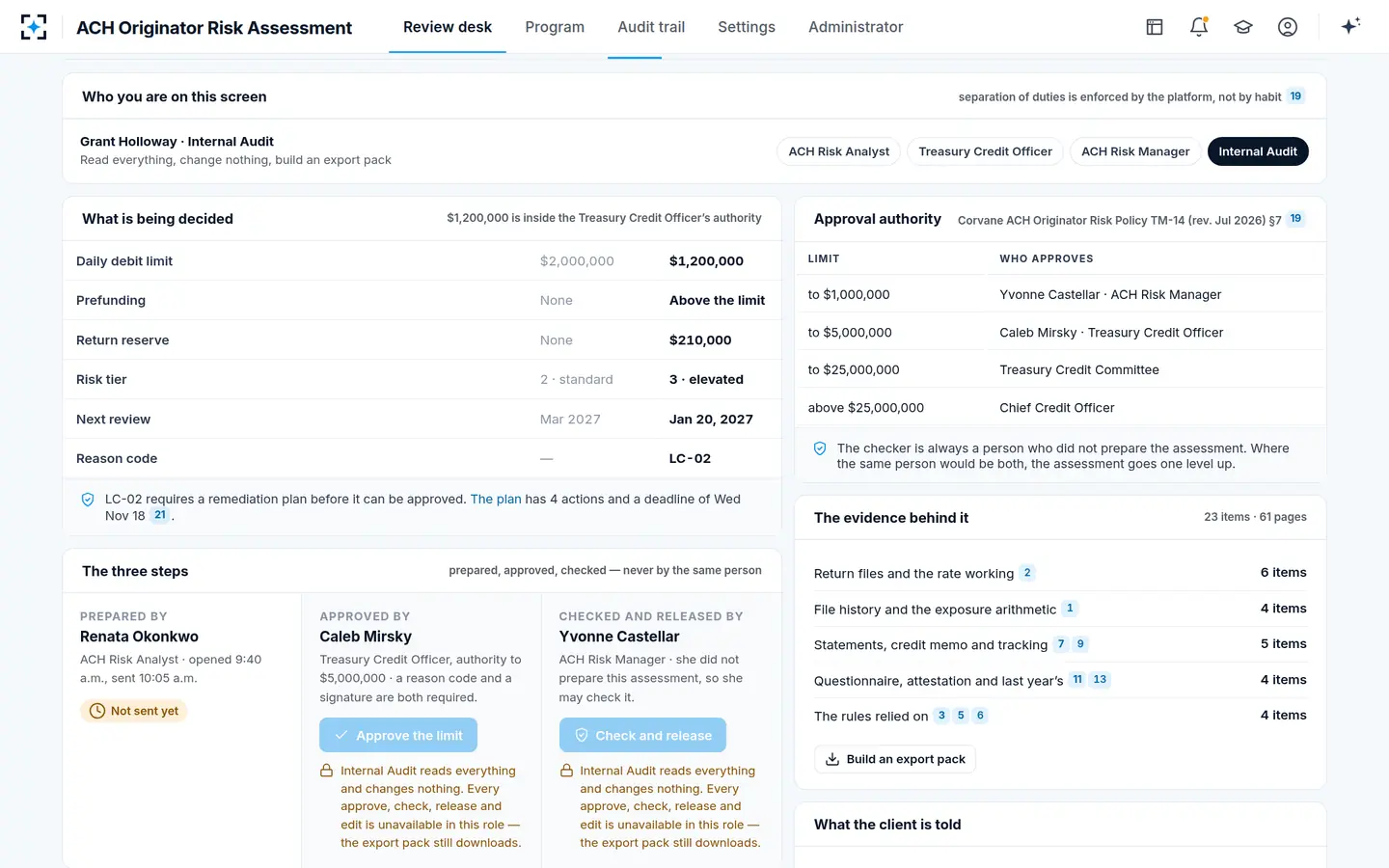
Internal audit reads everything and changes nothing
ACH risk for banks: credit, liquidity and operational, in one exam
The FFIEC frames ACH risk more broadly than credit: "ACH operations pose a variety of risks including credit, liquidity, and operational" (FFIEC, ACH risk management controls). An originator assessment touches all three. The limit addresses credit; the prefunding rule and the volume of uncollected debits address liquidity; the controls questionnaire and the check before a limit is released address operational risk, including the simplest operational failure of all, an approved number typed wrongly into the payments hub.
The same section asks banks to research returns, especially unauthorized returns, frequently, and to report breaches of limits to the right level of management. Those are the two places where an exam most often asks for dates: when did the bank first see the rate rising, and who knew when the limit was breached. A record that shows the nightly measurement, the warning, the off-cycle review and the decision with their times answers both. How three approaches to keeping that record compare is set out in ACH risk management software vs spreadsheets vs agents.
Before the exam letter arrives: what to have ready
The exam request usually asks for policies, a list of originators with their limits and ratings, reports to the board, audit results and a sample of originator files. Building those from mailboxes takes weeks. Having them ready is mostly a matter of keeping the review in one place as it happens.
Six things an ACH risk manager can have ready before an OCC exam
- The policy, with its version history
Tiers, limit bases, warning levels, review cadence, approval authority and clocks, and when each last changed.
- A list of every originator with limit, rating, tier and next review
Including third-party senders and their originators, and anyone past due.
- The board reports for the period
Composition of the book, return rates by originator, breaches and what was done.
- Off-cycle reviews and what triggered them
The trigger, the dates, and whether the limit moved, with a reason either way.
- A sample of assessments with their evidence
Each with the arithmetic, the statement pages, the controls answers, the approval and the check.
- Audit results and their follow-up
The Nacha rules compliance audit, internal audit of the ACH program, and the status of each finding.
In the solution, an examiner pack for one originator, or for a sample of twenty-five chosen by the examiner or at random, is built in a step from the assessments themselves, with a manifest and with customer account numbers masked to the last four digits. To see the pack built on your own originators, start from ACH Originator Risk Assessment; the assessment it is built from is laid out in the ACH originator risk assessment template.
Questions people ask
Does OCC Bulletin 2006-39 apply to state banks and credit unions?
It is addressed to national banks, federal branches and agencies, and since October 30, 2013 federal savings associations. Examiners at the other agencies work from the FFIEC's Retail Payment Systems booklet, an interagency handbook whose ACH procedures cover the same ground: creditworthiness monitoring, exposure limits, periodic review and monitoring across settlement dates.
Does the OCC require prefunding for ACH originators?
Not across the board. The bulletin expects underwriting standards to say when prefunding or collateral is required, and says that at a minimum banks should require prefunding of troubled borrowers, defined as those rated special mention or worse by the OCC or adversely rated by the bank's own system.
What is a high-risk ACH originator?
In the OCC's words, a company engaged in potentially illegal activities or with an unusually high volume of unauthorized returns. Its examples include online payment processors, certain credit-repair services, certain mail-order and telephone-order companies, illegal online gambling, offshore businesses and adult entertainment.
How many originator files will an examiner pull?
The procedures leave sample size to the examiner. What they test on each file is fixed: the rating, the limit and its basis, the review history, the response to rising returns and the over-limit approvals. A bank that can produce any file in that form can produce twenty-five.
Did the 2025 change remove any expectation about originators?
No. The change struck references to reputation risk. The underwriting standards, creditworthiness analysis, exposure limits, monitoring, high-risk and third-party sender expectations and the audit and reporting sections are unchanged.