ACH prefunding means an originator must have collected funds at its bank, held or moved aside, before the bank sends the originator's ACH credit file to the ACH Operator. Nacha's Risk Management Advisory Group puts it in one line: "Prefunding typically means the Originator may not originate a credit file greater than it has in its available balance at the FI" (Nacha RMAG, Originator Essentials). It protects the bank against one thing: paying out on a payroll or vendor file the client then cannot cover. It does not stop a fraudulent or duplicate file the balance happens to cover, and on debit origination, where the risk arrives after settlement as returns, it does little at all. Botminds' ACH Originator Risk Assessment proposes a prefunding rule alongside each originator's exposure limit and return reserve, from the client's own ninety days of files.
Examples come from a fictional sample bank, Corvane, and its fictional originator Pinecrest Membership Clubs; their figures are sample data from the solution.
Prefunding against an exposure limit, risk by risk
Prefunding: Removed: the money is collected before the file leaves.
An exposure limit: Capped at the limit; the bank is exposed up to it until settlement.
Prefunding: Not caught if the balance covers it.
An exposure limit: Caught when the total breaks the limit, across several days if need be.
Prefunding: Not caught: the fraudster spends the client's own balance.
An exposure limit: Caught when the file is larger than the client's pattern, before release.
Prefunding: Not addressed.
An exposure limit: Addressed when limits and permitted codes are monitored together.
Prefunding: Not addressed: prefunding applies to credit files.
An exposure limit: Sized into the debit limit, with a reserve beside it.
Prefunding: Reduced: funds are already in hand.
An exposure limit: Bounded, not removed.
What does ACH prefunding mean in practice?
It means the bank has the money before it takes the risk. The OCC states the operational test: "In cases in which the bank requires pre-funding before transactions are originated through the ACH network, the bank should ensure that it has collected funds before an ACH file is sent to the ACH Operator" (OCC Bulletin 2006-39). Collected is the important word. A balance made of deposits that have not cleared, or of ACH debits the same client originated days ago that could still be returned, is not collected funds, and prefunding against it moves the risk rather than removing it.
Why prefunding fits credit files
The FFIEC's handbook explains why credits are the natural home for prefunding. An originating bank that sends credits has "a typical credit exposure of three days," it says, and "Such credit risk may be mitigated by requiring pre-funding of the credit file" (FFIEC IT Handbook, Credit Risk). Three days of exposure on a payroll file is short, but a payroll file can be large, and the client's failure to fund it is exactly the event prefunding prevents.
How does ACH prefunding work?
The client's file is checked against funds it has already provided, those funds are held or moved so they cannot be spent twice, and only then is the file released. Examiners look at the holding step. The FFIEC's procedures ask, for prefunding arrangements with customers who have no credit line, whether management "blocks funds (held for disposition) or maintains them in separate accounts until the transaction date" (FFIEC, Appendix A, ACH funding and credit).
ACH prefunding, step by step, and the control at each step
| Step | What happens | The control that matters |
|---|---|---|
| 1. Submission | The client approves and sends its credit file to the bank | Client-side dual approval; the file total is known |
| 2. Funds check | The bank compares the file total with the client's collected balance | Collected balance only: uncleared items and recent debit deposits excluded |
| 3. Hold or move | The amount is blocked, or moved to a separate prefunding account | The funds cannot be withdrawn or used for another file |
| 4. Release | The file goes to the ACH Operator in its processing window | Released only after step 3; a shortfall holds the file |
| 5. Settlement and offset | On the settlement date the held funds settle the credits | The offset is booked at the item, batch or file level the bank chooses |
The fifth step is what "ACH prefunding settlement" usually refers to: a line on the client's statement where the file's total left its operating account ahead of the payments themselves. That is the hold or transfer of step 3 becoming the settlement of step 5. Nacha's Advisory Group notes that an originator's bank may book the offsetting entry at the item, batch or file level, which is why one client sees a single prefunding debit for a payroll file and another sees one per batch.
Does prefunding replace an exposure limit?
No, and Nacha says so directly. Its Advisory Group hears the question often enough to quote it.
We require prefunding of all credit transactions, so my credit risk is covered. Why do I have to set and monitor exposure limits too? What's the point?
Question put to Nacha's Risk Management Advisory Group, in its March 2025 article on exposure limits
The Group's answer is that prefunding covers one risk and limits cover several. "Prefunding protects the financial institution or TPS from the risk that their customer may not be able to fulfill their credit commitment when an ACH credit is submitted," it writes; limits also guard against fraud, operational error and the credit exposure of returned debits (Nacha RMAG, March 2025). Its originator guide is blunter: "Prefunding is not an exposure limit and does not control fraud risks or the risk of returns" (Originator Essentials).
The account-takeover example in the same article shows the gap. A business that pays its vendors by ACH credit is compromised; the fraudster sends larger credits than usual; the account has the money, so prefunding passes them; the funds leave the bank before the client knows. A limit set from the client's normal pattern would have stopped the file for a call. Nacha's rules require a limit for every originator regardless, prefunded or not, and require it to be reviewed. How to set one from the client's own history is worked through in how to calculate an ACH exposure limit.
When should a bank require ACH prefunding?
When the client's credit no longer supports the unsecured exposure its files create, and always for troubled credits. The OCC expects underwriting standards to say when prefunding or collateral applies, and sets a floor: banks require prefunding for a variety of reasons but, "at a minimum, should impose such requirements on troubled borrowers." It defines a troubled borrower in a footnote as one rated special mention, substandard, doubtful or loss by the OCC, or adversely rated on the bank's own system (OCC Bulletin 2006-39).
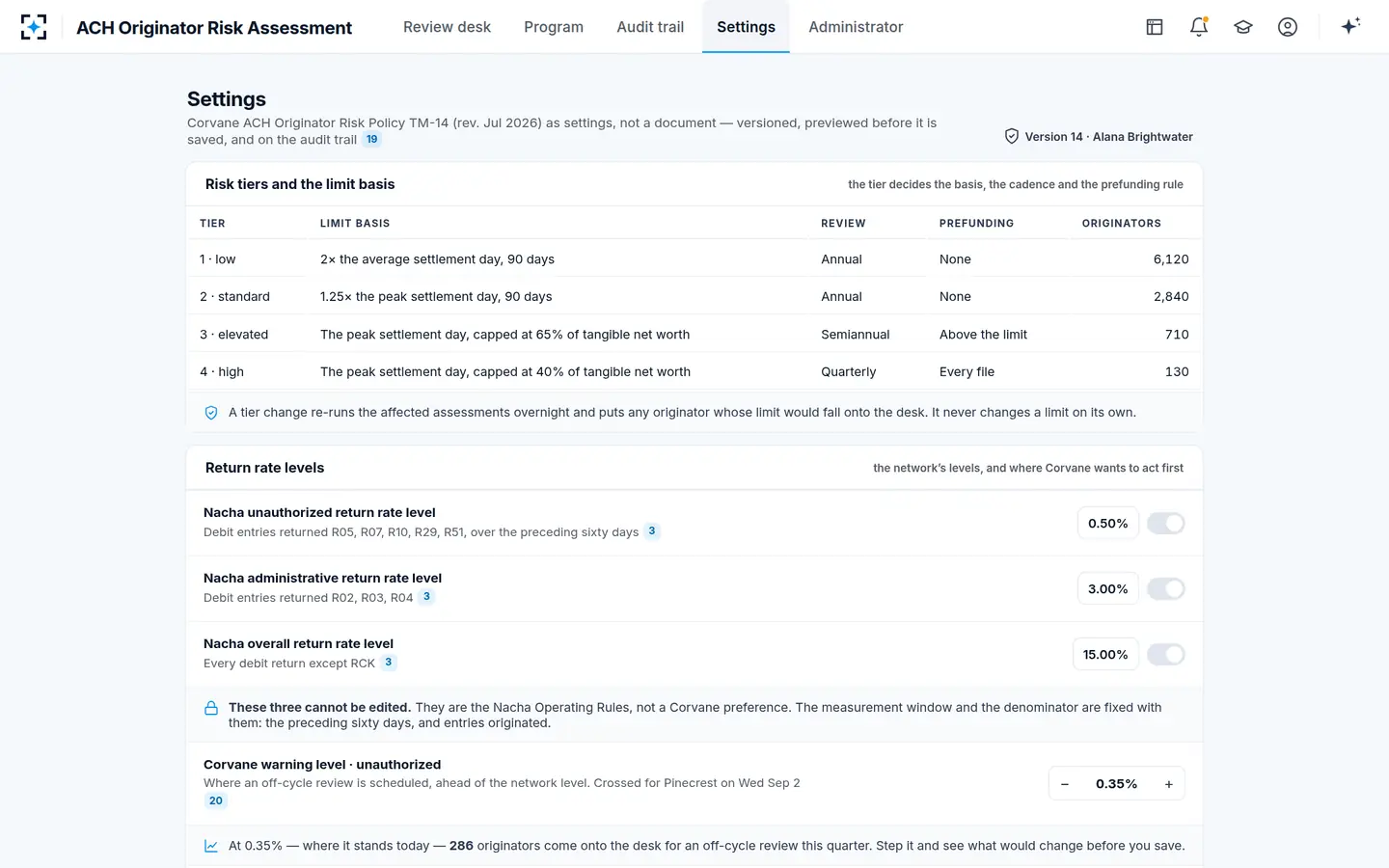
The FFIEC's handbook frames it as a matter of fit: "For certain customers, pre-funding or reserve arrangements may be necessary to control the risk" (FFIEC, ACH risk management controls). In practice the triggers are a weak or deteriorating credit, a new client with no history, volume that has outgrown the client's capacity, a client in remediation for returns, and a client whose files keep breaking its limit. A tier structure turns those into a rule: the sample bank requires no prefunding in its two lower tiers, prefunding above the limit in its elevated tier and prefunding on every file in its high-risk tier.
Prefunding, reserve and limit by risk tier: one way to write the rule
| Risk tier | Prefunding | Return reserve | Limit basis | Typical client |
|---|---|---|---|---|
| 1 · low | None | None | 2 × the average settlement day | Payroll and vendor credits, strong credit |
| 2 · standard | None | Where debit returns warrant it | 1.25 × the peak settlement day | Established originators with a month-end peak |
| 3 · elevated | Any file above the limit | Sized from the client's return rate | The peak day, capped at 65% of tangible net worth | Watch-rated credits, fast growth, rising returns |
| 4 · high | Every file | Sized from the client's return rate | The peak day, capped at 40% of tangible net worth | Troubled credits, clients in remediation |
Prefunding for debit originators: why a reserve fits better
Prefunding answers a credit file's risk; a debit originator's risk comes later, when receivers return debits the bank has already credited to the client. The FFIEC's handbook pairs the two tools accordingly, saying banks may mitigate credit risk "by requiring pre-funding for credit originators", and adequate risk-based reserves for debit originators (FFIEC, Credit Risk). A reserve is cash the client keeps at the bank against returns still to come, sized from its own return history.
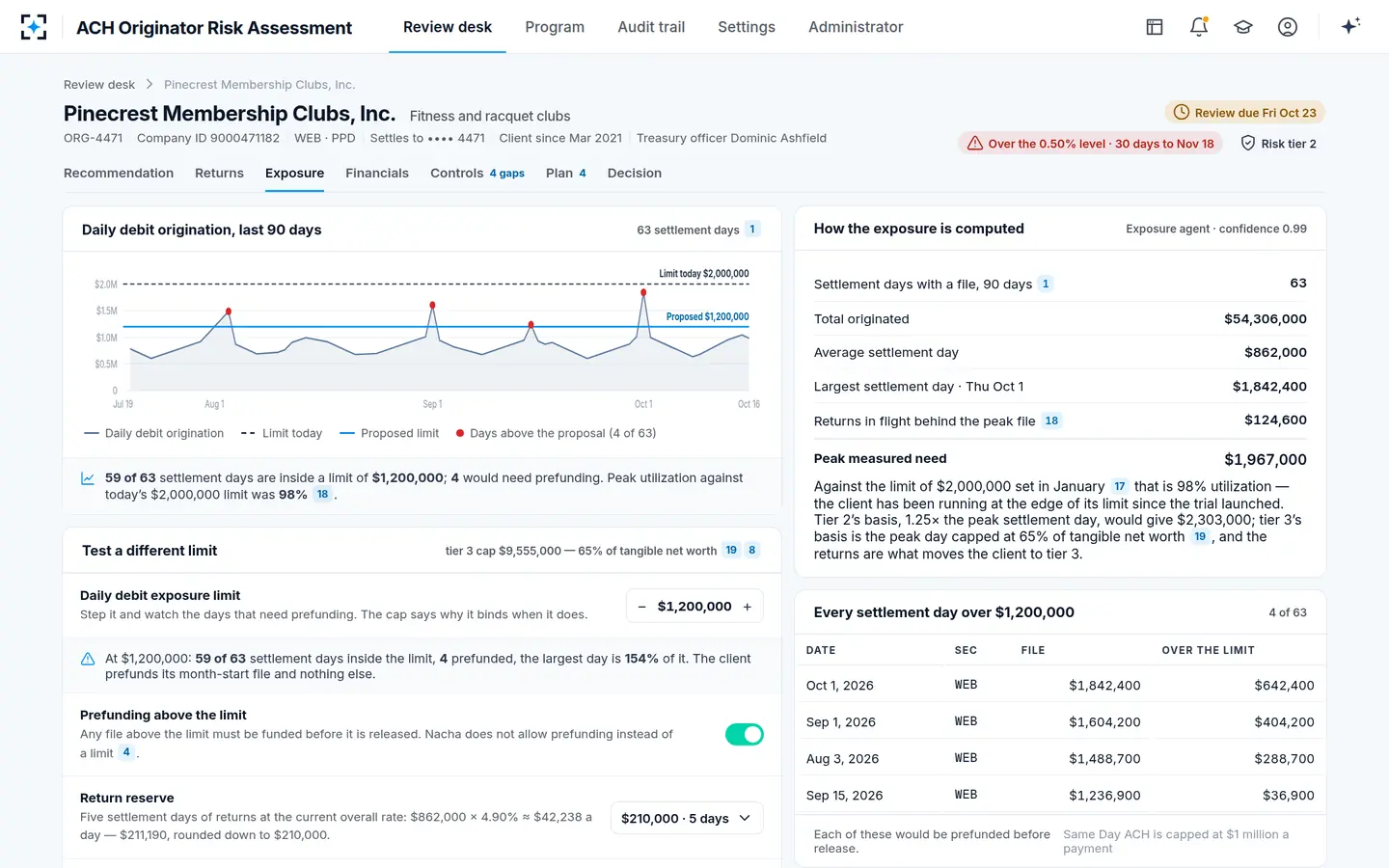
Pinecrest is a debit originator, so its structure shows both tools at work. Its reserve was sized at five settlement days of returns at its current overall rate: an average day of $862,000 times an overall return rate of 4.90%, about $42,238 a day, or $211,190 over five days, held as $210,000. Its prefunding rule applies only above its new limit, to the largest debit files, where the bank wanted collected funds in hand while the cause of the returns was fixed.
One debit originator's structure: a lower limit, prefunding above it, and a reserve
$1.2M
daily debit limit approved, down from $2,000,000
4of 63
settlement days in ninety that would have needed prefunding
$210K
return reserve: five days of returns at the 4.90% overall rate
0.62%
unauthorized return rate that prompted the change, against Nacha's 0.50%
Partial prefunding: prefund what is above the limit
Prefunding does not have to be all or nothing. A rule that prefunds only the part of a file above the limit keeps an originator's ordinary days unaffected and puts collected funds behind the days that carry the most exposure. The choice of limit then decides how often the rule bites, which can be tested against the client's own history before the limit is approved.
At a $1.2 million limit, four settlement days in ninety would have been prefunded
Testing the limit this way changes the conversation with the client. Instead of a cut announced by letter, the treasury officer can say which files would have been affected and by how much, and the client can see that its largest billing days, mostly at the start of the month, are the ones that need cash in hand. The solution's exposure screen lets the credit officer step the limit and watch the prefunded days change before signing.
Step the limit, and watch the prefunded days change
Prefunding and the client relationship
Prefunding has a cost to the client: it ties up cash a day or more ahead of payments, and for a business that pays its staff from the day's receipts that can be a hard change. That is the argument for using it precisely, on the files and tiers that need it, rather than as a blanket answer to every concern. It is also the argument for explaining it with the client's own numbers, and for writing down when it will come off: when the rate is back under the line for a set period, when current statements arrive, or when the tier moves down.
The OCC's guidance treats over-limit approvals and prefunding as part of the same unsecured-credit discipline, approved within the bank's credit policy. In the solution the prefunding rule, the reserve and the limit are approved together with one reason code and released together, and the client letter the treasury officer sends names all three and the plan, and nothing else. To see the rule proposed from your own originators' files, start from ACH Originator Risk Assessment; how prefunding fits the wider exposure after settlement is covered in ACH origination credit risk.
Prefunding is a tier rule in the bank's own policy
Questions people ask
Is a prefunded account the same as a return reserve?
No. Prefunding is money set aside for a specific credit file and spent when that file settles. A return reserve stays at the bank as a cushion against debits that may still come back, sized from the client's return rate. A client can have either, both or neither; Pinecrest has both.
What happens if a client does not have enough to prefund its file?
The file is not released until the shortfall is covered, or the bank approves an exception within its credit policy. The OCC's test is that collected funds are in hand before the file goes to the ACH Operator; releasing a prefunded client's file against uncollected funds defeats the arrangement.
Does prefunding protect against payroll errors?
Not if the client has the money. Nacha's Advisory Group gives the example of a payroll provider sending a duplicate or an extra cycle: the employer may have enough in its account to cover it, so a funds check passes, and only an exposure limit catches the error before release.
Can prefunding be removed once it is in place?
It should come off on stated conditions, recorded with the decision that imposed it: the return rate back under the line for a set period, current financial statements, or a move to a lower tier. At the sample bank the next review of Pinecrest was brought forward to January 20, 2027, the natural point to decide.
Is prefunding required by Nacha?
No. Nacha's rules require exposure limits; prefunding is a credit tool the bank chooses. Nacha's own originator guidance stresses that prefunding is not an exposure limit, so a bank cannot use it to skip setting one.