ACH fraud detection software reads the ACH entries a bank sends and receives, scores each against the patterns of fraud and the customer's own history, and puts the suspicious ones in front of a person with the evidence and the time left to act. Under Nacha's 2026 rules it is optional, since the rules prescribe no technology, but for most banks it is the practical way to monitor both sides of the business before money moves. The best ACH fraud detection software for a given bank is the one that covers sent and received entries in one place, works to the file and funds deadlines, keeps the evidence the annual review needs, and never takes the return or the hold decision away from the people who answer for it. Botminds' ACH Fraud Monitoring is built that way: agents score, link, ask the other bank and draft; a specialist prepares each action and a manager releases it.
Screens on this page show a fictional sample bank, Tessaly Community Bank. The rollout timings are our illustrative plan, not a measured result.
A go-live plan for ACH fraud detection software, file window by file window, with the sign-off for each step
- 1. Write the starting rules from the risk assessment
Which sent and received entries get scrutiny, with thresholds. Sign-off: ACH operations manager and BSA officer.
- 2. Connect the received files and the core
Forward and return files from the ACH Operator, accounts, history and holds from the core. Sign-off: a reconciled day of entries, counts matching to the item.
- 3. Connect sent files before release, and partners
Files from the ACH processing platform before each window; fintech partners' account and cash-out data. Sign-off: a late file is reported, not silently skipped.
- 4. Load the other banks' contacts and the request wording
Fraud contacts from the ACH Contact Registry; the approved text of a request to confirm. Sign-off: compliance reviews that nothing in it can reveal a SAR.
- 5. Set holds, clocks and escalation
Which flags hold a credit under the funds availability exemption; escalation hours before 9:00 a.m. and before each file. Sign-off: manager, with the Nacha dates locked.
- 6. Run in shadow for a full cycle
Flags shown, nothing held or sent, across at least one month-end and a payroll cycle. Sign-off: every fraud the team found by hand also flagged, or the rule changed.
- 7. Turn on holds for received credits
The exemption used only on a written rule, the ODFI told each time. Sign-off: a sample of holds checked by a second person.
- 8. Let the agents draft returns and notices
R17 or R06 returns, fraud notices and customer messages drafted, never sent without a maker and a checker. Sign-off: the first fifty releases sampled.
- 9. Measure each rule from day one
Flags, confirmed fraud, misses and time to decision, rule by rule. Sign-off: the first monthly report to the ACH operations manager.
- 10. Change thresholds only after replay
Every proposed change tested on past entries before it applies. Sign-off: approved or declined with a reason, on the trail.
What is ACH fraud detection software, and what do the Nacha rules ask of it?
Nothing directly: the rules bind the bank, not the tool. Nacha's credit-push resource center says the rules "are neutral regarding specific methods or technologies used to identify fraudulently initiated credit transactions" and lists the techniques it has in mind: velocity checks, anomaly detection, behavioral tolerances and pattern recognition (Nacha, Credit-Push Fraud Monitoring Resource Center). The rule pages note that "Vendor solutions have emerged on the market to assist in monitoring received payment activity" and that solutions may also be built in-house (Nacha, Phase 1).
What the rules ask of the bank shapes what the software must do. The procedures must be risk-based, must identify entries suspected of being unauthorized or sent under false pretenses, must cover the handling of flagged credits, and must be reviewed at least annually. Software that flags well but cannot show, a year later, what each rule caught has met half the requirement.
How does ACH fraud detection software work?
It compares each entry with what is normal for that originator, that account and that kind of payment, and raises a flag when the difference crosses a threshold the bank set. On the sending side the comparisons are the originator's usual payees, amounts, timing and files; on the receiving side they are the account's age, balance and history and the credits arriving into it. Nacha's own examples for receivers are an SEC code that does not fit the account, an atypical high-dollar credit, a run of similar credits such as several payrolls, and any of these into a new, dormant or mule account (Phase 2 FAQ).
The part that separates tools is what happens after the flag. Nacha's advisory group described the target in 2024.
Set up reports and tools in a way that automation can flag outlying transactions for an employee to review.
Nacha Risk Management Advisory Group, Considerations for Implementing the New Risk Management Rules, April 2024
A flag that lands in a list, with the account in the core, the history in another screen and the other bank's number in a binder, still costs the specialist most of an hour. In ACH Fraud Monitoring agents gather that evidence before a person opens the flag: a Mirror agent joins sent and received entries that share an account or device, so a mule account's money in and money out are seen together, and a Contact agent has usually asked the other bank before the morning starts.
What data does ACH fraud detection software need?
Every file the bank sends and receives, the accounts behind them, and the other banks' contacts, each at the moment a decision is still possible. Sent files are no use after release, and received credits are no use after funds are available, so the timing of each feed matters as much as its content.
What ACH fraud detection software reads, from where, and by when it must arrive
| Data | Usually from | Needed by | Why |
|---|---|---|---|
| Entries the bank sends | ACH processing platform, before each file is released | Before the release window | A sent entry stopped before release needs no recall |
| Credits the bank receives | Forward files from the ACH Operator | Before 9:00 a.m. local time on settlement date | The funds availability exemption only helps before funds are available |
| Accounts, history, holds, restrictions | Core banking system | With each file | Account age, past payers and balance are the receiver-side signals |
| Partner accounts, devices, cash-outs | Fintech partners' files or APIs | Before partners' payout windows | Mule accounts opened through apps move money out through the same app |
| Device and session scores, payee changes | Online banking and the existing fraud engine | Before sent files release | A payee changed yesterday from a new device is the sending-side signal |
| Other banks' fraud contacts | ACH Contact Registry, through Nacha's Risk Management Portal | Ready at all times | The request to confirm is what turns a suspicion into a decision |
| The bank's rules and the Nacha dates | The bank's program, versioned | Before go-live, then on every change | The annual review must show which rule version flagged what |
Two feeds are often missing at go-live. Fintech partners' cash-out data is the one that lets the software see a mule account's exit; without it, the bank sees money arrive and cannot tell that it is already queued to leave. And the bank's own past outcomes, which frauds were confirmed and which flags were cleared, are what a shadow run is measured against. Gather both before signing.
How long does ACH fraud software take to implement?
Weeks for the connections, and at least a full month of running beside the team before holds go on, because ACH fraud follows the payroll and month-end calendar. Our illustrative plan for a community bank that sends and receives is about eleven weeks from contract to agents drafting returns; a bank with clean file feeds and few partners can be faster, and one with many fintech partners slower.
An illustrative rollout of ACH fraud detection software, in weeks
- Rules from the risk assessment1 wk
- Connect files, core, partners3 wks
- Contacts, holds, clocks1 wk
- Shadow run, a full month4 wks
- Holds on, then drafted returns2 wks
The step banks are tempted to shorten is the shadow run. It is also the one that proves the software catches what the team already catches, which is the first question an examiner or auditor will ask about a new monitoring tool. A tool that cannot run in shadow, showing flags without acting, should be treated with caution.
Can ACH fraud software monitor received credits?
It should, and it is the half of the rule that is new: before 2026 the Nacha rules gave receiving banks no fraud monitoring duty of their own. Credit monitoring by RDFIs has to read the receiving account, not just the entry, and it has to work before funds become available if the bank wants to use Nacha's funds availability exemption, which Nacha allows only for a credit the bank's processes have actually flagged, never for one it simply has not screened yet (Nacha, October 1, 2024). Software that scores credits after posting meets the rule but gives up the hold.
Ask any vendor to show one received credit from file to decision on a sample of your own entries. The received credits agent, step by step, shows what that trace should contain.
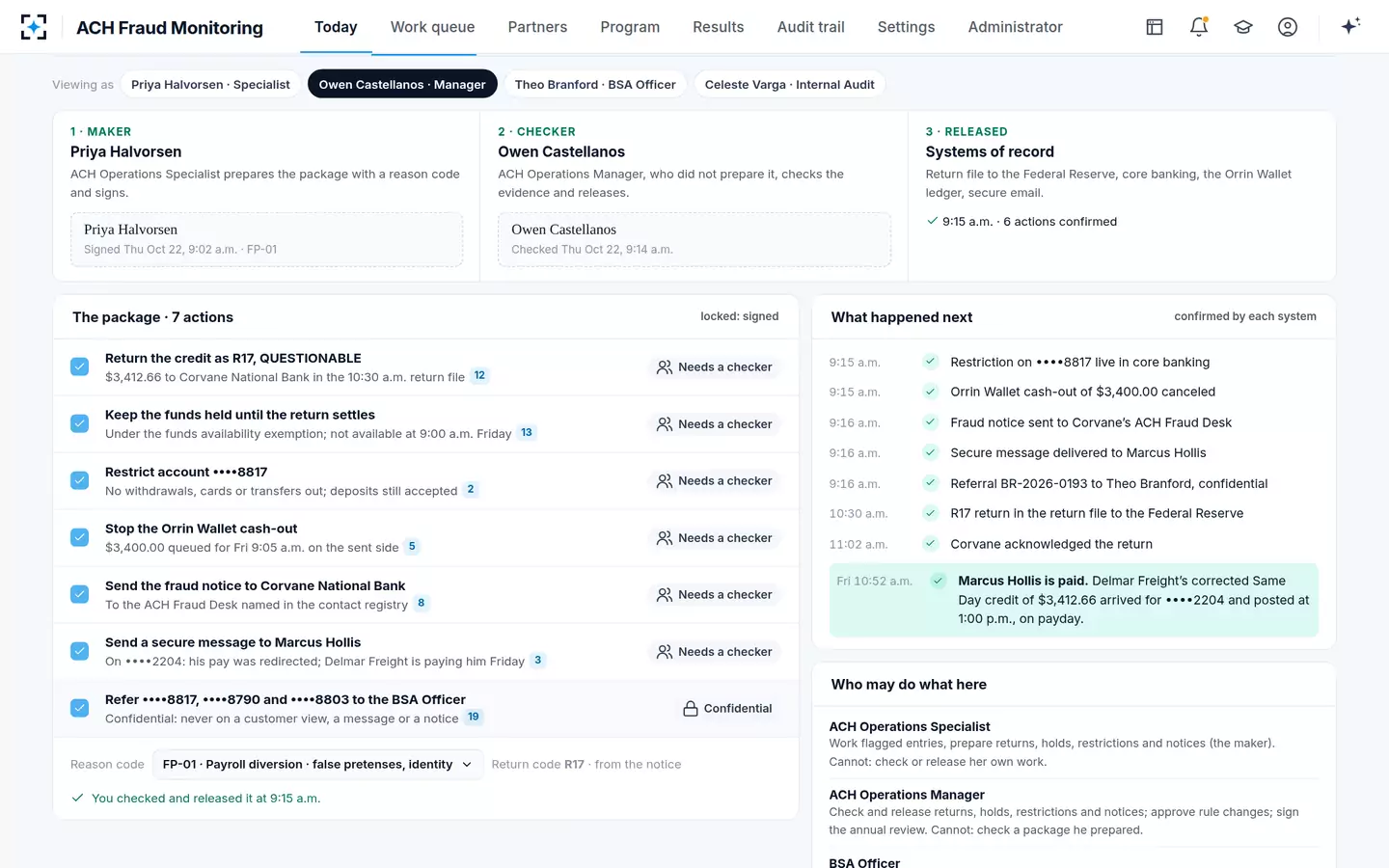
The manager's check in ACH Fraud Monitoring, and what each system confirmed after release
Does ACH fraud software meet Nacha rules?
Software cannot meet the rules on a bank's behalf; the bank's procedures, using the software, do. Bank regulators say the same about any vendor: using a third party leaves a bank exactly as responsible as if it had done the work in-house (Interagency Guidance on Third-Party Relationships, 2023). Nacha's FAQ likewise lets an RDFI use a third-party service provider while the obligation stays with the RDFI.
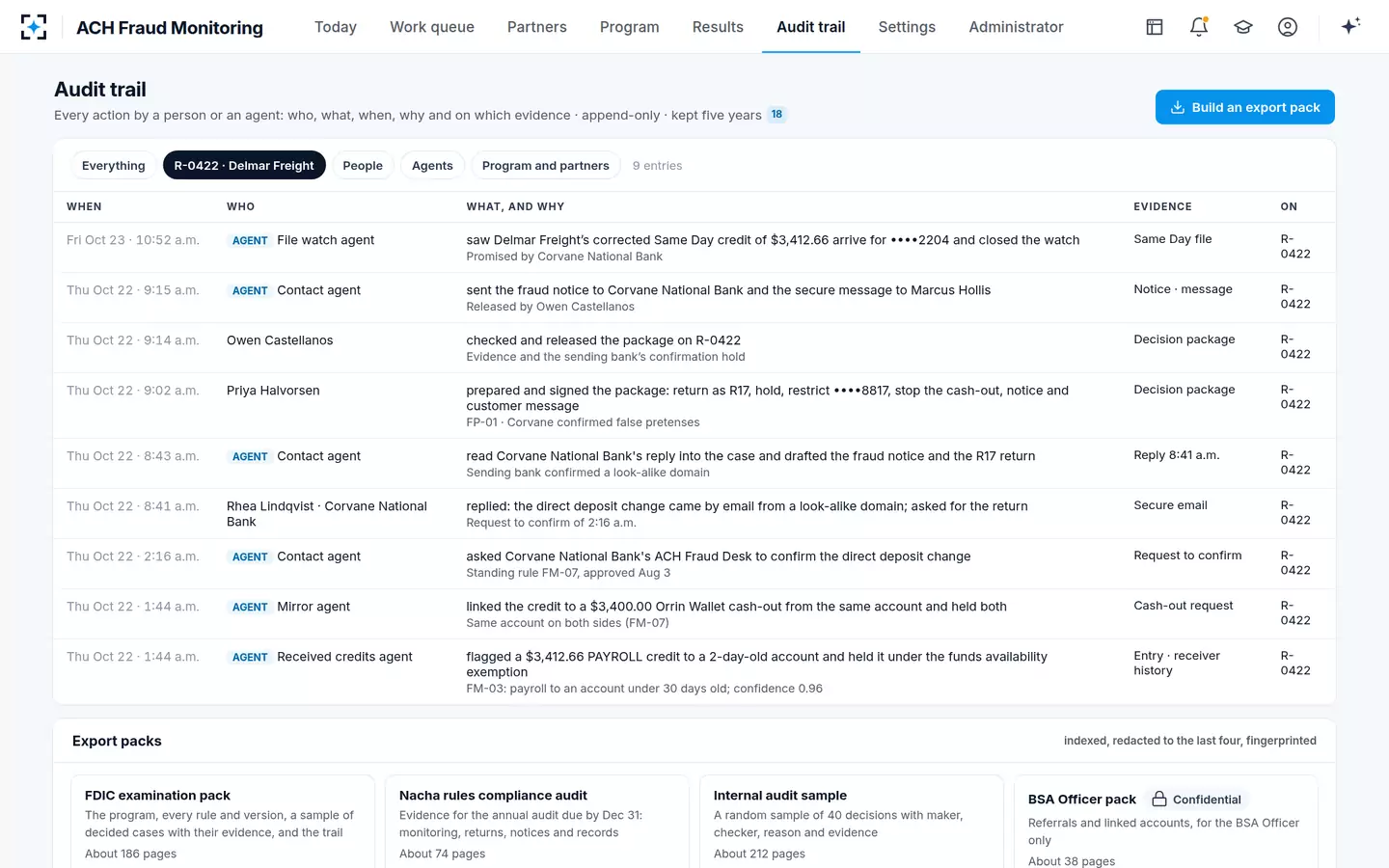
What the right software does is make compliance provable: the rule version that flagged each entry, the decision and who made it, the time against the deadline, and each rule's results for the annual review. ACH Fraud Monitoring keeps every action by a person or an agent on an append-only trail for five years, the Bank Secrecy Act's general retention period (31 CFR 1010.430), and builds evidence bundles for examiners, the Nacha rules compliance audit and internal audit.
Model risk is a separate question. Under the April 2026 interagency guidance, plain rule-based processes are not models, and generative and agentic AI sit outside its scope for now (OCC Bulletin 2026-13). That does not remove oversight; it moves it into the bank's own controls, which is why the questions below ask how an agent's instructions are versioned and tested.
Eight questions to put to any vendor
Ask for answers on your own files, not a demonstration dataset. The left column is what to ask; the right is the answer that should give a buyer pause.
Buying ACH fraud detection software: questions to ask, and answers that are warning signs
Ask: Do you score sent entries before release and received credits before funds are due, in one place?
Warning sign: Received credits are scored after posting, or in a separate product with its own queue
Ask: Can you link a received credit to a cash-out or sent entry from the same account or device?
Warning sign: Each side is alerted separately; the link is left to the analyst
Ask: How do you reach the ODFI or RDFI, and does the reply come back into the case?
Warning sign: Contact is by phone outside the tool, with nothing kept
Ask: Which actions can the software take without a person, and who checks a person's decision?
Warning sign: Automatic returns or account freezes on a score alone
Ask: Do holds happen only on a written rule, with the ODFI told?
Warning sign: A blanket delay on unscreened credits, which Nacha does not allow
Ask: Can you show each rule's flags and confirmed fraud for the past year, by version?
Warning sign: Only alert counts; outcomes live in a spreadsheet
Ask: How is a threshold or an agent's instructions changed, tested and approved?
Warning sign: Changes take effect immediately, with no replay and no second approver
Ask: How do you keep a SAR referral out of notices and customer messages?
Warning sign: Free-text notices with no check before they are sent
The fourth row deserves the most time. Respondents to the Federal Reserve's 2026 risk officer survey listed AI and machine learning among the tools that reduce ACH losses and, in the same list, that "Manual review remains critical despite automation" (Federal Reserve Financial Services, 2026; the survey says it is not independent academic research, margin of error ±6%). Software that removes the review removes the control.
What does ACH fraud detection software cost?
It depends on volume, the number of systems to connect and how much of the work is automated, and vendors price differently; there is no public benchmark from a regulator or research body to quote. The useful comparison is against the hours the bank spends now. Our estimate elsewhere puts received-credit monitoring by hand at about 92 hours a month for an institution receiving 3,000 credits a day, before any sent-side work; the Phase 2 cost estimate shows the assumptions so a bank can substitute its own.
Three costs are easy to leave out of a business case: the integration work on the bank's side, the shadow month when the team works both ways, and the annual review, which software can shorten but not remove. Three savings are easy to leave out too: frauds stopped before funds are available, time not spent on the phone hunting for the other bank, and an examination that samples a trail rather than a binder.
Where Botminds' ACH Fraud Monitoring fits, and where it does not
It fits a bank that sends and receives ACH, works with fintech partners or business clients, and wants the evidence of a risk-based program to build itself. It works beside the systems a bank already runs, reading the ACH processing platform, the Federal Reserve files, the core, partner data, the existing fraud engine and the contact registry, and releasing decisions back to them.
It is not an anti-money-laundering system and does not decide or file suspicious activity reports; it refers accounts to the BSA officer, confidentially. It is not a sanctions screen, a core replacement or a customer's own debit filter. And it does not return, hold past settlement, restrict or notify on its own: every such action is prepared by one person and released by another, a design target the trail can prove. The OCC's ACH guidance asks banks to define duties clearly enough to keep strong internal controls over transactions (OCC Bulletin 2006-39); the solution is built so that the duties stay where that guidance puts them.
One trail for every action, and the bundles built from it for examiners and auditors
How bank monitoring differs from a client's ACH debit filter matters to buyers who already sell debit blocks to business clients, and the annual review is where any tool's evidence is tested. To see the screens with your own files, start from ACH Fraud Monitoring.
Questions people ask
What is the best ACH fraud detection software?
The one that fits the bank's roles and risks: it should score sent entries before release and received credits before funds are due, link the two, reach the other bank, keep per-rule outcomes for the annual review and leave decisions to people. Nacha publishes a list of vendors offering fraud monitoring services but states that the list is not an endorsement.
Can ACH fraud software return entries automatically?
Technically some can; whether they should is another matter. Nacha leaves R17 returns to the RDFI's discretion and warns RDFIs to be aware of false positives. ACH Fraud Monitoring drafts returns and notices, and a specialist and a second person decide and release them.
Does ACH fraud detection software replace transaction monitoring for AML?
No. The two watch some of the same payments for different purposes. Nacha notes that a risk-based approach to credit monitoring aligns with AML monitoring practice, and the two programs should share referrals, but the decision to file a suspicious activity report stays with the BSA function.
How many alerts should ACH fraud software produce?
As few as catch the fraud. The fictional sample bank flagged 91 of 214,300 entries in a day, under 0.05%, and confirmed 435 frauds from 5,733 flags in 90 days. A tool should report this ratio rule by rule, so thresholds can be tuned with evidence.
Does a bank need separate software for ODFI and RDFI monitoring?
It does not need to, and one view is better. The same fraud often shows on both sides of one bank: a diverted credit arrives into an account that is already sending money out. Monitoring them separately means two queues and a link nobody makes.