Drug and device makers hand patient data, trial records and admin access to many suppliers. Before each contract or renewal, someone reads what the supplier claims about its security, compares it with what an auditor and a tester found, and decides how much risk is left. A named person then accepts that risk, in writing.
This guide is for anyone who runs, requests or signs these reviews: third-party risk analysts, heads of IT risk, chief information security officers (CISOs), privacy and quality teams, procurement, the business owners waiting on a renewal, and leaders deciding whether to automate the reading. No background needed.
Imagine you are a third-party risk analyst, the person who checks suppliers' security, at a mid-size drug company. Your clinical team runs 14 studies and about 38,000 participants on a cloud platform called Velunda Trial Cloud, and the contract renews on November 15. The vendor sends its security questionnaire, 611 of 627 answers complete, and a 112-page audit report.
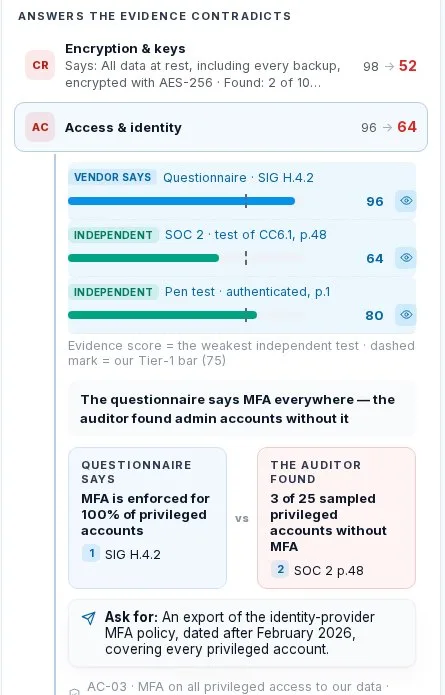
Answer G.1.2 says all stored client data, including backups in both hosting regions, is encrypted. It looks fine. Then you open page 52 of the audit report. For 2 of 10 sampled backup sets from the second region, encryption was not enabled before September 4, 2025. Management says the old backups were re-encrypted by November, and it gave the auditor no evidence.
The questionnaire says
Backups
"all encrypted"
Encryption score
98 of 100
The evidence shows
Backups
2 of 10 were not
Encryption score
52 of 100
Approve with seven conditionsRisk left: High, 64, so a second person signsThe vendor owes proof by set dates.
Reading the two documents side by side catches the gap while you can still ask for proof, and leaves a record of who accepted which risk and why.
Vendor security reviews at drug and device makers: the documents, the rules, the arithmetic and the people
What is in a vendor's evidence pack, who wrote each page, how to read a SOC 2 report in the order reviewers use, how to tell a real contradiction from a timing gap, what no test covers, and how residual risk gets a number. If you are new to reviewing suppliers, start here.
01 · In plain words
What a vendor security assessment is: checking what a supplier says against what someone tested
A drug company runs on other people's software. Its clinical trials collect data on a cloud platform. Its labs record results in a hosted system. A help-desk firm can reach every employee's laptop. A contract manufacturer connects remotely to plant equipment. Each of these suppliers holds something that matters: patient records, the data behind a drug application, or the keys to the network. If one of them is breached, the drug company still answers for it.
So before signing or renewing, its IT risk team asks the supplier to prove its security, and the supplier sends a pack of documents. The biggest is a questionnaire, often hundreds of questions, which the supplier fills in about itself. Next comes a SOC 2 report from an independent accounting firm, a CPA firm. It describes the supplier's controls, the safeguards it runs, such as login checks and encrypted backups, and in the usual form tests whether they worked over a period. Then a penetration test summary, where a hired tester tried to break in, plus policies, certificates and contracts.
The analyst reads them and answers a simple question: is what the supplier says true? Sometimes the questionnaire says "yes, 100%" and page 48 of the audit report says otherwise. Different people wrote those two statements for different reasons, and only someone who reads both will connect them.
From that reading comes a risk rating, a list of things the vendor must fix, wording for the contract, and a decision. A person signs it. That signature is your company's own decision, on the evidence in front of it, to accept a stated amount of risk for a stated time, and it certifies nothing about the vendor.
One Tier-1 renewal, from procurement's form to the next review date
Procurement sets the tierA form asks what data the vendor holds, whether it touches regulated records, what access it has and how hard it is to replace. The answers place it in a tier, and Tier 1 gets the closest review. In the example, the form arrives on September 24.
The vendor sends evidenceQuestionnaire, SOC 2 report, penetration test, policies, certificates and agreements. In the example, they arrive on September 26, with one letter missing.
The answers meet the evidenceEach answer is compared with the independent tests, gaps are listed, and the risk left over gets a reasoned number. This step is what this guide is about.
People decide, with conditionsThe analyst signs, and a senior person co-signs high risk. Requests go to the vendor and clauses to procurement. In the example, both signatures land on October 7.
The vendor is watchedExpiring reports, retest letters, notices from the vendor's own host, and a full review on the tier's schedule. In the example, the next one is October 2027.
The companies, people and figures in this example are fictional.
Why a clean audit opinion can sit beside a High rating, and three more surprises
A clean opinion can hold exceptions
An auditor can find failed tests and still issue a clean opinion, the kind auditors call unmodified. The opinion is on page 4. The exceptions are on pages 48 and 52. A reviewer who stops at the opinion misses them.
"SOC 2 certified" means nothing precise
SOC 2 produces a CPA firm's report with an opinion in it, and no certificate exists.1 What matters is the period, the scope and what the tests found, so read those.
The report can exclude the host
Many reports carve out the cloud provider underneath, so its controls were never examined in this report. You then need that provider's own report, or you have a gap with a respectable cover page.
Some of the controls are yours
The auditor assumes the customer runs certain controls, such as reviewing its own users each quarter. Skip one, and the vendor's clean result rests on something that is not happening.
SIG, SOC 2, CUEC, residual risk: four words this work runs on
SIG
The Standardized Information Gathering questionnaire from Shared Assessments, a licensed set of security questions. CAIQ is the cloud equivalent from the Cloud Security Alliance.
SOC 2 Type II
A CPA firm's report on whether a service organization's controls were designed well and worked over a period. Type I looks at design on a single date.
CUEC
Complementary user entity control: something the auditor assumes you, the customer, are doing.
Residual risk
The risk left after the vendor's controls and open findings are counted. Inherent risk is the same question before any controls.
You will also meet GxP, the quality rules for regulated work, such as good clinical and good manufacturing practice. Fourteen terms are defined in the summary and glossary.
02 · The evidence pack
What is in a vendor's evidence pack, who wrote each page, and how far each one takes you
In shortEach document answers a different question, and they differ most in who wrote them. A questionnaire is the vendor's own account. A SOC 2 Type II report and a penetration test come from outsiders, though the vendor chooses the scope. A certificate says a management system met a standard, within a stated scope. No single document covers everything, so the skill lies in knowing which one can prove what.
Document
Who wrote it
What it can prove
What to check first
SIG or CAIQ questionnaire
The vendor, often its sales or trust team
What the vendor is willing to state in writing. That is useful: a false answer is a contract issue
Blank and "N/A" answers, who signed, the date, and whether comments name evidence
SOC 2 Type II report
An independent CPA firm, on the vendor's described controls
Whether stated controls worked over the period, on samples
Period, categories in scope, carve-outs, exceptions, user entity controls
SOC 2 Type I report
An independent CPA firm
Design on one date. Nobody tested whether the controls worked
The as-of date, and a dated plan for Type II
Bridge letter
The vendor's management, with no auditor involved2
Only that management says nothing changed since the report's period
Who signed, the dates it covers, and how long the gap is
Penetration test summary
A tester the vendor hired
What was exploitable on the tested systems during the test
What was in scope, open highs, retest date
ISO 27001 certificate
A certification body, on the management system
That a management system met the standard within its scope
Edition (2022), expiry, and whether the scope names the service you buy
Compliance statement (FDA's Part 11, the EU's Annex 11)
The vendor
The vendor's claim. No body certifies a product for these rules
Whether validation evidence backs it
Data processing and business associate agreements
Both parties, usually lawyers
What was promised: sub-processors (the vendor's own suppliers that handle your data), notice periods, audit rights
Compare the sub-processor list with the questionnaire's
No single document tests everything, and GxP evidence and AI use are the usual blanks
What each document usually does for each security domain
SilentA claim or promiseSometimes testedUsually tested
QuestionnaireSOC 2 Type IIPen testISO certificateContractAccess and MFAA claim or promiseUsually testedSometimes testedA claim or promiseSilentEncryption and keysA claim or promiseUsually testedSometimes testedA claim or promiseA claim or promisePatchingA claim or promiseSometimes testedUsually testedA claim or promiseSilentIncident noticeA claim or promiseSometimes testedSilentA claim or promiseA claim or promiseResilience and backupA claim or promiseSometimes testedSilentA claim or promiseA claim or promiseChange controlA claim or promiseUsually testedSilentA claim or promiseSilentFourth partiesA claim or promiseA claim or promiseSilentA claim or promiseA claim or promisePrivacyA claim or promiseSometimes testedSilentSilentA claim or promiseGxP audit trail, validationA claim or promiseSilentSilentSilentSilentAI use of your dataA claim or promiseSilentSilentSilentA claim or promise
Our reading of the sources3,1,4 · MFA is multi-factor authentication: two or more different proofs of identity at login. Our generalization; your pack will differ. SOC 2 tests privacy only when that category is in scope, and many reports leave it out.
Show the numbers
Questionnaire
SOC 2 Type II
Pen test
ISO certificate
Contract
Access and MFA
A claim or promise
Usually tested
Sometimes tested
A claim or promise
Silent
Encryption and keys
A claim or promise
Usually tested
Sometimes tested
A claim or promise
A claim or promise
Patching
A claim or promise
Sometimes tested
Usually tested
A claim or promise
Silent
Incident notice
A claim or promise
Sometimes tested
Silent
A claim or promise
A claim or promise
Resilience and backup
A claim or promise
Sometimes tested
Silent
A claim or promise
A claim or promise
Change control
A claim or promise
Usually tested
Silent
A claim or promise
Silent
Fourth parties
A claim or promise
A claim or promise
Silent
A claim or promise
A claim or promise
Privacy
A claim or promise
Sometimes tested
Silent
Silent
A claim or promise
GxP audit trail, validation
A claim or promise
Silent
Silent
Silent
Silent
AI use of your data
A claim or promise
Silent
Silent
Silent
A claim or promise
SIG Core, SIG Lite and CAIQ: which questionnaire a vendor sends, and why the counts disagree
The SIG is a licensed product of Shared Assessments, so its full question list is not public. Guides quote different counts for SIG Core (855, 825 and 627 in three we read) and for SIG Lite (126, 150 and 128), and we did not read a count from Shared Assessments itself.5 Scope matters more than the total, because the 2026 edition comes with scoping presets, Lite, Core and Detail, and added no new risk domains. It maps the AI questions to ISO 42001.6 Our example's 627 questions are that sample's figure and should not be taken as the size of any real form.
CAIQ is the Cloud Security Alliance's questionnaire. Version 4.1, released in January 2026, has 283 questions, and the alliance's STAR registry accepts v4.0 and v4.1 submissions until December 2027.7
Two questionnaires from two vendors may ask the same thing differently, so a team usually maps every answer to its own control list. That mapping is where much of a review's reading time goes.
03 · Tiering vendors
Why a drug maker's vendor list looks different from a bank's: patient diaries, GxP records and plant links
In shortA breach at a pharma supplier can expose patients, and it can also put the integrity of trial or batch records in question, which reaches a drug application. So tiering looks at more than data sensitivity: does the vendor touch regulated records, reach your network, or take a year to replace? Tiers decide how much evidence you ask for and how often. We found no public count of how many vendors a drug maker runs, so count your own.
In clinical work, the sponsor, the company running the trial, keeps responsibility whatever it hands over. ICH E6(R3) says a sponsor may transfer trial activities to a service provider, but "the ultimate responsibility" for them stays with the sponsor, and the sponsor assesses the provider's suitability.8 The European Medicines Agency's guideline on computerized systems in trials says the same of data: tasks can be delegated, "but nevertheless the full responsibility for the data integrity, security and confidentiality resides with" the responsible party.9 A cloud platform's security therefore counts as part of the trial's quality.
Six kinds of pharma supplier, and what makes each one a security question
Supplier
What it holds or reaches
What a failure means
Usual tier
Trial data capture and patient diaries
Participant data, regulated trial records
Privacy harm, and doubts over data behind a submission
1
Lab information system
Quality control results
Batch release evidence in doubt
1
Contract manufacturer with a remote link
Batch records, a path to plant systems
Production stops or records are questioned
1
Patient services hub
Health information, benefit details, call recordings
Direct harm to patients who rely on the program
1
IT service desk or managed services
Admin access to laptops or servers
An attacker gets the helper's keys
1
Translation, events, marketing tools
Unpublished text, attendee names
Limited, though unpublished label text is sensitive
2 or 3
The tiers are our illustration, drawn from the fictional portfolio in Part B. Your own rules set them.
In the example, 486 vendors narrow to five that need an analyst this week
Tiering decides where the reading goes
Vendors in cyber scope486
Tier 1 or Tier 2209
Tier 161
Tier 1 with recent activity8
Needing the analyst now5
Fictional example from this guide · Northwind Bio's fictional portfolio, as of October 7, 2026.
Show the numbers
Stage
Count
Vendors in cyber scope
486
Tier 1 or Tier 2
209
Tier 1
61
Tier 1 with recent activity
8
Needing the analyst now
5
What a reassessment schedule usually looks like, and what should override it
No rule we read fixes the interval. A common pattern, used in our example, is every 12 months for Tier 1, 24 for Tier 2 and 36 for Tier 3, with triggered checks in between. The triggers matter as much as the calendar: a new report, an expiring certificate, a change of hosting, a new sub-processor, or a notice from the vendor.
NIST, the US standards institute, asks for the same two habits in general terms in its Cybersecurity Framework 2.0: know your suppliers "by criticality" and plan due diligence before you sign, then keep watching over the relationship.10
04 · The rules and their dates
The rules behind a pharma vendor review in November 2026: NIS2, HIPAA, GDPR, Part 11, Annex 11 and ICH E6(R3)
In shortNo law names a questionnaire or a score. They set duties, and you choose the method. NIS2 makes supply chain security a legal duty for many EU drug and device makers, in the member states that have transposed it. HIPAA's proposed rewrite would demand yearly written proof from business associates, though it is not final. GxP guidance keeps the regulated company responsible for what its IT service providers do. And no rule lets you certify a product for Part 11 or Annex 11.
Two years of change, with the HIPAA rewrite and the EU GMP drafts still unfinished
Oct 17, 2024NIS2 national laws due
Many member states ran late.
Oct 2024FDA Q&A final
Sets out what to weigh at an IT service provider in a clinical investigation.
Jan 6, 2025HIPAA rewrite proposed
Yearly written verification from business associates.
Apr 8, 2025DOJ data rule effective
Vendor agreements with covered persons can be restricted.
Oct 31, 2025ISO 27001:2013 ends
Certified organizations had to move to the 2022 edition.
Jan 20, 2026EU cyber package proposed
High-risk supplier rules, still proposals on November 3, 2026.
Jul 8, 2026NIS2 court referrals
The Commission takes Ireland, Spain, France and the Netherlands to the EU Court of Justice.
Jul 27, 2026AI Omnibus in force
The EU AI Act's high-risk dates move.
Q4 2026EU GMP target
Inspectors' target for final Annex 11 and 22 text. A target, with no adoption date.
Jul 2027HIPAA final action
Date on the US government's Unified Agenda of planned rules, listed under long-term actions.
Nine rules a vendor review answers to, with their status today
Rule
Status, November 2026
What it means for a review
NIS2, the EU's cybersecurity directive, Directive (EU) 2022/2555
In national law in 20 of 27 member states at January 1, 2026, Germany from December 6, 2025; France and Ireland were still pending then.21 On July 8, 2026 the Commission referred Ireland, Spain, France and the Netherlands to the EU Court of Justice for failing to notify transposition.16 The Dutch act took effect on August 15, 2026.22 We found no official later count. One compliance vendor's tracker shows 24 of 27 on November 2, 2026, with France, Ireland and Spain outstanding.23
Article 21(2)(d) requires supply chain security, and 21(3) says to weigh "the vulnerabilities specific to each direct supplier". Annex I covers medicinal product research and basic pharmaceutical manufacturing, and Annex II covers medical device manufacturing. Fines reach at least €10 million or 2% of turnover for essential entities, and €7 million or 1.4% for important ones.11
GDPR, the EU's data protection law, Articles 28 and 33(2)
In force.
Use only processors, the vendors handling personal data for you, "providing sufficient guarantees", with a right to audits written in, and a processor must tell you of a breach "without undue delay".24
HIPAA Security Rule, the US rule protecting electronic health information
In force as written. Proposed rewrite of January 6, 2025 is not final; the federal regulatory agenda lists final action for July 2027.12,18
Today: risk analysis, business associate contracts, and notice within 60 days.25,26 Proposed: written verification every 12 months, required MFA and encryption, and patches within 15 or 30 days.12 It binds covered entities, meaning health plans, clearinghouses and providers who send health information electronically in covered transactions, and business associates, the firms that handle it for them.27 Drug companies sponsoring trials are often not covered entities,28 and a commercial program depends on who runs it. Ask counsel, vendor by vendor.
FDA Q&A on electronic systems in clinical investigations
"Regulated entities are responsible for ensuring that electronic records meet applicable part 11 requirements." Section III.C lists what to weigh at a provider: oversight, validation, access controls, audit trails, data at rest and in transit. FDA will generally not review audit reports of the provider.
21 CFR Part 11, FDA's rule on electronic records and electronic signatures
In force; 2025 edition is the newest in the government's bound series.29
Section 11.10 asks for validation, audit trails and limited access, among others. A vendor can support this. The duty stays with the regulated user.
ICH E6(R3), the international good clinical practice guideline, and EMA's guideline on computerized systems
E6(R3) Principles and Annex 1 final, January 6, 2025. EMA guideline adopted March 7, 2023.8,9
EMA on cloud: contracts "detailed and explicit". On refusals: a provider that will not allow access to key documents or support audits and inspections "should not be used in clinical trials".
EU GMP Annex 11, the EU's good manufacturing practice annex on computerized systems
Revision of January 2011 still applies. The revision and draft Annex 22 remain drafts.30,19
Section 3: formal agreements with third parties, "the need for an audit should be based on a risk assessment", and supplier information available to inspectors.
SEC Regulation S-K, Item 106
In force. The SEC asked for comment on reforming these disclosures in January 2026, and we found no proposal to change them.31
A US-listed company discloses whether it has "processes to oversee and identify" cyber risks from third-party service providers, so what you say publicly should match what you do.32
DOJ rule on bulk sensitive data, 28 CFR Part 202
Effective April 8, 2025; certain duties from October 6, 2025.13
A vendor agreement that gives a country of concern or a covered person access to bulk US sensitive personal data can be a restricted transaction. Human 'omic data, such as genomic data, is in scope, so add ownership and location to your questions. Sections 202.510 and 202.511 exempt some regulatory approval data and transactions ordinarily incident to FDA-regulated clinical investigations, on conditions, so ask counsel which applies.
FDA's Computer Software Assurance guidance often comes up here. Its scope is software in medical device production and quality systems, so it does not govern a drug maker's vendor review.33 The EU's January 20, 2026 proposals would bar NIS2 entities from using components from designated high-risk suppliers in key assets.34 They are still proposals: on November 3, 2026, Parliament's file on the Cybersecurity Act 2 read "Awaiting committee decision".15
Your contract may ask for 24 hours while the law gives a business associate 60 days
Notice clocks, in days, and who owes whom. They start from different events
NIS2: entity to authority, early warning1
NIS2: entity to authority, notification3
HIPAA proposed: business associate, contingency plan activated1
HIPAA today: business associate to covered entity, outer limit60
Our reading of the sources11,26,12,24 · GDPR gives no number for a processor: "without undue delay". NIS2's clocks run from a company to its authority and set no vendor's deadline, so a 24-hour vendor clause is your own choice, and a sensible one if you want time to meet your duty.
Show the numbers
Item
Value
NIS2: entity to authority, early warning
1
NIS2: entity to authority, notification
3
HIPAA proposed: business associate, contingency plan activated
1
HIPAA today: business associate to covered entity, outer limit
60
A word on "compliant". A vendor cannot be "Part 11 compliant" or "GxP certified" in any way that transfers to you. GxP, Part 11 and Annex 11 apply to how a regulated company uses a system, and no authority certifies a product against them. A vendor's controls can support your compliance, and your review should find out whether they do.
05 · Reading a SOC 2 report
How to read a SOC 2 report in the order reviewers use: opinion, scope, carve-outs, your controls, exceptions
In shortStart with the opinion and its period, then check that the system you buy is in scope and which categories were examined. Find what was carved out. List the controls you are assumed to run. Only then read the test results for exceptions, and treat management's response as unaudited. Section numbers vary by report, so look for the content.
Six stops through a SOC 2 Type II report, each answering one question
1The opinion
Unmodified, qualified, adverse or disclaimed? For what period?
Auditor's reportSample p.4
2Scope and categories
Is your service in? Which of the five categories?
System descriptionSample p.12
3Carve-outs
Whose controls were left out?
System descriptionSample p.21
4Your controls
Which controls does the auditor assume you run?
System descriptionSample p.24
5Exceptions
What failed, on how large a sample?
Tests of controlsSample p.48 to 61
6Management's response
What does the vendor say, and is there evidence?
Often unauditedSample p.88
Fictional example from this guide · Page numbers are from the fictional Velunda report. One firm describes a Section 5 as the only unaudited section; layouts vary.35
Show the numbers
Step
What happens
Who
Time
The opinion
Unmodified, qualified, adverse or disclaimed? For what period?
Auditor's report
Sample p.4
Scope and categories
Is your service in? Which of the five categories?
System description
Sample p.12
Carve-outs
Whose controls were left out?
System description
Sample p.21
Your controls
Which controls does the auditor assume you run?
System description
Sample p.24
Exceptions
What failed, on how large a sample?
Tests of controls
Sample p.48 to 61
Management's response
What does the vendor say, and is there evidence?
Often unaudited
Sample p.88
Read the auditor's opinion first, and why it is only the start
A licensed CPA firm performs a SOC 2 examination, and the result is its opinion.1 "Unmodified" means the auditor found that controls were suitably designed and operated effectively in all material respects. A report can carry exceptions and still be unmodified, because an exception on one control may not change the auditor's overall conclusion. In our sample, the auditor writes that the exceptions "did not result in a modification of this opinion". A qualified, adverse or disclaimed opinion deserves a direct conversation with the vendor.
Five categories, and the one that is often missing for patient data
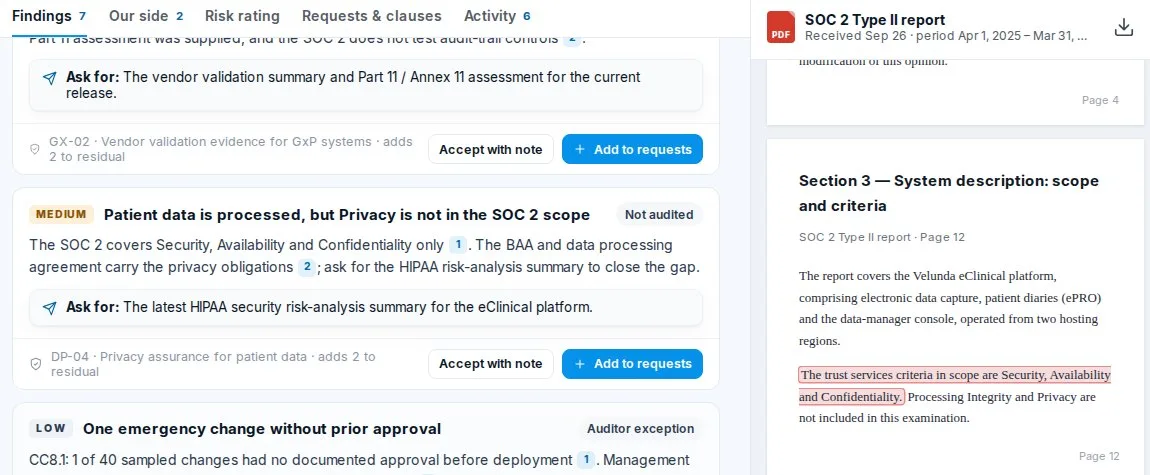
The American Institute of CPAs (AICPA), whose standards govern SOC reports, names five categories: Security, Availability, Processing Integrity, Confidentiality and Privacy.3 A report need not cover all five, and the vendor chooses its scope. In our sample, Processing Integrity and Privacy are out, on a platform holding patient diaries. Your own data decides whether that matters. On a clinical platform, processing integrity and privacy are both worth asking about.
Category
In Velunda's report?
What to ask on a patient-diary platform
Security
In
Is the tested system the one you use?
Availability
In
Do the tested commitments match what your studies need?
Confidentiality
In
Is patient data among the information the report treats as confidential?
Processing Integrity
Out
What else shows that diary entries are recorded complete and unchanged?
Privacy
Out
Can you see the risk analysis, the data map and the sub-processor list? Section 07 covers this
In and out are from the fictional Velunda report. The questions are ours.
Carve-out or inclusive: who examined the vendor's host
Many software vendors run on someone else's cloud. Under the carve-out method, the report excludes the controls of that host, which auditors call a subservice organization. Under the inclusive method, it includes them. After a carve-out, you need the host's own report. Keep one copy on file and reuse it, since many of your vendors may share a few hosts. Section 10 returns to this.
Complementary user entity controls, the part of the report addressed to you
The report lists what the auditor assumes each customer does: remove your own users promptly, review their access each quarter, require MFA through your identity provider, review audit-trail reports. Our sample lists seven. They are easy to file and forget. A better habit is to match each to a named owner and a status on your side, because if you are reviewing access once a year and the assumption says quarterly, the audit result does not fully apply to you.
Period, bridge letters and the gap nobody tested
A Type II report covers a stated period, and everything after it is untested. A bridge letter, or gap letter, is the vendor's management saying nothing significant changed.
A CPA writing on these letters says the AICPA's SOC guidance does not cover them, and that most cover no more than three months.36 A compliance software vendor calls three months the industry standard.2 The limit is market practice, and we did not read the AICPA's guide to confirm that it is silent. So a bridge letter covering six months asks you to trust an unaudited statement for half a year, and teams often press for the next report instead.
Six months of Velunda's service sit outside any auditor's period on the day of the decision
AuditedNot auditedOther evidence
SOC 2 Type II period
Gap: bridge letter requested
Penetration test fieldwork, July 2026
Renewal Nov 15; retest letter due Dec 15
Apr 2025Oct 2025Apr 2026Oct 2026
Fictional example from this guide · Decision on October 7, 2026: the period ended March 31, 2026, which is 190 days earlier (our count). Our sample's rule asks for a letter once the gap passes three months.
Show the numbers
Activity
From
To
SOC 2 Type II period
0
12
Gap: bridge letter requested
12
18.2
Penetration test fieldwork, July 2026
15
15.6
Renewal Nov 15; retest letter due Dec 15
19.5
20
06 · Finding contradictions
How to compare a questionnaire answer with an audit test, and what 3 of 25 can and cannot tell you
In shortA contradiction needs two passages that cannot both be true for the same scope and the same time. Many apparent ones are timing gaps: the test covered last year and the answer describes today. Either way, the fix is the same: ask for dated proof. Auditors test samples, so read small numbers with care: zero exceptions in 25 still allows a real failure rate of up to about 11%.
In our fictional cases, four answers line up against a test or a contract. Each row names both passages.
Control
The answer
The test
What you ask for
MFA on privileged access
SIG H.4.2: "MFA is enforced for 100% of privileged accounts"
SOC 2 p.48: 3 of 25 sampled privileged accounts without it
An identity provider policy export, dated after the claimed fix, covering every privileged account
Backup encryption
SIG G.1.2: all data at rest, including backups in both regions, AES-256
SOC 2 p.52: 2 of 10 backup sets unencrypted before September 4, 2025
A key service export and backup encryption report, both regions, dated after the re-encryption
Sub-processors (a second vendor)
SIG P.3.1: six listed
Agreed contract annex, p.9: four listed
A current list with locations, and the agreements for the two new ones
Shared admin accounts (a third vendor)
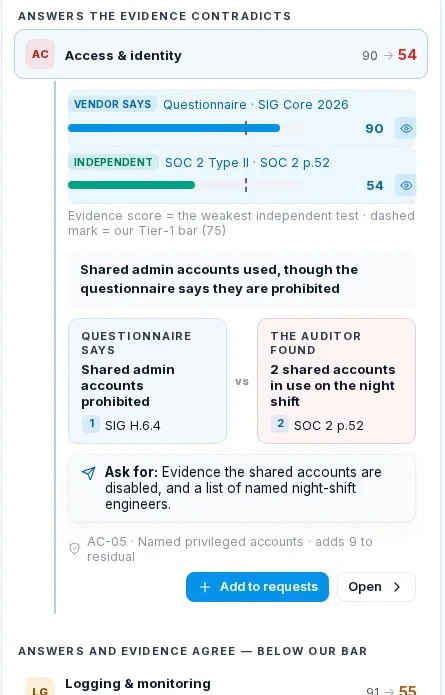
SIG H.6.4: prohibited
SOC 2 p.52: two shared accounts used on the night shift
Proof they are disabled, and named engineers on that shift
When a contradiction is really a timing gap
Look at the backup row. The answer is dated September 2026. The exception sits in a period ending March 2026, and the failure ended on September 4, 2025. Both statements could be true: a real gap, later fixed. Management says so, and gave the auditor no evidence. So you should write "contradicted by the evidence on file", ask for dated proof, and avoid saying the vendor lied. That wording protects your team, and a person answering honestly will have the proof on hand.
An older exception still tells you something. The answer says "all", while the report shows the control was absent for part of the period. If the vendor's answer carried no comment about the history, ask why the person filling it in did not know, or did not say.
Scoring a domain by its weakest independent test, and the limits of that
Many teams score each domain from the questionnaire and from each independent test on a 0 to 100 scale. A simple rule is to take the weakest independent test as the evidence score. In the example, encryption reads 98 from the questionnaire, 60 from the SOC 2 test and 52 from the penetration test finding on old versions of TLS, the protocol that protects data between systems, so the evidence score is 52. The gap is 98 − 52 = 46 points. The scale is a company's judgment and no standard defines it; its use is to rank where to read first.
Encryption and access fall far below what the vendor says, and two more domains were never tested
Velunda, questionnaire against evidence, 0 to 100, on the company's own scale. Our bar for Tier 1 is 75
What the vendor saysWhat the evidence shows
Access and identity9664
Encryption and keys9852
Patching and pen tests7246
Incident response and notice7072
Resilience and backup9088
Logging and monitoring8886
Change and secure development9280
Fourth parties8690
Fictional example from this guide · Data protection and privacy (92 said) and GxP and audit trail (94 said) are not drawn on the evidence side: no independent test covers them.
Show the numbers
What the vendor says
What the evidence shows
Access and identity
96
64
Encryption and keys
98
52
Patching and pen tests
72
46
Incident response and notice
70
72
Resilience and backup
90
88
Logging and monitoring
88
86
Change and secure development
92
80
Fourth parties
86
90
The arithmetic of a sample: 3 of 25 is a range
Auditors test samples, so 3 of 25 is 12% of the sample. If those 25 were drawn at random, the exact 95% range for the true rate runs from about 2.5% to 31%. For 2 of 10, it runs from about 2.5% to 56%. Those are our calculations, and an auditor's sample may be chosen on judgment and need not be random, so treat them as a sense of scale.
The practical point is that "only 2 of 10" says little about how many backups were affected, which is why a full export beats a smaller sample.
A clean sample of 25 can still hide a failure rate of about one in nine
The most a true failure rate could be, at 95% confidence, when a random sample finds no exceptions
25.9%10 sampled
11.3%25 sampled
7.2%40 sampled
4.9%60 sampled
3%100 sampled
Illustrative · replace with your own numbers · Our calculation: 1 − 0.05^(1/n). It assumes a random sample.
Show the numbers
Period
Value
10 sampled
25.9%
25 sampled
11.3%
40 sampled
7.2%
60 sampled
4.9%
100 sampled
3%
07 · What no test covers
Claims no test covers: audit trails, system validation, privacy and AI use on a GxP platform
In shortA SOC 2 report examines security controls against general criteria. Whether a clinical system is validated, keeps audit trails to Part 11 or follows your protocol lies outside what it is written to test. Privacy is often out of scope. AI use of your data is usually only a questionnaire answer. These gaps are the ones a pharma team must fill with other evidence, and they are where a quality group should join the review.
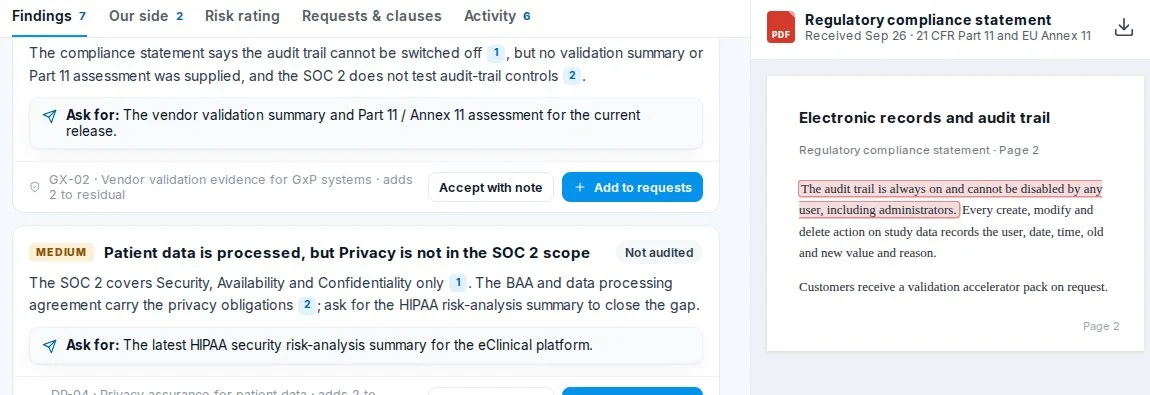
An audit trail is a system's time-stamped log of who created or changed a record. Validation is documented proof that a system works as intended. Our sample's vendor says its audit trail "is always on and cannot be disabled by any user, including administrators". That may be true. Nothing in its pack tests it.
FDA's guidance lists audit trails, validation, access controls and record retention among what a regulated company should weigh at a provider, and says the company "may consider reviewing the IT service provider's documentation" where the provider did the validation.4 EMA is firmer: if the vendor's validation documentation is insufficient, or the sponsor cannot rely on the vendor to provide it, "the responsible party should validate the system".9
Part 11 itself asks for validated systems, secure computer-generated time-stamped audit trails and authority checks.29 A vendor's statement that it meets those clauses is a promise about your future inspection. It belongs on the claim side of the page until a validation summary, a qualified audit or your own testing sits beside it.
The riskiest blanks in a pharma review sit where failure costs most and tests are rarest
What a failure costs a drug maker →
Get other evidence
Read closely
Ask once
Check the sample
GxP audit trailMFA and accessValidationPrivacyAI useChange control
How often an independent test covers it →
Illustrative · replace with your own numbers · Our judgment, to prompt discussion. Move the points to suit your vendors.
Show the numbers
Item
How often an independent test covers it (0–1)
What a failure costs a drug maker (0–1)
GxP audit trail
0.12
0.72
MFA and access
0.75
0.66
Validation
0.12
0.58
Privacy
0.38
0.54
AI use
0.12
0.32
Change control
0.72
0.22
Four questions that fill the gaps a SOC 2 report leaves on a regulated system
Validation
Ask for the validation summary for the release you run, and check that your configuration is covered. FDA notes that validation applies to configurations and customizations specific to your protocol.4
Audit trail
Ask who can turn it off and how anyone would know. Then look at your side: who reviews it, and how often. In our sample, only 9 of 14 studies have that review running.
Privacy
If Privacy is out of the SOC 2, ask for the risk analysis, the data map and the sub-processor list, and compare the list with the contract. For a business associate, ask for the HIPAA risk analysis summary.25
AI use
Ask whether your data, queries or outputs improve a model offered to others, and where the model runs. For critical GMP uses, draft EU GMP Annex 22 says generative AI and large language models "should not be used".19
Draft Annex 22 is still a draft. EMA's workshop report says consultation comments supported allowing these models in GMP applications and that the drafting group has discussed widening the scope, with no revised text published.37
08 · What goes wrong
Eight ways a vendor security review goes wrong, and what a real hearing showed about one missing control
In shortReviews usually fail in ordinary ways: reading the opinion and stopping, trusting a management response, accepting a certificate without its scope. We found no FDA warning letter that turns on a security questionnaire, and regulators speak here through guidance. The public record on breaches shows why basic controls deserve a second look: in testimony to Congress, one parent company's chief executive said a remote access portal had no multi-factor authentication.
The error
Why it happens
How to catch it
Stopping at the opinion
The first pages read as a pass
Read every exception, and write down each one you dismiss
Treating a management response as evidence
It sits inside an audited-looking report
Ask for dated proof of every claimed fix
Reading a certificate without its scope
The logo answers the question on the form
Check that the scope names your service and that the edition is current. ISO 27001:2013 certificates had to move to the 2022 edition by October 31, 202514
Accepting a stale report
The renewal date is close
Count months from the period's end, and set a limit
Forgetting the carved-out host
The host's name sits in a system description
Keep a list of who runs on whom, and reuse host reports
Filing user entity controls
They look like boilerplate
Give each one an owner on your side, with a status
Reading a Part 11 statement as proof
Security and quality teams each assume the other checked
Bring quality into Tier-1 reviews of GxP systems
Findings that never close
Nobody owns the conditions after signature
Date every request, and book the check in the calendar
What the 2024 Change Healthcare testimony says about MFA on a remote portal
Change Healthcare is a health care clearinghouse and a subsidiary of UnitedHealth Group.12 UnitedHealth Group's chief executive told a House subcommittee on May 1, 2024 that on February 12 "criminals used compromised credentials to remotely access a Change Healthcare Citrix portal", and "the portal did not have multi-factor authentication".38 HHS later noted that its breach report, filed July 19, 2024, listed 100 million people as an approximate figure, with the company still determining the number.12
We cite that record for one lesson. Multi-factor authentication on remote access is a common questionnaire item, and a single missed system can sit behind a confident general answer. That says nothing about what any questionnaire in that case said; the testimony does not address one. It is the reason our example treats "100%" with care.
Only about 23 in 100 third-party organizations fully fixed their MFA findings
23 in 100
third-party organizations fully remediated missing or improperly secured MFA on their cloud accounts, in Verizon's 2026 dataset of 7,513 exposures. Half of all findings closed within about a month, and roughly 32% lingered
third-party organizations fully remediated missing or improperly secured MFA on their cloud accounts, in Verizon's 2026 dataset of 7,513 exposures. Half of all findings closed within about a month, and roughly 32% lingered
23 of 100
The same report gives 31% for full remediation of weak passwords and excessive permissions, with half of findings taking almost eight months. For known exploited vulnerabilities, the median time to full resolution went up to 43 days, from 32 the year before.39 A vendor promising "high findings in 30 days" is therefore promising better than that median, so ask for evidence.
09 · Residual risk
How vendor residual risk gets a number: inherent 88, base 34, seven findings, High 64
In shortRate how much harm the vendor could do before any controls, take credit for controls you have evidence for, then add points for each open finding, with a reason for each. No regulator prescribes these numbers, so yours should be written down and applied the same way each time. The number supports a decision. The decision belongs to a person, who accepts the remaining risk by name.
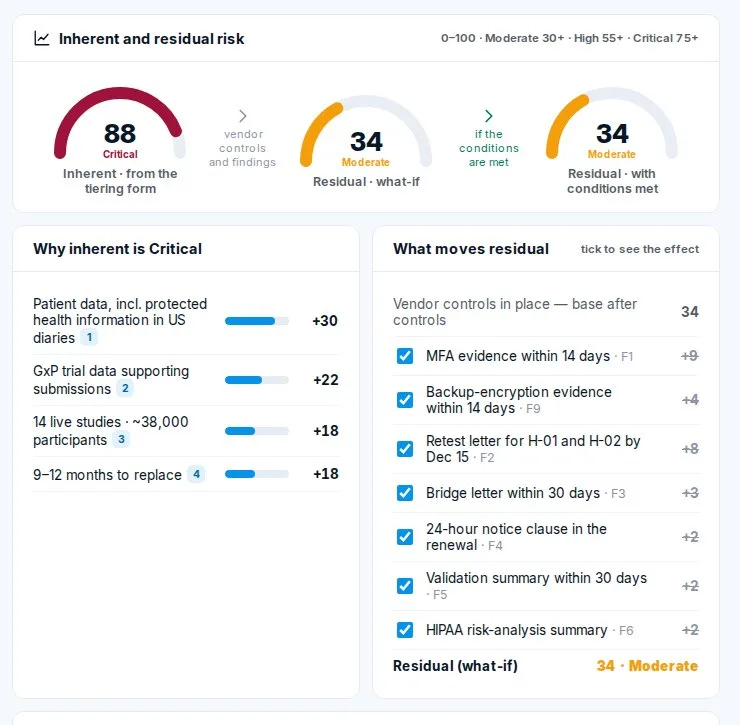
Take one worked rating from our fictional case. Inherent risk comes from the procurement form: patient data including protected health information in US diaries (+30), GxP trial data supporting submissions (+22), 14 live studies and about 38,000 participants (+18), and 9 to 12 months to replace (+18). That adds to 88, which is Critical on this company's scale. Vendor controls with evidence bring the base to 34.
Seven open findings then add 30 points: 34 + 9 + 8 + 4 + 3 + 2 + 2 + 2 = 64, High. If every condition is met, the score returns to the base: 34, Moderate.
The MFA gap and the open penetration test findings make up more than half of the added risk
Points added to the base of 34, by finding
MFA evidence9
Open high pen-test findings8
Backup encryption evidence4
No bridge letter3
72-hour incident notice2
No validation evidence2
No privacy assurance2
Fictional example from this guide · 9 + 8 = 17 of 30 points. Weights are the example company's; yours will differ.
Show the numbers
Item
Value
MFA evidence
9
Open high pen-test findings
8
Backup encryption evidence
4
No bridge letter
3
72-hour incident notice
2
No validation evidence
2
No privacy assurance
2
The rating moves from Critical to High, and to Moderate only if the vendor delivers
88Inherent
34Base after controls
64Residual today
34With conditions met
Fictional example from this guide · This company's scale: Low below 30, Moderate 30 to 54, High 55 to 74, Critical 75 and above.
Show the numbers
Period
Value
Inherent
88
Base after controls
34
Residual today
64
With conditions met
34
Who accepts the risk that is left, and why the name matters
Someone has to accept what remains, and that person should have the authority to do so. Many programs set two signatures for High or Critical: the analyst who did the work, then a senior risk owner. Business owners want the system renewed, so they should see the conditions while someone outside their line signs. When a vendor will not fix a finding, a written acceptance names who accepted it, for how long and why. Every assessment file should let a reader see that sentence three years later.
What the rating is for. A rating with a reason beside every point lets a reviewer challenge the reasoning, which a bare "High" or a vendor's letter grade never allows. Treat the number as a summary of the reasons, and use the reasons to decide.
10 · Fourth parties
Fourth-party risk: when nine of your vendors run on one cloud host
In shortYour vendor's suppliers are your fourth parties, and you have no contract with them. A hosting provider or an email tool can sit under dozens of your vendors. So track who runs on whom, reuse the host's report, and when a host sends a security notice, check every dependent vendor at once. Rules are also starting to look at where those suppliers sit.
Verizon's yearly Data Breach Investigations Report counts three kinds of third-party relationship: a flaw or back door in a vendor's product, a vendor holding your data, and a vendor connected to your environment.39 A SOC 2 carve-out speaks to the second kind. EMA's guideline asks that sub-contracting and your oversight of it be written into agreements, and says data jurisdiction questions should be settled in the contract before you use a cloud solution.9
In the example, nine of the 14 vendors in view depend on one cloud host
9of 14 vendors
Run on the host9
The host itself, or elsewhere5
Fictional example from this guide · When the fictional host reports an attack on its support portal, those nine are the ones to check.
Show the numbers
Part
Value
Run on the host
9
The host itself, or elsewhere
5
Three kinds of vendor relationship, and what to ask about each
A flaw in the vendor's product
The data stays with you, and the way in is the vendor's software. Ask about secure development, patch windows and how you hear about flaws.
The vendor holds your data
The attacker goes for the vendor or for your account there. Ask about encryption, MFA, separation between customers, and who the sub-processors are.
The vendor connects to you
Remote support and plant links are the classic case. Ask about named accounts, MFA, session recording and who approves each session.
In the US, 28 CFR Part 202 adds a location question for bulk sensitive personal data: who owns the vendor, and from where its staff can reach the data.13 The EU's proposed rules on high-risk suppliers would add another, if they pass as proposed.34
11 · The numbers
Third-party breaches in 2026: what Verizon, IBM and Gartner publish, and what nobody publishes
In shortVerizon's 2026 report puts third-party involvement at 48% of breaches, up from 30% a year earlier. That figure covers more than vendors who hold your data, and Healthcare's own share is 32%. IBM's average breach cost for health care is $6.64 million, on a modeled basis. Nobody publishes how many vendors a drug maker runs, what a review costs or how often answers fail a test, so those numbers have to come from you.
Nearly half of confirmed breaches now involve a third party
48 in 100
breaches in Verizon's 2026 report involve a third party, across more than 22,000 confirmed breaches. The metric combines three relationships: a flaw or back door in a vendor's product, a vendor holding your data, and a vendor connected to your environment
breaches in Verizon's 2026 report involve a third party, across more than 22,000 confirmed breaches. The metric combines three relationships: a flaw or back door in a vendor's product, a vendor holding your data, and a vendor connected to your environment
48 of 100
The third-party share has more than tripled across three editions of the report
15%2024 report
30%2025 report
48%2026 report
Source39,40 · Verizon's 2025 report says the share doubled from 15% to 30%. Its 2026 report says 48%, up from 30%.
Show the numbers
Period
Value
2024 report
15%
2025 report
30%
2026 report
48%
Manufacturing runs far above the average; Healthcare sits below it
Share of breaches with third-party involvement, 2026 report, by sector page
Retail68%
Manufacturing (NAICS 31–33)61%
All breaches48%
Educational Services40%
Public Administration36%
Financial and Insurance34%
Healthcare (NAICS 62)32%
Source39 · Not every sector page is shown. Drug manufacturers fall under Manufacturing. Verizon publishes no pharma line, and it ties part of Healthcare's share to one software campaign.
Show the numbers
Item
Value
Retail
68%
Manufacturing (NAICS 31–33)
61%
All breaches
48%
Educational Services
40%
Public Administration
36%
Financial and Insurance
34%
Healthcare (NAICS 62)
32%
$6.64M
average cost of a health care breach in IBM's 2026 report, the highest of any industry and down from $7.42 million the year before.41,42
IBM and Ponemon, 602 breaches, modeled cost
45%
of organizations had a third-party related business interruption in two years, in a Gartner survey of 376 executives in 2023.43
As reported by CIR Magazine
14%
of 154 third-party risk professionals were highly confident that vendors meet security requirements, in a 2020 survey by a ratings firm.44
We read a summary; dated, and from a vendor
IBM's global average across all industries is $4.99 million, and the US average is $11.5 million.45,41 These reports count all causes of breach, so read them for scale only.
The figures no one publishes, and what to count instead
What you might want
What we found
What to count instead
Vendors per drug maker
No public figure
Your own list, matched to what you pay, by tier
Hours per Tier-1 review
No public figure. Vendor sources quote their own
Time logs on your next five reviews
How often a SOC 2 report carries exceptions
No public figure
Your last 50 reports: how many had any, and on which criteria
How often answers contradict tests
No public figure
Replay ten past packs and count
Time saved by AI on this reading
Vendor claims only; no independent study found
A blind comparison on your own files
12 · Automation and AI
What AI can and cannot do in a vendor review, and what regulators have said
In shortSoftware can read a 600-answer form and a 100-page report, cite each passage and line up answers against tests. It cannot test a control or carry the risk. We found no peer-reviewed study measuring AI on this reading, so judge any tool on your own past files. Keep a person on every decision, and hold the tool to the same questions you ask any vendor.
Software can carry the reading and the first draft; a person takes the decision and the risk
1Read
Every answer and page, with a reference kept for each.
SoftwareMinutes
2Compare
Answers against tests, flagged with both passages.
Software, checked by the analystMinutes
3Weigh
Is it a real gap or a timing gap? Does it matter here?
AnalystHours
4Draft
Requests and clauses from approved wording.
Software, sent by the analystMinutes
5Decide and accept
Sign the decision, name the risk accepted.
Analyst and senior risk ownerNamed people
Illustrative · replace with your own numbers · Times are illustrative.
Show the numbers
Step
What happens
Who
Time
Read
Every answer and page, with a reference kept for each.
Software
Minutes
Compare
Answers against tests, flagged with both passages.
Software, checked by the analyst
Minutes
Weigh
Is it a real gap or a timing gap? Does it matter here?
Analyst
Hours
Draft
Requests and clauses from approved wording.
Software, sent by the analyst
Minutes
Decide and accept
Sign the decision, name the risk accepted.
Analyst and senior risk owner
Named people
Four limits to keep in view when AI reads vendor evidence
It can invent a passage
A confident summary with no page behind it is worse than none. Require a citation for each finding, and open a sample to check them.
Reports are confidential
A SOC 2 report is a restricted use report by definition, meant for the readers it names,46 and it often comes under a nondisclosure agreement too. Check where your tool processes it, and that it never trains on it.
Vendors can write for the reader
Answers may be drafted by a vendor's own AI. Fluent text says nothing about control, so the comparison with independent tests matters more.
A score hides its reasons
If you cannot see why a point was added, you cannot defend it. Ask for the reason beside each one.
What FDA, the EU and industry guidance say about AI near this work
FDA's draft on AI for regulatory decision-making (January 2025, still a draft on FDA's page) concerns AI producing information to support decisions about the safety, effectiveness or quality of drugs.47 Our reading is that an internal vendor review falls outside it. The same draft can matter for a vendor whose AI feeds your submission.
EU AI Act. Regulation (EU) 2026/1744 moved the high-risk dates: Annex III to December 2, 2027, and Annex I to August 2, 2028.17 Check your vendors' AI features against those lists, and ask them for their classification.
Draft EU GMP Annex 22. Applies to AI in critical GMP uses, still a draft, as section 07 says.19,37
ISPE GAMP AI guide (July 2025), from the pharmaceutical engineering society: a risk-based framework for AI-enabled computerized systems in regulated life sciences, including supplier responsibilities.48
Data integrity. Whatever reads the evidence, the records you sign should stay attributable and complete: who decided, on what passage, and when.
13 · How teams review today
How pharma IT risk teams run a Tier-1 review today: who does what, and where about 20 hours go
In shortProcurement starts it, a third-party risk analyst carries it, and privacy, quality, identity and the business owner each hold a piece. The largest block of time is reading and mapping documents to your own controls. We found no published study of the hours, so the split below is an estimate for you to replace with your own count.
Analyst, head of IT risk, privacy, procurement: who touches one renewal
AN
Third-party risk analyst
Runs the assessment, chases evidence, writes findings, proposes the rating and signs.
Cares about: where the auditor says no.
HR
Head of IT risk
Owns the method, co-signs high residual risk and confirms risk acceptance.
Cares about: seeing the page behind every point.
BO
Business owner
Runs the study or the process that depends on the vendor, and owns some controls on your side.
Cares about: what to fix, by when, before the renewal date.
PO
Privacy office
Reviews agreements, sub-processors and data flows.
Cares about: which sub-processors touch patient data.
QA
Quality and computer systems validation
Judges GxP evidence and vendor audits.
Cares about: what an inspector will ask to see.
PC
Procurement
Starts the tiering and puts security terms into the contract.
Cares about: exact clause wording, in time.
From procurement's form to a signed decision, with the hand-offs
Six steps take a Tier-1 review from procurement's form to a booked reassessment, and the analyst works on all six
1Intake and tier
Data, GxP, access, replaceability.
Procurement, analystDay 0
2Evidence out and back
Questionnaire, reports, reminders.
Vendor, analystOften weeks
3Reading and mapping
Each answer and test to your controls.
AnalystDays, part time
4Findings and rating
With privacy, quality and identity.
Analyst, specialistsDays
5Requests and clauses
To the vendor and to procurement.
Analyst, procurementDays
6Decision and booking
Signature, co-signature, next date.
Analyst, head of IT riskOne sitting
Illustrative · replace with your own numbers · An illustrative shape. Your own dates will tell you more.
Show the numbers
Step
What happens
Who
Time
Intake and tier
Data, GxP, access, replaceability.
Procurement, analyst
Day 0
Evidence out and back
Questionnaire, reports, reminders.
Vendor, analyst
Often weeks
Reading and mapping
Each answer and test to your controls.
Analyst
Days, part time
Findings and rating
With privacy, quality and identity.
Analyst, specialists
Days
Requests and clauses
To the vendor and to procurement.
Analyst, procurement
Days
Decision and booking
Signature, co-signature, next date.
Analyst, head of IT risk
One sitting
Reading and mapping take well over half of a Tier-1 review's analyst hours
An estimate for one Tier-1 review by hand: about 20 hours
Reading and mappingComparing and reviewing findingsVendor follow-upDecision and sign-off
Hours by hand12 h4 h2.5 h
Illustrative · replace with your own numbers · No public figure exists. This split is an estimate from the solution described in Part B. Time your own reviews and replace it.
Show the numbers
Reading and mapping
Comparing and reviewing findings
Vendor follow-up
Decision and sign-off
Hours by hand
12 h
4 h
2.5 h
1.5 h
Three ways pharma teams staff vendor reviews, and what each one trades
Way
Good for
Where it falls short
In house, on spreadsheets
Low volume and a team that knows the control framework well
Long reports get skimmed near a deadline, and reasons stay in people's heads
Outsourced assessment or shared exchange
Volume on lower tiers, and reports shared across customers
The general view misses your data, your GxP use and your controls, and you still have to decide
Third-party risk software and security ratings
Tracking, questionnaires, and outside-in scans between reviews
Many tools move the documents around and leave reading to people. Scans see the outside only. Test what a tool does on your hardest pack
Part B · See it working
Botminds Vendor Security Assessment on one Tier-1 renewal, from evidence pack to two signatures
Part A described the work without naming a product. This part shows how Botminds does it, for a fictional drug company, Northwind Bio, and a fictional trial platform, Velunda Trial Cloud. Every company, person, score and document in the screens is sample data, and no real vendor is rated. Software agents, each with one job, read, compare and draft. People decide, and a named person accepts each risk.
14 · One renewal, compared
October 7: Velunda says every backup is encrypted, and page 52 of its audit report disagrees
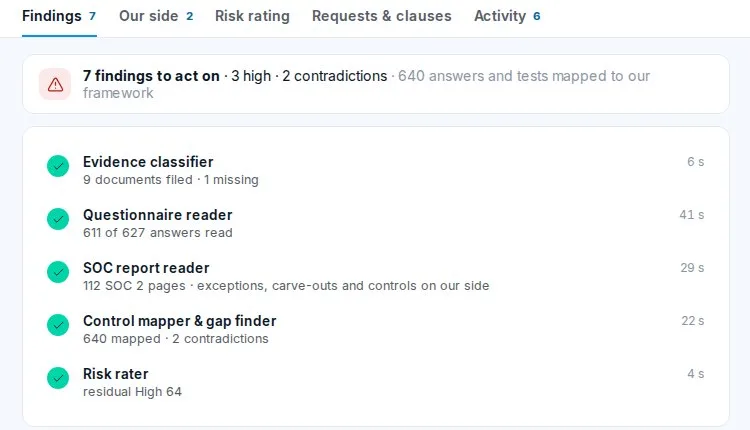
In shortThis is the example from the top of the page, inside the product. Priya Ranvelle, a third-party risk analyst at Northwind Bio, has a decision due in two days on a platform running 14 studies. The agents have already read 611 answers and 112 pages. A radar shows where what the vendor says and what the evidence shows part ways, and each gap opens onto both passages.
1
Priya's list says five assessments need her, and Velunda's is due in two days
Velunda Trial Cloud is Tier 1 and in analysis. Inherent risk is Critical 88, residual is High 64, 9 of 10 documents are in and one is missing, and the decision is due October 9. The renewal is November 15.
Fourteen vendors show recent activity. Another 472 are in monitoring, all quiet, so the 486 in scope never become a reading list.
Every open assessment. Tier, stage, inherent and residual risk, evidence and the clock, for each vendor with recent activity.
2
The security radar plots what Velunda says against what the evidence shows
Ten domains sit around the circle. Blue is the questionnaire, green is the weakest independent test, and the dashed ring is Northwind's bar for Tier 1, 75. Red marks a contradiction. Two white marks show claims nothing tested.
On the right, the contradiction finder sorts everything by the size of the gap. Encryption reads 98 from the questionnaire. The SOC 2 test gives 60 and the penetration test 52.
The security radar. Answers against evidence in ten domains, with the finder open on Encryption and keys. The strip below reads inherent Critical 88, today High 64 and, with conditions met, Moderate 34.
3
One click opens the auditor's exception, word for word
SIG G.1.2 says all data at rest, including database backups in both hosting regions, is encrypted with AES-256. The SOC 2 test found 2 of 10 sampled backup sets from the secondary region without encryption at rest before September 4, 2025. The passage sits on page 52, highlighted, beside the finding.
The penetration test adds a related item: old TLS versions still accepted on the file-transfer service.
The auditor's exception, on page 52. The sample report files backup encryption at rest under criterion CC6.7. That mapping is the sample's: the real CC6.7 concerns transmission, movement and removal of information.49
4
The second contradiction: MFA for 100% of privileged accounts, except 3 of 25
Answer H.4.2 says MFA is enforced for all privileged access. The SOC 2 test of CC6.1, on page 48, found 3 of 25 sampled privileged accounts without it. The finding names what would close it: an identity provider policy export dated after February 2026, covering every privileged account.
This finding adds 9 points to residual risk, the most of any.
A contradiction needs both passages. The questionnaire on one side, the auditor on the other, then the request that would settle it.
5
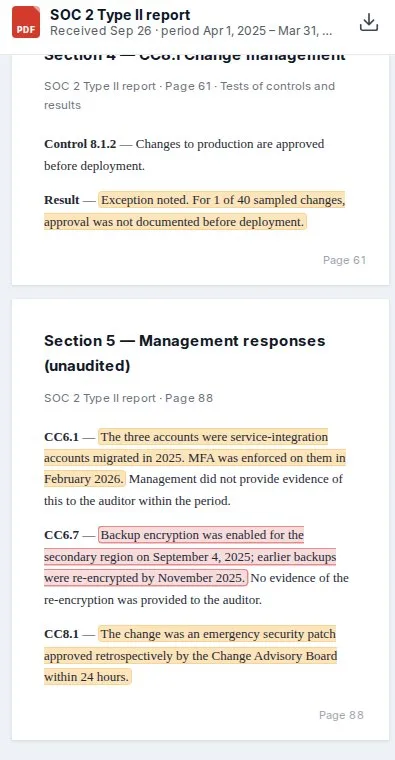
What management says goes on the record as a claim
Management's response says earlier backups were re-encrypted by November 2025, and that MFA reached the three accounts in February 2026. Neither was evidenced to the auditor. The fixes may be real, which is why the finding asks for dated proof and avoids calling the answer false.
The SOC report reader quotes exceptions word for word and keeps management's replies apart from what was tested.
Management's responses, unaudited. Three replies on page 88 of the sample report, with the evidence gap stated.
15 · The full read
Inside Velunda's workspace: seven findings to act on, the untested claims and the seven controls on Northwind's side
In shortThe workspace holds the evidence pack on the left, the findings in the middle and the source document on the right, so any statement can be checked where it stands. Seven findings need action. Two of them are claims no independent test covers, and one is a stale report. Below those sit a one-off that was noted and a carved-out host resolved by reusing a report on file. The tab "Our side" holds the controls the auditor assumed Northwind runs.
Findings, side by side. Thirteen domains, each marked Met, Below our standard, Auditor exception or Missing evidence. The questionnaire on the right shows answer H.4.2 highlighted. Its tabs and row numbers are the sample's text.
Velunda's seven findings are of five kinds, and only two are contradictions
7to act on
Contradiction: MFA, backup encryption2
Open pen-test findings1
Stale evidence: no bridge letter1
Below the standard: 72-hour notice1
No test: validation, privacy2
Fictional example from this guide
Show the numbers
Part
Value
Contradiction: MFA, backup encryption
2
Open pen-test findings
1
Stale evidence: no bridge letter
1
Below the standard: 72-hour notice
1
No test: validation, privacy
2
Open penetration test findings, and a report six months old
Two high findings remain open from the July test: a site user could read another site's patient diaries by changing a record identifier, and the file-transfer service still accepts TLS 1.0 and 1.1. Northwind's standard asks for a fix and retest within 30 days. The retest is planned for November, after the renewal, so the decision carries a dated retest letter. The SOC 2 period ended March 31, and the bridge letter was never received, which adds another finding.
Open findings and a stale period. The tester's wording appears on the right. On these screens the transfer service reads FTPS.
Audit trail and Privacy: two claims the SOC 2 never looked at
A claim with nothing behind it yet. The vendor's own statement says the audit trail cannot be disabled. The finding asks for the validation summary and its Part 11 and Annex 11 assessment. A vendor's statement supports your compliance work only when evidence backs it.
What is in scope. Security, Availability and Confidentiality on this report. Privacy is out, on a platform with patient diaries.
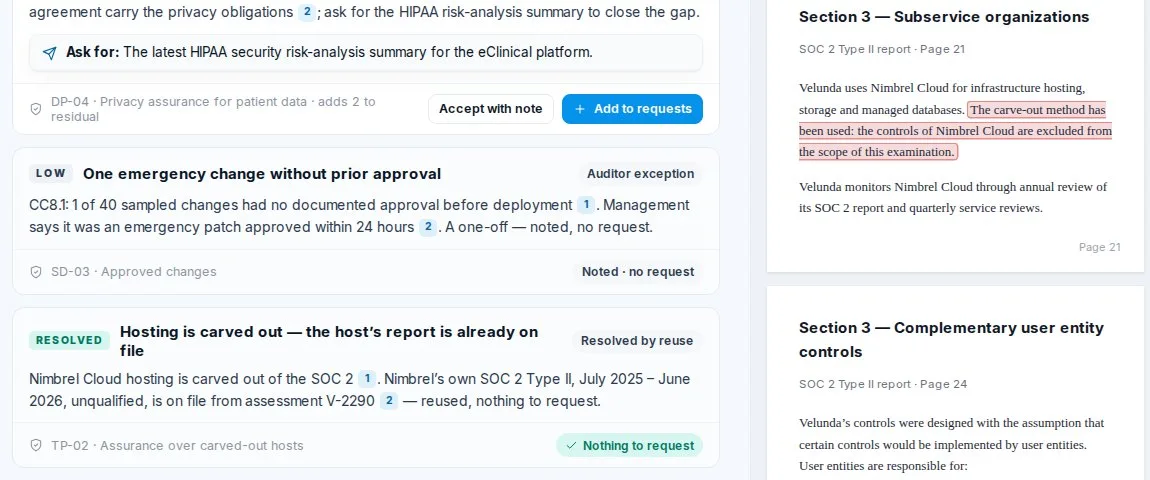
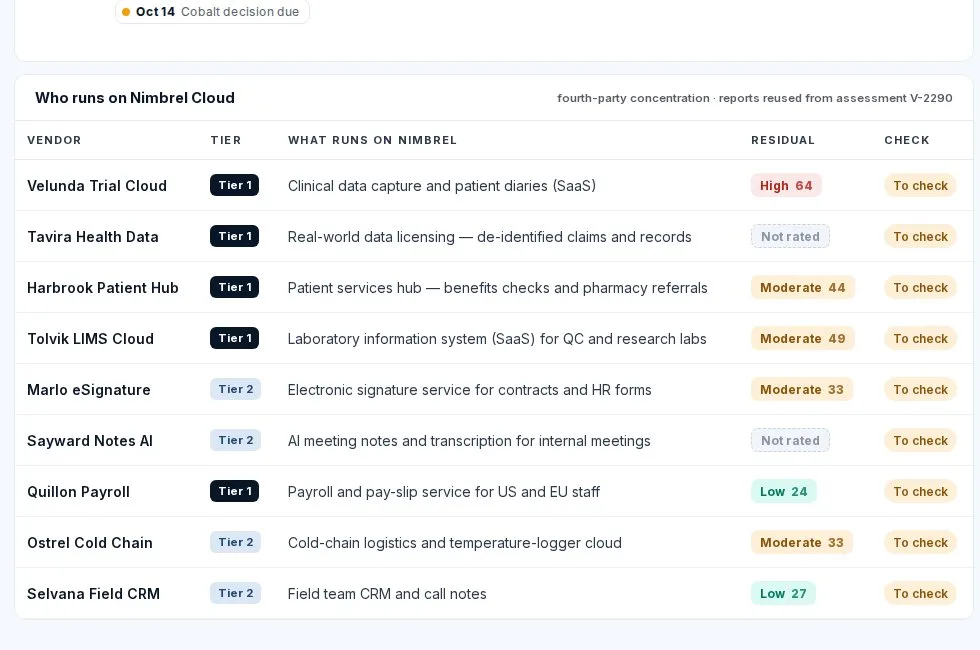
A carved-out host, resolved by reuse. The report excludes Nimbrel Cloud, and Nimbrel's own report is on file from an earlier assessment. Nothing needs requesting.
The SOC report reader lists each complementary user entity control, and each is matched to Northwind's own framework with a named owner. Five are in place and two need action. Access review for this system runs once a year where the report assumes quarterly; that one goes to Dana Okafor, the identity and access lead. Audit-trail review runs in 9 of 14 studies; that one goes to Dr. Maya Chen, the clinical operations business owner.
Controls on our side. The auditor's assumption, your control, its owner and the status, beside page 24 of the sample report.
How the assessment ran. Each agent's step is listed with its output: 9 documents, 611 answers, 112 pages, 640 mapped, residual 64.
16 · Rating to signatures
From High 64 to a co-signed approval: the reasons, the requests, the clauses and who accepted what
In shortThe risk rater shows why inherent risk is Critical and what moves residual, point by point. Ticking a condition shows its effect. The writer drafts one request per finding and one clause per domain. Priya chooses and signs. Residual is High, so Omar Haddad, Head of IT Risk and Compliance, co-signs. Nothing goes to the vendor until the analyst sends it.
1
Why High: a reason beside every point
The gauges read 88, 64 and 34. Below them, four factors explain the 88, and seven lines explain how a base of 34 becomes 64. Each carries its reason and a citation back to the page behind it.
Inherent and residual risk. Why inherent is Critical on the left, what moves residual on the right.
2
Tick a condition, and watch the score
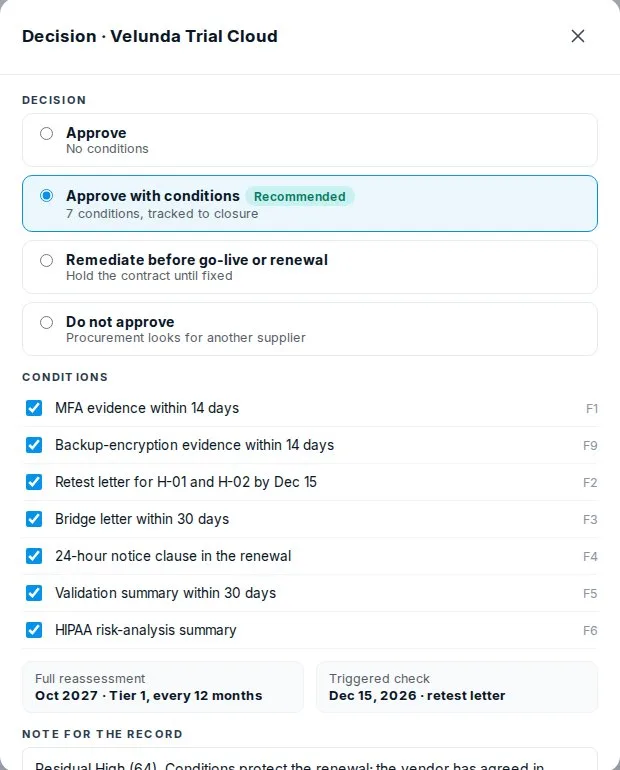
Omar asked to see the page behind every point, and the same list answers the next question: what if the vendor delivers? With every box ticked, the middle gauge falls to 34, Moderate. An analyst can test which condition matters most before writing any of them into a contract.
The what-if. With all seven conditions met, the middle gauge reads Moderate 34.
3
Seven requests to Velunda's CISO, each tied to its passage
The request letter to Marta Lindqvist lists one item per finding, with the evidence that would close it and the document it relates to. Priya reads it and sends it herself.
On item 3, the 14-day window is for the dated fix plan. The retest letter itself is due December 15.
The request to the vendor. Seven items, each with its due date and its source.
4
Clause wording procurement can use as written
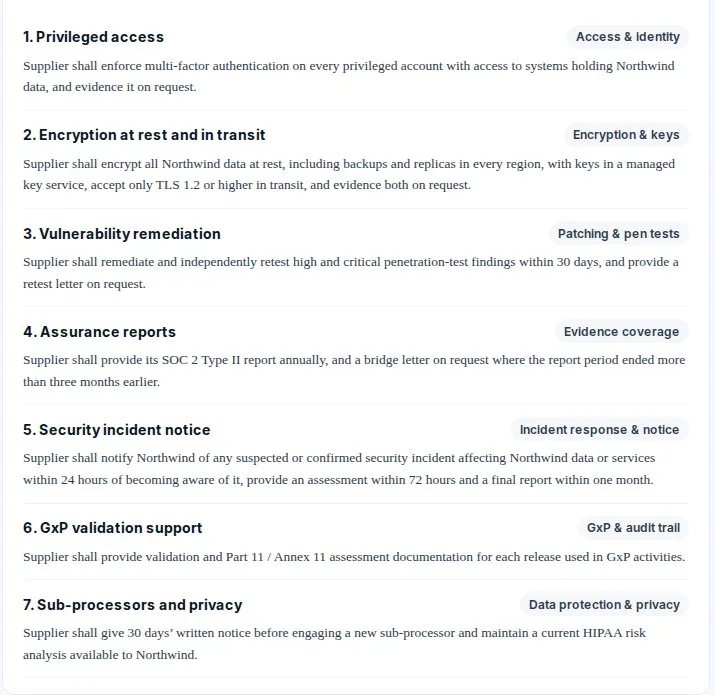
Sam Patel, the procurement category manager, asked for wording, so he gets it, from the approved library, one clause per domain with a finding. The incident notice clause asks for 24 hours, then an assessment within 72 hours and a final report within one month. Those are Northwind's own terms for its suppliers.
Contract clauses for the renewal. Sample clauses from a company's own library.
5
Priya chooses, and the conditions travel with the decision
The options run from approve to do not approve. The recommendation is to approve with conditions, seven of them, tracked to closure. Full reassessment is October 2027. A triggered check on December 15 follows the retest letter.
Instead of a request, an analyst can choose "Accept with note" on a finding, and a Tier-1 high finding needs the Head of IT Risk to confirm that acceptance. So each accepted risk has a person's name and a reason on it.
The decision. A recommendation, seven conditions, the reassessment date and the rule that brings in a second signature.
6
Two signatures, and the same-day record
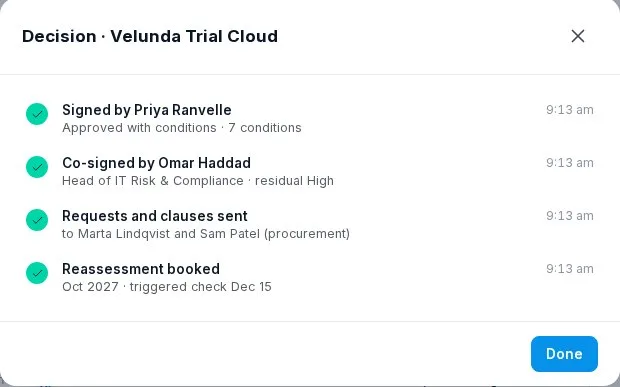
Priya signs. Omar Haddad co-signs for the High residual. The requests go to Marta Lindqvist and the clauses to Sam Patel, and the reassessment is booked. The activity trail keeps every step, for people and agents alike, with decisions and rule changes kept seven years.
Signed and co-signed. Four steps, each time-stamped.
The activity trail. From Sam Patel's tiering form on September 24 to the booked reassessment on October 7.
Proof of the fixes falls due before the renewal, and the retest letter a month after it
Sep 24Tiering form
Procurement submits; Tier 1.
Sep 26Evidence filed
Eight documents; the bridge letter is missing.
Oct 7Read and signed
Two signatures, seven requests.
Oct 21Evidence due
MFA and backup proof, within 14 days.
Nov 15Renewal
With a 24-hour notice clause.
Dec 15Retest letter
A triggered check.
Oct 2027Full reassessment
Tier 1, every 12 months.
Fictional example from this guide
Show the numbers
When
What
Sep 24
Tiering form
Sep 26
Evidence filed
Oct 7
Read and signed
Oct 21
Evidence due
Nov 15
Renewal
Dec 15
Retest letter
Oct 2027
Full reassessment
Velunda's ISO 27001 certificate also runs out on November 30, 2026, two weeks after the renewal. It raises no finding on these screens; an analyst would still want the renewed certificate on file. October 21 is 14 days from the signed decision, by our count.
17 · The whole portfolio
Beyond one vendor: other contradictions, unread evidence, host notices, the portfolio view and the six agents
In shortThe same method runs across 486 vendors. It finds a different kind of gap on each: sub-processors on one, shared admin accounts on another, a model trained on your queries on a third. It tracks who runs on whom, and the calendar comes from the decisions. Rules live in settings and are versioned. Six agents do the reading and drafting; two people sign.
Three more vendors, three different gaps
A patient services hub: six sub-processors listed, four agreed. Harbrook is strong elsewhere, and the gap sits in one place. The screen files the agreed contract under its independent evidence bar; a contract records a promise and tests nothing, so read that bar as "what was agreed".
A service desk: shared admin accounts. With admin access to 9,400 laptops at stake, the fix is due in seven days.
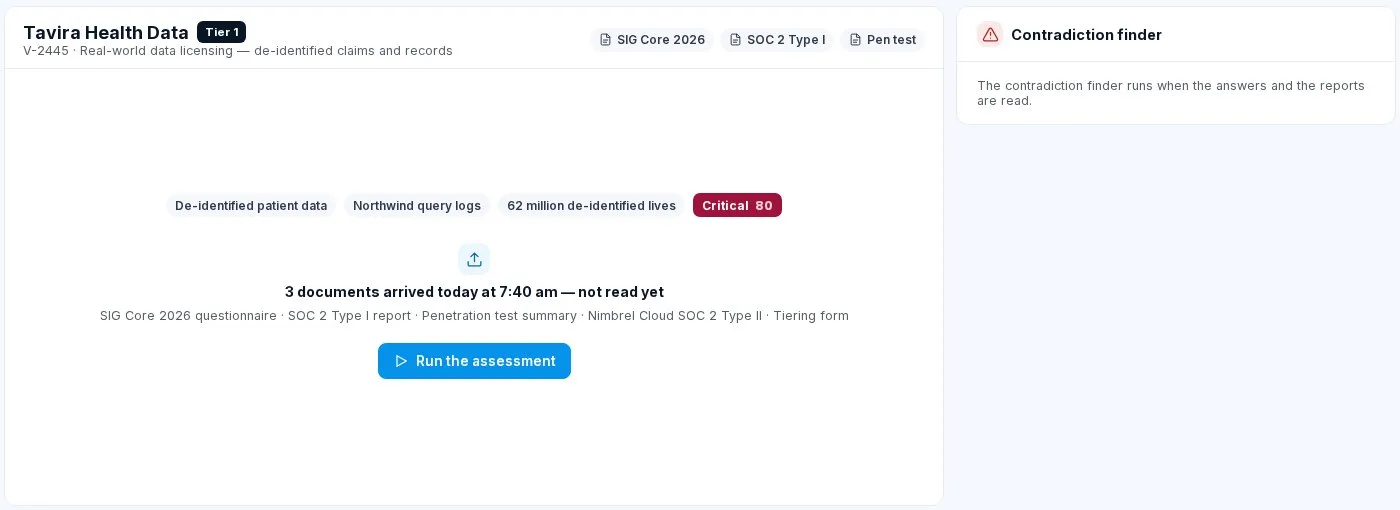
A new data vendor, read in minutes. A Type I report only, no expert determination letter, and an answer that your queries would improve its shared model, which Northwind's rule forbids without written approval.
Before that read. Three documents arrived at 7:40 am, and the analyst starts the run.
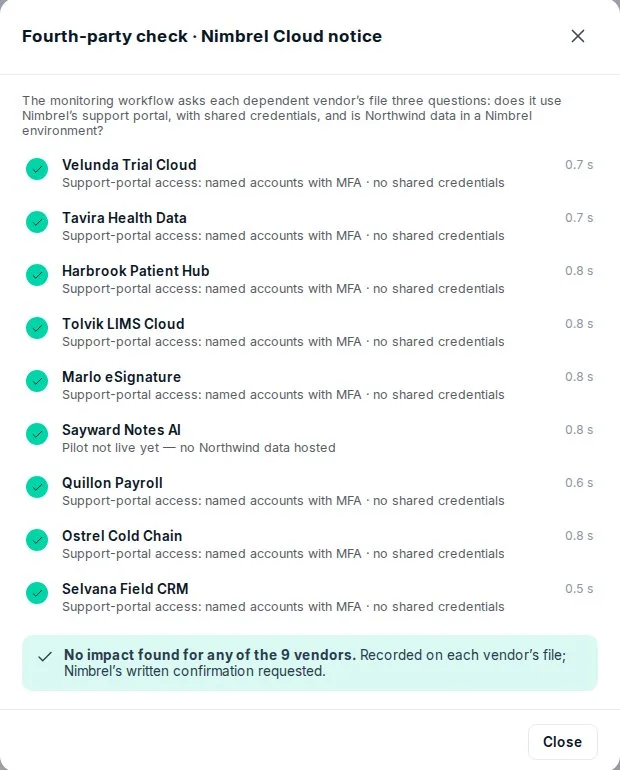
Reassessment calendar, host notices and who runs on Nimbrel
Monitoring. Reassessments by tier, the next 90 days, and signals such as a host's notice or an expiring certificate. Requests stay as drafts until the analyst sends them.
Who runs on Nimbrel Cloud. Nine vendors share one fourth party, and their reports are reused from one assessment.
A host's notice, checked in one go. Nimbrel reports an attack on its support portal. Nine vendor files are checked against three questions, the result is recorded on each, and written confirmation is requested.
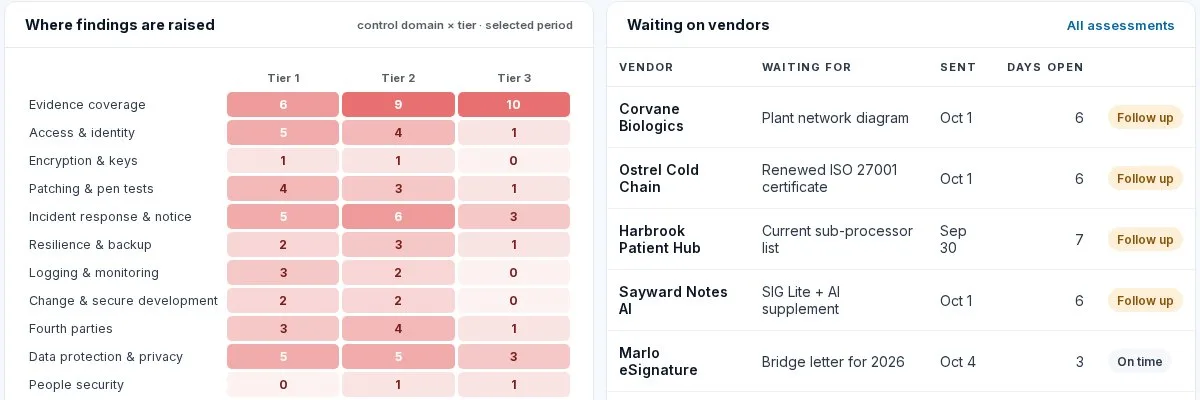
The portfolio: throughput, residual risk by tier and where findings cluster
The dashboard, on sample data. 6.6 hours and 9 days are the solution's design targets. The by-hand 20 hours is an estimate.
Where findings cluster. Findings by domain and tier, and who the team is waiting on.
Most Tier-1 vendors sit at Moderate, and nine carry High or Critical residual
Residual risk in the sample portfolio of 486 vendors
LowModerateHighCritical
Tier 1 (61)21317
Tier 2 (148)706215
Tier 3 (277)22152
Fictional example from this guide
Show the numbers
Low
Moderate
High
Critical
Tier 1 (61)
21
31
7
2
Tier 2 (148)
70
62
15
1
Tier 3 (277)
221
52
4
0
Your tiering, evidence rules, cadence and approvals, set as versioned settings
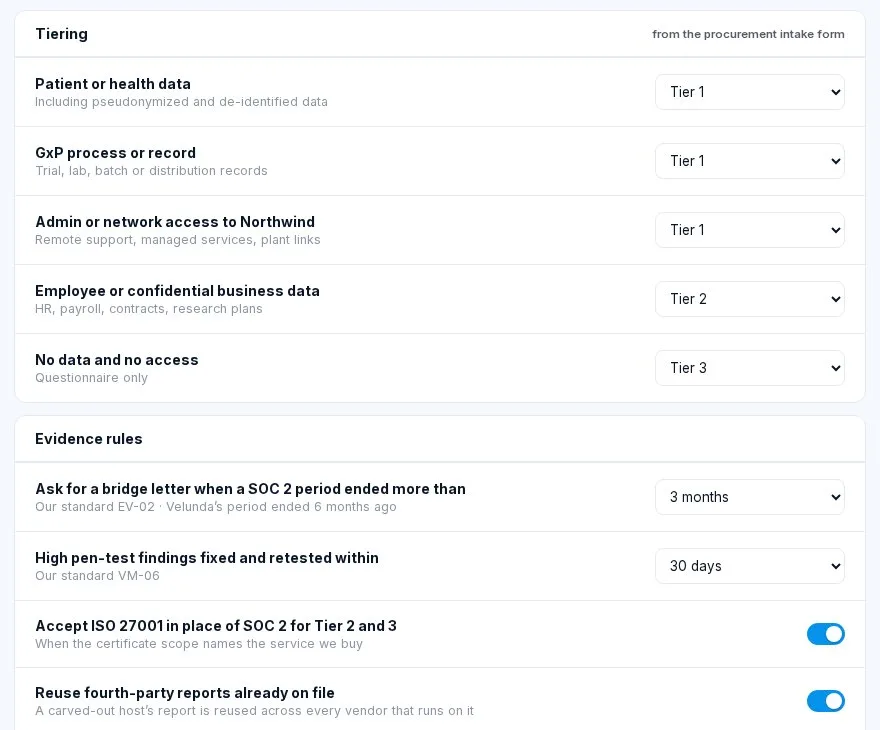
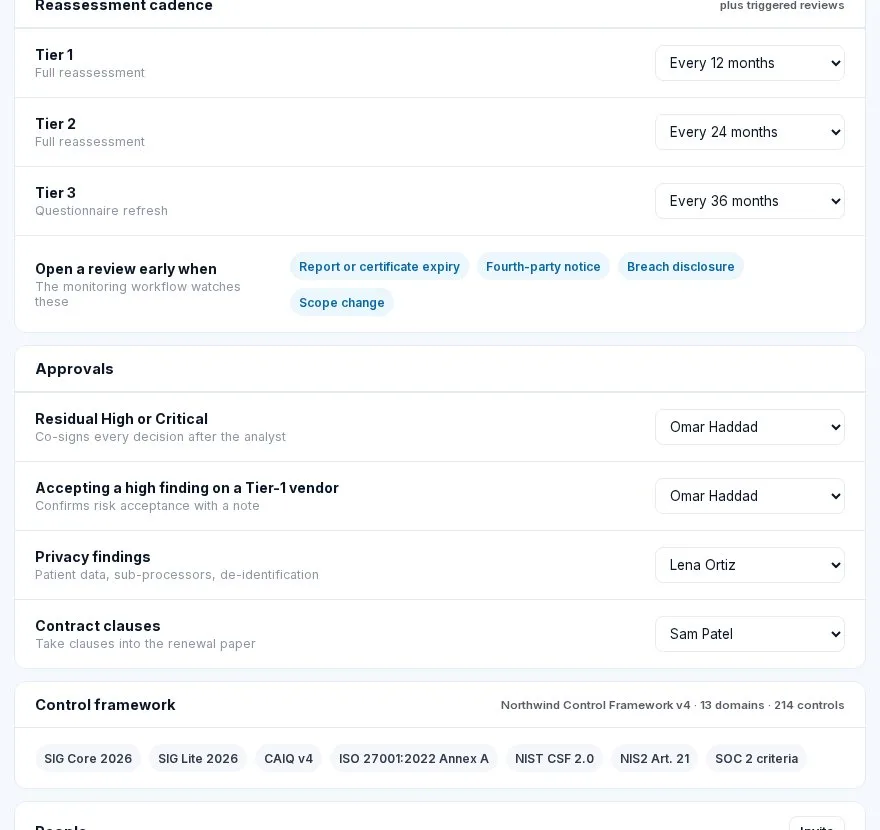
The rules the agents apply are settings: what makes a vendor Tier 1, how old a report may be before a bridge letter is asked for, how fast a high finding must be fixed, whether ISO 27001 can stand in for SOC 2 on lower tiers, and who signs what. Changes are versioned and apply to open assessments.
Tiering and evidence rules. Patient data, GxP records and admin access make a vendor Tier 1 by default.
Cadence and approvals. Every 12, 24 and 36 months, four triggers, named approvers and the framework mappings.
Six agents read and draft; an analyst and a head of IT risk decide
Evidence classifier
Files each document a vendor sends into the right assessment, and flags what is missing.
Never opens a protected file without the vendor's key.
Questionnaire reader
Reads SIG Core, SIG Lite and CAIQ answers with their comments, and treats a blank or "N/A" with no reason as unanswered.
Always cites the reference for every answer it uses.
SOC report reader
Reads in the order reviewers use: opinion, scope, carve-outs, controls on your side, exceptions, management responses. Also reads penetration tests and policies.
Never treats a management response as evidence.
Control mapper and contradiction finder
Maps answers and tests to your control framework, and finds contradictions, missing evidence, stale periods and carved-out hosts.
Never raises a contradiction without both passages.
Risk rater
Scores inherent risk from the tiering form, and residual from controls and findings, with a reason for every point.
Never gives a bare score. High or Critical routes to the co-signer.
Request and clause writer
Drafts one request per finding, one clause per domain from approved wording, and books the next review.
Never sends anything to a vendor without the analyst.
What goes into a vendor assessment, and what comes out
From the vendor
SIG Core, SIG Lite and CAIQ questionnaires
SOC 2 Type II and Type I reports, bridge letters
Penetration test summaries
Policies, certificates, data processing and business associate agreements
From your own team
Procurement's tiering form
Your control framework and rules
Approved clause library
Reports on file for shared hosts
Agents read, compare and draftEvery score and finding cites its passage
A contradiction needs both passages
A person accepts each risk
Outputs
Security radar: said against shown, by domain
Contradictions with both passages cited
Inherent and residual risk with a reason for every point
Controls on your side, each with a named owner
Requests, contract clauses and the next review date
A signed decision, on the record
Systems a vendor assessment connects to
Supplier portal and mailboxWhere vendors send evidence
Procurement intakeTiering forms and renewal dates
Contract repositoryClauses, agreements and renewals
Governance, risk and compliance toolsFindings, conditions and exceptions
Identity and accessRoles, single sign-on and e-signature
Security ratings and news feedsSignals between reviews
6.6 hours
of analyst time per Tier-1 assessment, against about 20 by hand.
Design target; by-hand figure estimated
9 days
median from complete evidence to a signed decision, against a 15-day goal.
Design target
2 of 2
contradictions surfaced in the sample vendor's evidence, each with both passages side by side.
Sample case
Enterprise controls. Roles and a second signature for high risk, a full activity trail, versioned rules, vendor documents kept within each assessment and visible to the assessment team and business owner, and records kept seven years. Agents do not train on vendor documents. Botminds' credentials: SOC 2 Type II audited and information security managed to ISO 27001. An assessment made here certifies nothing about the vendor. It records your company's own decision, with your people's names on it, and the record is built to support your compliance work.
Part C · Ready to automate?
Should you automate your vendor security reviews? The costs, the return, your readiness and how to test it
This part speaks to you, the person deciding. It covers what a missed gap and a slow review can cost, how to size the return on your own numbers, a scored readiness check, what to ask any vendor, including us, and a pilot you can run on evidence packs you have already reviewed.
18 · What a miss costs you
What a missed contradiction and a late renewal cost a drug or device company, and how to find your own number
In shortPublished costs describe breaches and fines, which are large and rare, and they say little about your reviews. The costs you carry every month are quieter: analyst days, renewals signed before the reading ended, conditions nobody tracks, and controls on your side that were never running. Measure those on your last 20 reviews.
$6.64M
average health care breach in IBM's 2026 report. It covers all causes, and it is a model of many costs, so use it for scale only.41
IBM and Ponemon, as summarized by Baker Donelson
2%
of worldwide turnover (revenue) or €10 million, whichever is higher, is the least the top NIS2 fine must reach for an essential entity. For an important entity, it is 1.4% or €7 million.11
Directive (EU) 2022/2555, Article 34
9–12 mo
to move live studies to another platform in the fictional example. A late finding may leave you no real choice but to renew.
Sample case; find your own
Reading and mapping is where a Tier-1 review's hours can come down; judgment and sign-off shrink far less
One Tier-1 review, by hand and with the solution
By hand, estimatedWith the solution, design target
Reading and mapping to your controls12 hours1 hour
Comparing and reviewing findings4 hours2.8 hours
Vendor follow-up2.5 hours1.9 hours
Decision and sign-off1.5 hours0.9 hours
Illustrative · replace with your own numbers · Totals 20 and 6.6. These come from the solution's own design, so replace them with a count from your own reviews.
Show the numbers
By hand, estimated
With the solution, design target
Reading and mapping to your controls
12 hours
1 hour
Comparing and reviewing findings
4 hours
2.8 hours
Vendor follow-up
2.5 hours
1.9 hours
Decision and sign-off
1.5 hours
0.9 hours
Where vendor review costs hide, and how to find your number in a week
Cost
Where it hides
How to find your number
Analyst hours per review
Inside salaries, split across reading, email and meetings
Ask three analysts to log time on their next five Tier-1 reviews
Days from complete evidence to decision
Spreadsheets, and the business owner's calendar
Take the dates from your last 20 reviews and count how many missed your goal
Renewals signed before the review ended
Contract systems nobody compares with the risk register
Compare contract dates with decision dates for the past year
Exceptions read too late, or not at all
Inside old reports
Reread ten past SOC 2 reports and count exceptions missing from your findings
Conditions that never closed
Email threads after signature
List last year's conditions, and count those closed by their date
Your own controls not running
Report sections that get filed away
Take three Tier-1 reports and confirm each listed control with its owner
Costs a vendor review calculator leaves out: breaches, inspections, findings and trust
A breach at a vendorResponse, notices, legal work and lost time. You may owe duties to regulators and to people even when the vendor made the error.
Doubt over trial dataIf a platform's records are in question, the cost falls on the study and potentially on the submission that relies on it. No published average was found.
An inspector's questionAnnex 11 expects supplier information to be available to inspectors on request, and a blank file is hard to explain.30
What you said in publicA US-listed company's Item 106 disclosure should match what it does with vendors.32
Vendors who stop answeringRepeating the same questions at every renewal can use up goodwill, and answers can get thinner.
People who leaveReading long reports by hand can wear senior analysts down, and their judgment on hard cases is what you want to keep.
19 · Your return
Sizing the return on faster vendor reviews: four levers and a calculator you fill in
In shortAnalyst hours can be counted. Risk avoided mostly cannot, so leave it out of the sum and describe it separately. Every default below is an assumption. Change them to your own, and treat a result that only works on the optimistic inputs as a reason to run a pilot before you commit.
Four value levers in a third-party risk team
Tier 1
Reading hours on Tier-1 reviews
Reading and mapping come off the analyst, who keeps the judgment.
Tier-1 reviews × hours saved × hourly cost
Tier 2
Hours on Tier-2 reviews
Where these reports get skimmed today, the first gain is coverage, then time.
Tier-2 reviews × hours saved × hourly cost
Reuse
Host reports read once
A shared host's report gets read once and reused across every vendor on it.
reused reports × hours per read × hourly cost
Not counted
Reviews finished before renewal
Count how many decisions land before the contract date. This carries no dollar value here, and it may be the main reason to do this.
decisions before renewal ÷ all renewals
Vendor review hours and dollars, on your volumes
No source publishes these inputs. Every default is an assumption, marked illustrative, except the 20 and 6.6 hours, which are the solution's estimate and design target.
Your volume and costHours per reviewReuse and running cost
Illustrative yearly value
Tier-1 hours saved, valued$0
Tier-2 hours saved, valued$0
Repeat reads avoided, valued$0
Yearly value after running cost$0
Hours freed for judgment0
Formulas: Tier-1 reviews × (hours by hand − hours with automation) × hourly cost; the same for Tier 2; repeat reads × hours × hourly cost; total less running cost. A breach avoided is not counted. Nothing you enter leaves this page.
Which vendors to read first: where a security read pays back soonest
Start with Tier-1 renewals on GxP and patient data, where both the stakes and the reading are heavy
Illustrative · replace with your own numbers · Replace with your own vendors. Plant-link suppliers often have little paperwork and high stakes, so people should keep those.
Show the numbers
Item
Evidence to read per review (0–1)
What a failure costs (0–1)
Trial platforms
0.72
0.76
Plant links
0.12
0.72
Patient hubs
0.75
0.62
IT admin firms
0.12
0.56
Lab systems
0.72
0.32
Marketing tools
0.75
0.20
Translation
0.12
0.14
20 · Readiness check
Is your third-party risk team ready to automate reading? Eight scored questions and one to reflect on
In shortPick the answer closest to your team today. Eight questions score 0 to 2, and the last is for reflection. The meter adds up your score as you go, and each question says why it matters and what a strong answer sounds like. A low score points to useful work you can start now.
1
Vendor register
Do you have one list of vendors in cyber scope, with tier and owner?
Why it mattersYou cannot tier what you cannot list. A vendor you pay and never reviewed is the gap that matters most.
A strong answer"One register, matched to accounts payable each quarter."
2
Your control framework
Do you have your own numbered control list, mapped to SIG or CAIQ?
Why it mattersEvery answer and test needs somewhere to land. Software follows your framework, and a framework in one person's head cannot be tested.
A strong answer"Thirteen domains, 200-odd controls, mapped and reviewed each year."
3
Evidence rules
Are your rules on report age, bridge letters and patch windows written down?
Why it mattersA rule can be applied the same way each time. An analyst's feeling cannot be, and it is hard to defend.
A strong answer"Bridge letter after three months, high findings retested in 30 days, by tier."
4
Residual risk method
Is your rating written down, with reasons, and who signs at each level?
Why it mattersNo regulator sets the numbers, so yours have to be defensible. A tool will apply whatever you give it.
A strong answer"Inherent factors, base after controls, points per finding, and a second signature at High."
5
Quality and GxP
Does quality join reviews of systems that hold regulated records?
Why it mattersA SOC 2 report does not test Part 11 or validation. Someone has to fill that gap.
A strong answer"Quality signs off GxP evidence on Tier-1 systems, and audit plans draw on the same findings."
6
Baseline numbers
Do you know your hours and days per review, by tier?
Why it mattersNo public benchmark exists, so your own count is the only way to prove a change.
A strong answer"Tier 1 about 20 hours and 15 days, counted on our last 20."
7
Closing the loop
Do conditions reach the contract, a date and an owner?
Why it mattersA condition that stops at the memo protects nobody. This is where a review turns into lower risk, or fails to.
A strong answer"Clauses reach procurement, conditions are dated, and our own controls have owners."
8
Confidentiality and sign-off
Have legal and privacy agreed how vendor reports may be processed by software?
Why it mattersSOC 2 reports are restricted use by definition.46 Pilots stall when no one asked in advance.
A strong answer"Legal reviewed the report terms, and a named owner runs the program."
9
Every answer checked against a test · for reflection
If every answer your Tier-1 vendors gave you were compared with their reports tomorrow, which vendors would you look at first, and who would have to be in the room?
Why it mattersYour answer shows where the value lies, and which business owners to talk to early.
A strong answerA short, specific list, for example: "the two trial platforms and the patient hub, with clinical operations and privacy."
0–6
Explore
Match your vendor list to what you pay, write down your evidence rules, and reread three Tier-1 SOC 2 reports with their user entity controls. Those steps improve your program on their own.
7–11
Ready to pilot
Replay ten past evidence packs and compare what comes out with what your team found. Then run new Tier-1 renewals in parallel.
12–16
Ready to implement
Go live on Tier-1 renewals with people deciding, then extend to Tier 2 as the measures hold.
21 · Questions for any vendor
What to ask a third-party risk software vendor about citations, SOC 2 reading, scoring and your data
In shortBring a hard past pack and watch what happens. These questions test whether a tool reads the evidence, cites what it claims, tells you what it could not determine and leaves decisions with your people. Ask us too. Each question says why it matters and what a strong answer sounds like.
A
Reading a report and a questionnaire
A1
On this report, show me each exception, its sample size and its page.
Why it mattersExceptions are the point of a Type II report. A summary that drops the sample size hides a lot.
Strong answerWord-for-word quotes, one click from the page.
A2
What do you do with carve-outs and user entity controls?
Why it mattersBoth move risk back to you, and both are easy to file and forget.
Strong answerHosts tracked and reports reused; each control matched to an owner on your side.
A3
How do you tell a management response from a test result?
Why it mattersThey look alike on a page, and only one was examined.
Strong answerKept apart, and a claimed fix with no proof becomes a request.
B
Contradictions and scoring
B1
Show me a contradiction you found, and a case you considered and rejected.
Why it mattersFalse alarms cost analysts time. Timing gaps need different wording from real conflicts.
Strong answerBoth passages shown, with period and scope considered.
B2
Can I see why each point was added, and change the weights?
Why it mattersA bare score is hard to defend to a board or an auditor.
Strong answerYour method, versioned, with a reason beside every point.
B3
Who accepts a risk, and where is that recorded?
Why it mattersSoftware cannot accept risk. A person with authority must.
Strong answerA named person, a reason and a date, with a second signature at your chosen level.
C
GxP evidence and contracts
C1
How do you treat a vendor's Part 11 or Annex 11 statement?
Why it mattersIt is a claim. No body certifies a product against those rules.4,30
Strong answerListed as untested until validation evidence sits beside it.
C2
How do conditions reach the contract and the calendar?
Why it mattersIf nobody tracks a condition after signature, the vendor has little reason to meet it.
Strong answerClauses from your library, requests with dates, and triggered checks booked.
D
Data, AI and scale
D1
Where are vendor reports processed, who can see them, and do you train on them?
Why it mattersThose reports are confidential to your vendors, so you owe them care.
Strong answerRegions you choose, access by assessment, and no training on your documents.
D2
How do you stop a model inventing a passage, and how do you test that?
Why it mattersWe found no independent study of AI reading vendor evidence, so the proof must come from your files.
Strong answerNo uncited statement, and measured results on your past packs.
D3
What are your own security credentials, in exact words?
Why it mattersThis tool will hold other vendors' reports. Apply your own test to it. "Certified" is a word to examine.
Strong answerExact reports, periods and scopes. Ours: SOC 2 Type II audited and information security managed to ISO 27001.
D4
What do I get when an auditor asks about one decision three years from now?
Why it mattersYour defense is the record of what you knew at the time.
Strong answerAn export of evidence, findings, score, signers and rule version in one place.
22 · How to start
A 10-week pilot on your own Tier-1 evidence: replay ten past packs, then run live renewals beside your team
In shortStart by replaying evidence packs you already reviewed, and measure whether the solution finds what your team found and what it missed. Then run new Tier-1 renewals in parallel. Your people keep every decision. If the numbers do not hold on your own files, you have learned that cheaply.
Replay first, then run live beside your team, and decide at week 10
Your teamTogether
Baseline: hours, days and findings on ten past packs
Legal and privacy agree terms for vendor reports
Load control framework, tier rules, clause library
Replay the ten packs, compare findings
New Tier-1 renewals in parallel
Measure and decide
Week 0246810
Illustrative · replace with your own numbers
Show the numbers
Activity
From
To
Baseline: hours, days and findings on ten past packs
0
2
Legal and privacy agree terms for vendor reports
0
2
Load control framework, tier rules, clause library
1
3
Replay the ten packs, compare findings
3
5
New Tier-1 renewals in parallel
5
9
Measure and decide
9
10
Eight things to measure in a vendor security review pilot
Measure
How
Bar to set before you start
Exceptions found
Compare with a senior analyst's full read of ten reports
Every exception found, with sample size and page
Contradictions, true and false
Two reviewers score each flag blind
Set a false-alarm limit you can live with
Citations that hold
Open a sample of 50 and read the passage
Every cited passage says what the finding says
Rating agreement
Compare final ratings, and read each disagreement
Each difference explained by a stated fact
Untested claims listed
Quality reviews the GxP items
No GxP claim counted as tested without evidence
Days from complete evidence to decision
Dates in the register, compared with baseline
Your own goal; the solution's design target is 9 days
Analyst hours per Tier-1 review
Time logs, compared with baseline
Your own goal; the solution's design target is 6.6 hours
Conditions closed by their date
Check at week 10 and again at three months
Better than your baseline
The full working-session questions for your own team: nine questions in three groups
Bring IT risk, privacy, quality, procurement, legal and one business owner into one room.
1
Which vendors come first
1
Which vendors and renewals come first, and why?
Why it mattersA narrow start gives clean measures.
Strong answer"Tier-1 clinical platforms renewing in the next two quarters."
2
What happens when a business owner needs an answer before the review ends?
Why it mattersThis is when reviews get shortened.
Strong answer"A short extension or approval with conditions, with a named signer."
3
When do you still send a person to audit a vendor?
Why it mattersAnnex 11 ties audits to a risk assessment, and paper has limits.30
Strong answer"GxP-critical systems, and when evidence stays thin after a request."
2
Your rules
4
Who approves the rating method and the evidence rules?
Why it mattersEvery rating rests on them.
Strong answer"The head of IT risk, each year, with changes versioned."
5
What is your notice clause, and can every Tier-1 vendor meet it?
Why it mattersYour own reporting clock may depend on it.11
Strong answer"24 hours for Tier 1, with exceptions signed and recorded."
6
Who decides what a finding is worth, and what can be accepted?
Why it mattersA vendor will not fix everything, so someone must own what remains.
Strong answerA written limit by tier and a named acceptor.
3
Who sees vendor documents, and for how long
7
Who may read a vendor's SOC 2 report in your company?
Why it mattersThose reports describe the vendor's weak spots, and they are restricted use reports.46
Strong answerThe assessment team and the business owner, by role.
8
How long do you keep decisions and evidence?
Why it mattersInspections and disputes can come years later, and trial records can outlast contracts.
Strong answerA table agreed with counsel; the sample uses seven years.
9
Who tells a vendor a condition was missed, and what happens next?
Why it mattersA condition with no consequence stops working.
Strong answerA named owner, a written path, and procurement in the loop.
23 · Questions people ask
Vendor security assessment questions, answered
In shortShort, standalone answers to the questions people most often search, as of November 2026. None of this is legal advice.
What is a vendor security assessment?
A vendor security assessment is the review a company runs before signing or renewing with a supplier that will hold its data or reach its systems. It collects the supplier's questionnaire, audit reports, test results and agreements, compares what the supplier says with what independent tests show, and rates the risk that is left. A named person then decides and accepts that risk.
What is the difference between SOC 2 Type I and Type II?
A Type I report looks at whether controls were suitably designed on a single date. A Type II report also tests whether they worked over a period, often 6 to 12 months. For a supplier that holds sensitive data, Type II tells you far more, and a Type I is best treated as a first step with a dated plan for Type II.
Is SOC 2 a certification?
No. SOC 2 is an attestation: a licensed CPA firm examines controls and issues a report with its opinion. No certificate exists, though some vendors use the word. Read the period, the scope, the categories and the test results.
How do you read a SOC 2 report?
Start with the auditor's opinion and period, check that your service and the categories you need are in scope, and find any carved-out subservice organizations. List the controls you are assumed to run. Then read the test results for exceptions, with their sample sizes, and treat management's responses as unaudited claims.
What is a SOC 2 bridge letter?
A bridge letter, or gap letter, is a statement from the vendor's management that nothing significant changed since the end of the report's period. An auditor does not review it. We found no standard for it from the American Institute of CPAs, and common practice treats about three months as the limit, so a longer gap is a reason to press for a new report.
What are complementary user entity controls?
They are controls a SOC 2 auditor assumes the customer runs, such as removing its own users promptly or reviewing access each quarter. Skip them, and the vendor's result may not apply to you. Give each one a named owner on your side.
What does carve-out mean in a SOC 2 report?
Under the carve-out method, the report excludes a subservice organization's controls, typically the vendor's cloud host. Those controls were not examined in this report, so you need the host's own report. Keeping one copy on file for each shared host saves repeated work.
What is the difference between SIG Core, SIG Lite and CAIQ?
The SIG is a licensed questionnaire from Shared Assessments: Core is the fuller version, and Lite is shorter, for lower-risk vendors. The 2026 edition also offers scoping presets. CAIQ is the Cloud Security Alliance's questionnaire, built around its Cloud Controls Matrix, and is the form used for its STAR registry; version 4.1 has 283 questions. Published question counts for the SIG vary, and the licensed form is the one to check.
Does NIS2 apply to pharmaceutical companies?
It can. NIS2 is the EU's cybersecurity directive. Its Annex I names entities doing research and development of medicinal products and those making basic pharmaceutical products and preparations, and Annex II names medical device makers, subject to size rules. Article 21 requires supply chain security measures. National transposition varies: 20 of 27 member states had finished by January 1, 2026, and on July 8, 2026 the Commission took Ireland, Spain, France and the Netherlands to the EU Court of Justice over it, so check your countries.
Does HIPAA require a vendor security assessment?
HIPAA requires covered entities and business associates to run a risk analysis and hold business associate contracts. Drug companies sponsoring trials are often not covered entities, and a commercial program depends on who runs it, so ask counsel which role applies to each vendor. A rewrite proposed on January 6, 2025 would require yearly written verification from business associates; it is not final, and the federal regulatory agenda lists final action for July 2027.
Does a Part 11 statement from a vendor mean a system is compliant?
No. A statement is a claim, and no authority certifies a product against Part 11, FDA's rule on electronic records and signatures. FDA's guidance says regulated entities are responsible for ensuring that electronic records meet Part 11. Ask for validation evidence, and check what you must do yourself, such as validating your configuration and reviewing audit trails.
What is fourth-party risk?
Fourth-party risk comes from your vendor's suppliers, such as a software vendor's cloud host or email service. You usually have no contract with them. Track who runs on whom, reuse the host's reports, compare sub-processor lists with your contract, and check dependent vendors whenever a host sends a notice.
How often should vendors be reassessed?
No rule we read sets a period. A common scheme, used in this guide's example, is every 12 months for Tier 1, 24 for Tier 2 and 36 for Tier 3, with earlier checks when a report expires, a host sends a notice, a scope changes or a breach is disclosed.
Can AI do a vendor security assessment?
AI can read questionnaires and reports, cite passages, flag answers a test contradicts and draft requests. It cannot test a control or accept risk. As of November 3, 2026, we found no independent study of its accuracy on vendor evidence, so measure it on your own past evidence packs and keep a person on every decision.
24 · Summary and glossary
Vendor security assessment on one screen: the method, the November 2026 rules and the terms
Print this page
In shortThe whole guide on one screen: the method, the rules as of November 2026, the readiness bands and the terms.
The method
Keep one register of vendors, matched to what you pay, and tier them on data, GxP use, access and how hard they are to replace.
Write your control framework, evidence rules and rating method down, and have them approved.
Treat the questionnaire as claims, and map each one to a control.
Read each SOC 2 report in order: opinion, scope, carve-outs, your controls, exceptions, responses.
Compare answers with tests. Cite both passages, check the dates, and ask for dated proof.
List what no test covers: GxP evidence, privacy and AI use. Bring in quality and privacy.
Give every point a reason. A named person decides, and accepts what remains.
Date every condition, own your side's controls, and watch fourth parties between reviews.
Readiness: score 0–2 on eight questions: 0–6 explore · 7–11 pilot · 12–16 implement.
As of November 2026: NIS2 in national law in 20 of 27 member states at January 1, 2026, with four referred to the EU Court of Justice on July 8, 2026 · GDPR Articles 28 and 33(2) · HIPAA rewrite proposed January 6, 2025, final action listed July 2027 · FDA electronic systems Q&A final, October 2024 · ICH E6(R3) Principles and Annex 1 final, January 6, 2025 · EU GMP Annex 11 at January 2011, revision and Annex 22 still drafts · DOJ 28 CFR Part 202 effective April 8, 2025 · ISO 27001:2013 transition ended October 31, 2025 · EU AI Act high-risk dates December 2, 2027 and August 2, 2028.
14 terms
Third party, fourth party
Your vendor, and your vendor's vendor.
SIG, CAIQ
Standard security questionnaires from Shared Assessments and the Cloud Security Alliance.
SOC 2
A CPA firm's examination of a service organization's controls, with an opinion.
Type I, Type II
Design on a date, or design and operation over a period.
Exception
A test result where a control did not work as described.
Management response
The vendor's reply to an exception, usually unaudited.
Carve-out
A report method that excludes a subservice organization's controls.
CUEC
A control the auditor assumes you, the customer, run.
Bridge letter
Management's statement covering the time since the report's period.
Penetration test
A hired attempt to break in, reported as findings by severity.
Inherent risk
The harm a vendor could do, before any controls.
Residual risk
What is left after controls and open findings.
GxP
Quality rules for regulated work, such as good clinical and good manufacturing practice.
Tier
How much evidence a vendor owes, and how often.
25 · Sources
Sources
Accessed November 2026. Regulatory status statements are as of November 2026. Where we read only a summary or a secondary account of a source, the entry says so.
Drata, "SOC 2 Certification or Attestation: Understanding the Difference", April 17, 2026: "SOC 2 is an attestation, not a certification"; only licensed CPA firms; the output is an opinion; Type 1 and Type 2, the Type 2 period "typically six to twelve months". Drata sells compliance software. drata.com
Vanta, "What is a SOC 2 bridge letter?", read November 3, 2026: the service organization writes it; "no more than three months" as industry practice. Vanta sells compliance software. vanta.com
AICPA and CIMA, SOC 2 topic page, read November 3, 2026: SOC is "a suite of service offerings CPAs may provide", used "to provide assurance reports"; the five categories, in the title of the SOC 2 guide. The page never calls a SOC report a certificate. We did not read the guide itself. aicpa-cima.com
FDA, "Electronic Systems, Electronic Records, and Electronic Signatures in Clinical Investigations: Questions and Answers", final guidance, October 2024, Docket FDA-2017-D-1105: section III.C on IT service providers, Q7 and Q10. fda.gov
Three guides on the SIG, read November 3, 2026, showing how counts differ: Spendflo (855 Core, 126 Lite), Drata (825 and 150), Wolfia, April 13, 2026 (627 and 128). None is a count we read from Shared Assessments, and the licensed form was not read. spendflo.comdrata.comwolfia.com
Mitratech, "SIG 2026: Key Updates and Considerations", March 5, 2026: no new risk domains, ISO 42001 mapping, scoping presets Lite, Core and Detail. The SIG itself is licensed by Shared Assessments and was not read. mitratech.com
Cloud Security Alliance, "CCM v4.1 Transition Timeline", February 19, 2026: CCM and CAIQ v4.1 released January 2026; CAIQ v4.1 has 283 questions; the STAR registry accepts v4.0 and v4.1 until December 2027. cloudsecurityalliance.org
ICH E6(R3) Good Clinical Practice, Step 4, January 6, 2025: sections 3.6.6 to 3.6.8 on service providers. database.ich.org
EMA, "Guideline on computerised systems and electronic data in clinical trials", EMA/INS/GCP/112288/2023, adopted March 7, 2023: section 6.7 on cloud solutions, Annex 1 on agreements, Annex 2 on validation. ema.europa.eu
NIST, "The NIST Cybersecurity Framework (CSF) 2.0", CSWP 29, February 26, 2024: GV.SC-01 to GV.SC-10. nist.gov
Directive (EU) 2022/2555 (NIS2): Article 21(2)(d) and 21(3) on supply chain security; Article 23 on incident reporting; Annex I (health sector) and Annex II (medical device manufacturing). publications.europa.eu
HHS, "HIPAA Security Rule To Strengthen the Cybersecurity of Electronic Protected Health Information", notice of proposed rulemaking, 90 FR 898, January 6, 2025: written verification from business associates at least every 12 months, 24-hour notice of contingency plan activation, patch windows of 15 and 30 calendar days, multi-factor authentication and encryption; also its account of the Change Healthcare breach report. govinfo.gov
Department of Justice, "Preventing Access to U.S. Sensitive Personal Data and Government-Related Data by Countries of Concern or Covered Persons", 90 FR 1636, January 8, 2025 (28 CFR Part 202): effective April 8, 2025; certain duties from October 6, 2025; vendor agreements as restricted transactions; sections 202.510 and 202.511 exempt regulatory approval data and transactions ordinarily incident to FDA-regulated clinical investigations, on conditions. govinfo.gov
DQS, "Transition for ISO 27001:2022", updated May 25, 2023, on IAF MD 26:2022: the transition period ends October 31, 2025, and all 2013 certifications "will expire or be withdrawn" after it. We read this certification body's account, not IAF MD 26 itself. dqsglobal.com
European Parliament, Legislative Observatory, procedure 2026/0011(COD), Cybersecurity Act 2, read November 3, 2026: "Awaiting committee decision", proposal COM(2026)0011 of January 20, 2026. oeil.europarl.europa.eu
European Commission, "July infringements package: key decisions", July 8, 2026: Ireland, Spain, France and the Netherlands referred to the Court of Justice for failing to notify measures transposing NIS2, with a request for financial sanctions. ec.europa.eu
European Commission, AI regulatory framework page: Regulation (EU) 2026/1744 in force July 27, 2026; Annex III from December 2, 2027; Annex I from August 2, 2028. digital-strategy.ec.europa.eu
Unified Agenda, RIN 0945-AA22, read November 3, 2026: Long-Term Actions, NPRM 01/06/2025, final action 07/00/2027. reginfo.gov
Draft EU GMP Annex 22, consultation July 7 to October 7, 2025, section 1. Still a draft on November 3, 2026: the EudraLex Volume 4 page lists Annex 11 at January 2011 and no Annex 22. picscheme.org
EMA, 3-year work plan of the GMDP Inspectors Working Group, 2026 to 2028: Q4 2026 target for giving the Commission final text. ema.europa.eu
Wavestone, "NIS 2: Where are European countries in transposing the directive?", updated January 2026: 20 of 27 Member States as of January 1, 2026; Germany from December 6, 2025; France and Ireland still pending at that date. wavestone.com
Clyde & Co, "Dutch Cybersecurity Act enters into force on August 15, 2026", July 21, 2026: adopted by the Dutch Senate on July 7, 2026. We read this law firm's note, not the Dutch statute. clydeco.com
NISD2.eu, "NIS 2 EU implementation tracker", read November 3, 2026: "As of November 2, 2026: a national NIS2 law is in force in 24 of the 27 EU countries"; France, Ireland and Spain outstanding. A compliance vendor's count, not the Commission's. Cullen International, May 29, 2026, counted four not yet transposed. nisd2.eucullen-international.com
Regulation (EU) 2016/679 (GDPR): Article 28(1) and 28(3)(h) on processors; Article 33(2) on breach notice to the controller. publications.europa.eu
45 CFR 164.308(a)(1)(ii)(A) and 164.308(b), 2025 edition of the Code of Federal Regulations: risk analysis; business associate contracts. govinfo.gov
45 CFR 164.410, 2025 edition: a business associate notifies the covered entity without unreasonable delay and no later than 60 calendar days after discovery. govinfo.gov
45 CFR 160.103, definitions of covered entity and business associate. law.cornell.edu
Philip H. Lebowitz, "Protecting Privacy and Encouraging Research", Pharmaceutical Executive, 2005: "many individuals and entities involved in research, such as sponsoring pharmaceutical companies, are not covered entities". A lawyer's article, read for this point; the definitions it rests on are still those in 45 CFR 160.103. duanemorris.com
21 CFR 11.10(a), (d), (e) and (g), controls for closed systems; 2025 edition. govinfo.gov
EudraLex Volume 4, Annex 11, "Computerised Systems", revision January 2011: section 3, Suppliers and Service Providers. health.ec.europa.eu
ABA Banking Journal, April 10, 2026: SEC Chairman Paul Atkins issued a request for comment on reforming Regulation S-K's cybersecurity disclosures in January; banking trade groups asked the SEC to rescind Item 106. We found no SEC proposal to change it. bankingjournal.aba.com
17 CFR 229.106(b)(1)(iii) (Regulation S-K, Item 106): whether the registrant has processes to oversee and identify cyber risks from third-party service providers. law.cornell.edu
FDA, "Computer Software Assurance for Production and Quality Management System Software", final guidance, February 2026: scope is medical device production and quality system software. fda.gov
A&O Shearman, "European Commission announces new cybersecurity package", February 4, 2026, on the proposals of January 20, 2026: proposals only, not in force. aoshearman.com
Linford & Co., "What is Section 5 of the SOC 2?", November 10, 2021: "the only unaudited section", and its content varies by report. linfordco.com
Megan Kovash, Linford & Co., on gap and bridge letters, updated June 5, 2026: the service organization signs; the AICPA "doesn't actually cover bridge letter requirements in the SOC guidance"; "most bridge letters typically cover a period of no more than three months". We did not read the AICPA's guide itself. linfordco.com
EMA, report of the multistakeholder workshop on expert contributions to AI guidance (Annex 22), EMA/156789/2026, workshop of June 30, 2026: consultation comments on large language models and generative AI in GMP; no revised text published. ema.europa.eu
Testimony of Andrew Witty, Chief Executive Officer, UnitedHealth Group, House Energy and Commerce Subcommittee on Oversight and Investigations, May 1, 2024. docs.house.gov
Verizon, "2026 Data Breach Investigations Report": more than 31,000 incidents and 22,000 confirmed breaches, incidents from November 1, 2024 to October 31, 2025; third-party section (the metric combines three kinds of vendor relationship), multi-factor survival analysis, patching, and the Healthcare and Manufacturing sector pages. verizon.com
Verizon, "2025 Data Breach Investigations Report": "the percentages of breaches where a third party was involved doubled, going from 15% to 30%". verizon.com
Baker Donelson, "Ten Takeaways from IBM's 2026 Cost of a Data Breach Report", July 30, 2026: 602 breaches, 17 industries, health care $6.64 million, US $11.5 million. bakerdonelson.com
eSecurity Planet, "IBM 2026 Cost of a Data Breach Report: Key Findings", July 30, 2026: supply chain compromise ranked second among initial attack vectors; health care down from $7.42 million. esecurityplanet.com
Gartner survey of 376 senior executives involved in third-party cybersecurity risk management, July and August 2023, as reported by CIR Magazine, December 13, 2023. We read this report of the survey, not Gartner's own release. cirmagazine.com
RiskRecon and Cyentia Institute, "State of Third-Party Risk Management 2020", survey of 154 professionals. We read a summary of the release of November 23, 2020 and Help Net Security, February 8, 2021, not the full report. RiskRecon sells security ratings. businesswire.com
IBM and Ponemon Institute, "Cost of a Data Breach Report 2026": global average $4.99 million. ibm.com
Sensiba, "Why You Can't Freely Share Your SOC 2 Report", October 26, 2023: "The SOC 2 report is, by definition, a restricted use report", with the readers it names. sensiba.com
FDA, "Considerations for the Use of Artificial Intelligence To Support Regulatory Decision-Making for Drug and Biological Products", draft guidance, January 2025, Docket FDA-2024-D-4689; page content current January 6, 2025, read November 3, 2026. fda.gov
ISPE, GAMP Guide: Artificial Intelligence, July 2025, on developing and using AI-enabled computerized systems in GxP areas. ispe.org
Trust services criterion CC6.7 and its points of focus, as reproduced by Cyberday, in a summary read November 3, 2026. We did not read the AICPA's own text. cyberday.ai
Next step
See it on your own vendor evidence.
Explore the solution, or bring one past Tier-1 evidence pack and your control framework, and we will compare what your team found with what the solution finds.
We use essential cookies to make this site work, and cookieless, anonymised analytics to understand how it's used. "Accept all" also turns on Google Analytics, which sets cookies. Privacy policy