Most foreign bribery cases run through someone else: a distributor, a consultant, a customs broker. So before a drug or device company signs with one, it finds out who really owns the firm, whether an official stands behind it, and why the money it asks for makes sense. That check is third-party due diligence.
This guide is for anyone who runs, requests or signs these reviews: third-party risk leads and analysts, compliance officers, legal counsel, procurement, country managers, and leaders deciding whether to automate the work. No background needed.
Imagine you are the third-party risk lead at a mid-size drug company. Your general manager in Vietnam wants a distributor, Halvora Medical Trading, to bid in public hospital tenders in four provinces for your tablet, Dravenzo: $2.4 million a year, and the November tender round is close.
Its answers to your questionnaire arrive on October 7 at 6:52 am: 62 of them, signed as complete and accurate. Answer 3.1 lists two owners and "other investors 30%". Answer 4.2 says "No" to government links. On those answers alone it scores 62 on your risk scale, which is Medium, and an analyst could clear it.
Then you trace the 30%. The company registry names Lotus Ridge Holdings, a British Virgin Islands company. Its owner is Thach Thu Hanh. Her husband is a deputy provincial health director who sits on the tender board that approves the tenders Halvora would bid in.
As declared
30% owner
"other investors"
Score
62, Medium
As traced
30% owner
a named person
Score
82, High
Approve only with conditionsHe steps aside or she sells, in writing,before anyone signs the contract.
Careful due diligence catches the name behind "other investors" while you can still say no, and leaves a record of why you decided as you did.
Anti-bribery due diligence on distributors and intermediaries: the owners, the rules, the money and the people behind a review
Who counts as a third party, why a doctor at a public hospital can be a foreign official, how ownership is traced now that the registers have changed, how a risk tier is worked out, and what real cases teach, explained without selling anything. If you are new to anti-bribery compliance, start here.
01 · In plain words
What third-party due diligence is: finding out who you are really paying, before you sign
A drug or device company cannot be everywhere itself. To sell in a province where it has no staff, it hires a distributor. To clear cold-chain shipments at a port, it hires a customs broker. To file a registration dossier, it hires a local regulatory consultant. To run a study, it hires a contract research organization, or CRO. Each of these outside firms is a third party, and many of them deal with public hospitals and government staff on the company's behalf.
The risk runs back to the company. If a distributor pays a hospital purchasing official to win a tender, a public contract put out to competing bids, the law can hold the drug company responsible, even if nobody at headquarters handed over any money. Anti-bribery law treats the outside firm as a possible pipe for the bribe. The US Foreign Corrupt Practices Act, or FCPA, reaches anyone who pays a third party "while knowing" that some of the money will reach an official, and "knowing" includes being aware of a high probability and looking away.1
So before signing, the company checks. It sends a questionnaire asking who owns the firm, whether any owner is linked to officials, who its resellers are and where it wants to be paid. Then it checks the answers against outside records: company registries, sanctions lists, lists of officials and their families, and local news.
It looks at the deal terms too. A fee paid only if a tender is won tells you something. So does a margin far above the local norm. The result is a risk tier, usually Low, Medium or High, and a decision: approve, approve with conditions, or walk away.
The hard part is the gap between what a firm says and what is true. A questionnaire is the firm's own account of itself. Someone has to follow the "other investors 30%" through a registry extract and an offshore record until a person's name appears, and that takes time. Meanwhile a country manager is asking when the contract can be signed, because a tender closes next month.
One distributor review, from a business request to a re-review date
The business asksA country manager names a distributor, gives a business reason and shares the draft terms. The request gets a first-look risk tier. In the example, this happens on September 29.
The firm answersA questionnaire goes out in the local language and English. The firm answers it and signs it. In the example, 62 answers come back on October 7.
The answers are checked against the evidenceOwners are traced to people, every person is screened, news and courts are read, and the terms are compared with policy. The tier is set. This step is what this guide is about.
A person decides, with conditionsThe risk lead approves, rejects or escalates and signs. Legal counsel turns each condition into contract language before anyone signs with the distributor.
The relationship is watchedDaily list checks, payments against the caps, annual certifications, and a full re-review on the tier's schedule. In the example, the next one is due October 7, 2027.
The people, companies and figures in this example are fictional.
Why a clean sanctions result can sit beside a High tier, and three more surprises
Clean on every list, still high risk
Sanctions lists name people and firms that governments have designated. They say nothing about a tender board member's spouse. In the example, all four lists come back with no true match, and the review ends at High.
The register may not answer you
The British Virgin Islands register of owners is closed to the public, and access on request opened only on April 1, 2026, on narrow grounds. US companies no longer report their owners to the Financial Crimes Enforcement Network (FinCEN).2,3 So plan a route to the owner that does not rest on a register, and let "we could not find out" become a finding.
A signing date is a risk factor
Reviews get shortened under pressure to sign before a tender round. The US Department of Justice (DOJ) asks whether the review of vendors works "in a timely manner", so a slow process that people route around counts against you too.4
Enforcement fell, and the risk stayed
US foreign bribery actions dropped sharply in 2025, yet the law did not change. Prosecutors generally have five years to bring an anti-bribery charge, and the EU, UK and others are moving the other way.5,6,1,7
Beneficial owner, PEP, red flag, tier: four words this work runs on
Beneficial owner
The real person who ultimately owns or controls a company, however many companies stand in between.
PEP
A politically exposed person: someone in a prominent public role. Checks usually include their relatives and close associates.
Red flag
A fact that raises the risk of bribery and calls for a response. It is a question to answer, and it proves nothing alone.
Risk tier
The depth of review a third party gets. High usually means enhanced checks and a senior signature.
Distributors, customs brokers, CROs and event firms: which outside partners carry bribery risk, and why
In shortClose to nine in ten US foreign bribery matters on record involve an outside firm or person: Stanford's FCPA Clearinghouse counts 305 of 342 through mid-2025. In life sciences, the risk depends on what the partner does and whom it meets: a firm that bids in public tenders needs far deeper checks than a translator. Reviewing all of them the same way wastes effort and misses the ones that matter.
DOJ's guide to evaluating compliance programs says companies should understand the "qualifications and associations" of partners, because distributors and similar intermediaries are "commonly used to conceal misconduct, such as the payment of bribes to foreign officials".4 UK guidance adds a point about depth: an IT contract may need little checking, while an intermediary helping a company enter a foreign market "will typically require a much higher level of due diligence".8
Nearly nine in ten recorded FCPA matters involve a third-party intermediary
305 of 342
FCPA matters from 1977 through July 2025 allege a scheme that used a third-party intermediary, on Stanford's yearly chart
FCPA matters from 1977 through July 2025 allege a scheme that used a third-party intermediary, on Stanford's yearly chart
89 of 100
Counts disagree a little, so treat this as "about eight or nine in ten". Stanford's second chart on the same page lists 68 of 343 matters with no intermediary, which implies 80%. For 2015 through 2024, the yearly chart gives 133 of 154, or 86% (our arithmetic).9 A February 2026 law firm deck says "90%+".10 An older OECD study of 427 cases, as a law firm summarizes it, found intermediaries in three of four.11
Consultants, brokers and sales intermediaries appear in about three of four matters, shell companies in one of five
Share of FCPA matters naming each kind of intermediary; one matter can name several
Consultant, broker or sales intermediary72.9%
Shell company20.4%
Contractor or subcontractor7%
Lawyer0.87%
Source9 · Stanford's label for the first group also names people who sell on a company's behalf. It keeps no separate line for distributors.
Show the numbers
Item
Value
Consultant, broker or sales intermediary
72.9%
Shell company
20.4%
Contractor or subcontractor
7%
Lawyer
0.87%
Eight kinds of life sciences partner, and what puts each near an official
Partner
What it does for you
Where it meets the public sector
Usual first-look tier
Distributor
Imports, stocks and sells your product, often at a margin it keeps
Public hospital tenders, health departments, insurers
High where it bids in tenders
Regulatory consultant
Prepares and follows up registration dossiers
Health authority staff, pricing committees
High, more so with fees tied to approval
Government affairs or market access consultant
Advises on reimbursement lists and stakeholder meetings
Ministries, reimbursement agencies
High to Medium
Customs broker or freight forwarder
Clears shipments
Customs officers, port health inspection
High to Medium
CRO
Runs trial sites and pays investigators
Doctors at public university hospitals
Medium
Event firm or medical communications firm
Handles travel, lodging, speakers
Physicians at public institutes
Medium
Translator or medical writer
Works on documents
None
Low
Cold-chain depot
Stores product under temperature control
None, or a license inspection
Low
The tiers here are our illustration, drawn from the fictional register in Part B. Your own policy sets them.
03 · Why drug and device makers
Why a doctor at a public hospital can count as a foreign official, and what that does to a drug company's risk
In shortIn many countries the state runs the hospitals and buys the medicines, so a purchasing manager, a tender board member or a doctor on the payroll can count as a government official under anti-bribery law. Healthcare ranks second among all industries in Stanford's count of FCPA matters. A drug company can be exposed in a single country through dozens of ordinary business contacts.
The FCPA covers employees of a foreign government's "instrumentality", which can include state-owned or state-controlled entities. The US government's FCPA Resource Guide names healthcare and life sciences among the areas where governments often operate through such entities, and it gives factors for telling: ownership, control, status and function.1 This surprises many people outside compliance. Selling medicines to a public hospital means dealing with officials every working day, without anyone ever visiting a ministry.
Healthcare ranks second only to oil and gas in recorded FCPA matters
Top five of 15 industries, FCPA matters since 1977
Oil and gas95
Healthcare75
Industrial goods63
Technology51
Aerospace and defense47
Source9 · Stanford assigns one industry to each matter, as read November 3, 2026, with data through July 30, 2025. Its industry chart totals 554, a wider count than its 342 enforcement matters.
Show the numbers
Item
Value
Oil and gas
95
Healthcare
75
Industrial goods
63
Technology
51
Aerospace and defense
47
Four life sciences moments when a third party stands between you and an official
A public tender
In the OECD's 2014 study of 427 cases, as a law firm summarizes it, bribes were paid to win public contracts in 57% of cases.11 A distributor bidding for you stands right at that point.
A registration or a price
A consultant who "facilitates approvals" meets the people who decide. A fee paid only on approval rewards the outcome, so ask what it pays for.
A trial payment
Investigators at public hospitals may be government employees. Payments follow a site budget at fair market value (what the work is normally worth there) and go to the institution where the rules require it.
A shipment at the port
"Miscellaneous port disbursements" paid in cash are the classic line to question. The FCPA's narrow exception for routine government action needs legal review, and many other laws, the UK Bribery Act among them, have no such exception.1,8
The MedTech Europe code has its own chapter on these partners. Member companies should run "risk-based pre-engagement and renewal" due diligence and should write the code's duties into contracts.12
04 · The rules and their dates
The anti-bribery rules that shape a review in November 2026, and what changed since 2025
In shortAnti-bribery laws set liability and prescribe no questionnaire or score, and prosecutors judge whether your checks fit your risks. US enforcement narrowed in 2025 while the FCPA itself stayed unchanged; its last amendment was in 1998. The UK added a fraud offense, and the EU now has an anti-corruption directive that national laws must carry by June 1, 2028. The ownership registers you rely on changed in 2026 too; section 05 covers those.
Eighteen months changed who enforces, and how far your checks can see
Feb 10, 2025US pauses FCPA enforcement
Executive Order 14209 orders a review.
Jun 9, 2025New FCPA guidelines
Senior sign-off on each new matter, four named priorities.
Sep 1, 2025UK failure to prevent fraud
Large organizations answer for fraud by associated persons unless procedures were reasonable.
Jan 28, 2026One UK sanctions list
The list from the Office of Financial Sanctions Implementation (OFSI) closes.
Mar 10, 2026One DOJ enforcement policy
Department-wide, antitrust excepted.
Apr 1, 2026BVI access opens
Owner data on a legitimate interest, 25% and above.
May 11, 2026EU directive published
Directive (EU) 2026/1021.
Jul 23, 2026Vietnam look-through
Decree 296 traces every layer to a person.
Aug 14, 2026US exemption made permanent
FinCEN's final rule keeps the exemption for US companies, first made in March 2025.
US foreign bribery actions fell to eight in 2025, the first year of the narrower policy
Actions by the Justice Department (DOJ) and the Securities and Exchange Commission (SEC), by presidential term. 2025 is one year: DOJ's eight FCPA and FCPA-related actions, none from the SEC
Eight rules a third-party review answers to, with their status today
Rule
Status, November 2026
What it means for a review
US Foreign Corrupt Practices Act
In force, last amended in 1998.6 Enforcement narrowed by guidelines of June 9, 2025, with new matters authorized by the Assistant Attorney General or higher.13
Covers payments through a third party when you know or consciously avoid knowing. Fine up to $2 million per violation for a company; for individuals up to $250,000 and five years.1
DOJ Evaluation of Corporate Compliance Programs
September 2024 text at DOJ's link; no later version found.4
Asks about business rationale, whether pay fits the work, audit rights and their use, and management "throughout the lifespan" of the relationship.
DOJ Corporate Enforcement Policy
March 10, 2026, department-wide except antitrust.16,20
A declination, a decision not to prosecute, rests on self-disclosure, cooperation and remediation with no aggravating circumstances, though prosecutors may still recommend one where some exist. The company gives up what it gained.20
UK Bribery Act, section 7
In force since 2011. Guidance page updated January 22, 2025.8
A commercial organization commits an offense if an associated person bribes for its benefit, unless it proves "adequate procedures". Fine without a cap.21 Principle 4 is proportionate, risk-based due diligence.
A separate offense about fraud for the organization's benefit. Reaches large organizations; associated persons include those acting on its behalf, and due diligence is one of six principles.
EU Anti-Corruption Directive
Published May 11, 2026. National laws due June 1, 2028, with June 1, 2029 for two parts.7,22
Says legal persons, such as companies, "should not be able to avoid responsibility by using intermediaries". Top fines must reach at least 5% of worldwide turnover or €40 million for bribery. Genuine, effective programs can count as mitigation, and a court can weigh a program kept only for cosmetic purposes, or "window dressing".
France's Sapin II anti-corruption law
In force. The guidance from France's anti-corruption agency is non-binding.23
Requires checks on clients, first-tier suppliers and intermediaries. The agency recommends all third parties, before and during the relationship.
Brazil and China
Brazil's Decree 11,129 of 2022; China's market regulator's guidelines of January 2025, not legally binding.24,25
Brazil names third-party due diligence in its program criteria. China's guidelines are written for health care and life sciences companies.
A policy can change after a contract is signed. US anti-bribery charges generally have a five-year limitations period, so a deal signed in 2026 could be looked at under a later approach; that reading is ours.1 Prosecutors in the UK, France and Switzerland also announced a joint anti-corruption task force on March 20, 2025.5
US enforcement continues. On March 19, 2026, DOJ announced its first declination under the new policy, a decision not to prosecute a French medical device maker that self-disclosed payments, which DOJ called bribes, to a worker at a state-owned hospital, routed through a consultant. The company agreed to give up about $1.2 million.26 As of July 2026, the SEC had brought no new FCPA action that year, and a Senate bill to extend the limitations period to 10 years had gone to committee with no change enacted.27
A note on ISO 37001. ISO 37001 is a management system standard that an organization can be audited against. The second edition came out in February 2025, and certified organizations must move to it by February 28, 2027.19 Holding a certificate does not replace your own review of a partner, and a partner's certificate does not clear it.
05 · Tracing the owners
How to trace a beneficial owner in 2026, when some registers are closed and thresholds disagree
In shortYou follow each corporate owner up the chain until a person appears, and you multiply the shares as you go. Legal registers mostly stop at 25%, so a company policy set at 10% has to rely on other evidence below that line. Access has changed: the US register now excludes US companies, EU and British Virgin Islands registers require a legitimate interest, and Vietnam's new decree requires a look-through, tracing through every layer to a person. When you cannot find an owner, record that as a finding.
The four steps from "other investors 30%" to a person's name
In the example, four records turn an anonymous 30% into a tender board link
1The questionnaire
Answer 3.1 says "other investors 30%" with no names.
The firmDay 0
2The local registry
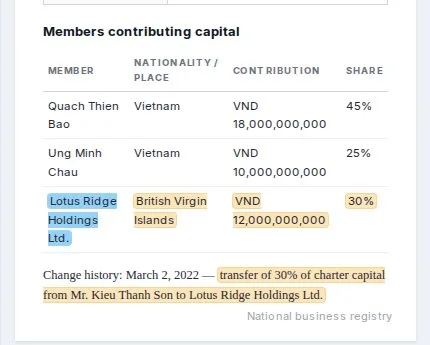
The extract names Lotus Ridge Holdings Ltd., British Virgin Islands, as a 30% member since March 2022.
National registryFirst pull
3The offshore company's records
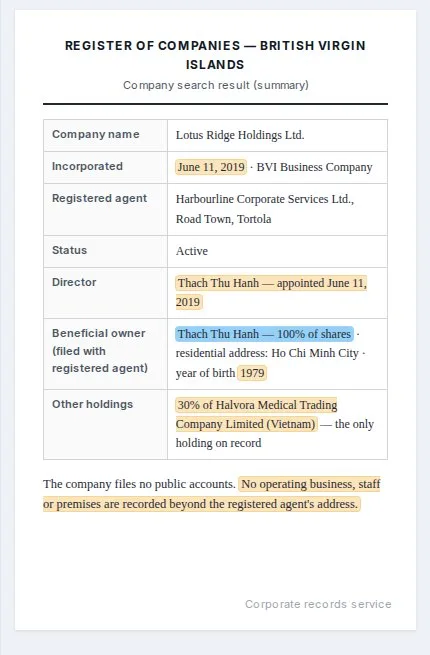
Thach Thu Hanh holds 100% of Lotus Ridge.
Records service or the firmSecond pull
4The PEP record
She matches on name, birth year and city: spouse of a deputy provincial health director on the tender board.
PEP databaseThird pull
Fictional example from this guide
Show the numbers
Step
What happens
Who
Time
The questionnaire
Answer 3.1 says "other investors 30%" with no names.
The firm
Day 0
The local registry
The extract names Lotus Ridge Holdings Ltd., British Virgin Islands, as a 30% member since March 2022.
National registry
First pull
The offshore company's records
Thach Thu Hanh holds 100% of Lotus Ridge.
Records service or the firm
Second pull
The PEP record
She matches on name, birth year and city: spouse of a deputy provincial health director on the tender board.
PEP database
Third pull
Multiplying down the chain: how 60% of a 30% owner comes to 18%
Regulation (EU) 2024/1624, which applies from July 10, 2027, sets out the method for indirect holdings in its recitals: multiply the shares in the ownership chain, then add together everything the same person holds.28 In the example, Thach Thu Hanh owns 100% of a company that owns 30%, so her share is 100% × 30% = 30%.
Now change one fact (illustrative): if she held 60% of Lotus Ridge, her share would be 60% × 30% = 18%. No 25% register would need to name her. A policy set at 10% would still want her name, so you would have to ask for it and verify it another way.
Three common ownership lines answer three different questions
An owner below a legal line can still matter to a bribery review
Example policy: trace any owner of this muchcompany choice10%
EU and Vietnam: beneficial owner in generalUK: more than 25%25%
OFAC: blocked persons own this much, added togetherthen the firm is blocked50%
Our reading of the sources28,18,29,30 · No anti-bribery law sets an ownership threshold. A family member's 5% can matter if the family holds the rest; Vietnam's decree counts family members who together reach 25%.
Show the numbers
Item
Value
Example policy: trace any owner of this much
10%
EU and Vietnam: beneficial owner in general
25%
OFAC: blocked persons own this much, added together
50%
Who can read the owner of a company in five places, as of November 2026
Place
Rule
Can you read it?
What it means for you
United States
FinCEN final rule, effective August 14, 2026. It makes permanent the exemption of US companies first made by an interim rule in March 2025. Companies formed abroad and registered to do business in a US state or Tribal jurisdiction still report.3
No public register, and no filing for US companies.
Ask the firm, and verify through state filings, licenses and investigators.
United Kingdom
People with significant control: more than 25% of shares or votes.29
Shown on the Companies House register, with limited exceptions.
A strong starting point, and it stops at 25%.
European Union
Directive 2024/1640: public access only on a demonstrated legitimate interest, with national laws due by July 10, 2026. Regulation 2024/1624, which applies from July 10, 2027: 25% or more in general.17,28
Case by case. Practice varies by member state while national rules settle.
Plan for an application and a wait. State your purpose.
British Virgin Islands
Register not public. Legitimate interest access since April 1, 2026, tied to money laundering purposes or BVI anti-money-laundering duties. US$75. Shows owners of 25% or more: name, month and year of birth, nationality and nature of interest. Owners can seek an exemption.2,31
Only if you qualify. The sources read do not say that a company vetting a distributor does.
Ask the firm for certified company records from its corporate services provider. Refusal is a red flag.
Vietnam
Law 76/2025/QH15 and Decree 168/2025 from July 1, 2025: list filed at registration, 25%. Decree 296/2026 of July 23, 2026 adds three tiers: ownership, then control, then senior manager, looking through every layer.32,18
The law firm notes read do not address access by a private company.
Ask for the firm's own filed list, and compare it with the registry extract.
The UK and EU rows come from primary text. The British Virgin Islands and Vietnam rows rest on law firm notes, and we did not read the decrees themselves. Those firms say their notes are not legal advice, so check with local counsel before you rely on any of them.
When the trail stops. Nominee shareholders (people holding shares in their name for someone else), a trust, a refusal to answer: the honest result is "owner unknown", and it belongs in the file as a finding. Reluctance to disclose ownership is on standard red flag lists.10 Writing "no issue found" where the truth is "could not determine" is one of the most damaging errors a review can make, because it hides the risk from the person who signs.
06 · Tiers and scoring
How a third-party risk score works: six factors, worked through from 62 to 82
In shortMost programs score a few weighted factors and add rules that force a tier whatever the sum. No regulator prescribes the factors or the weights, so yours must be written down, approved and applied the same way each time. The example shows why the input matters: the same firm scores 62 as declared and 82 as traced, and a single fact, a family link to an official, forces High by itself.
UK guidance groups bribery risk into country, sector, transaction, business opportunity and business partnership.8 A common scorecard turns those groups into factors, each rated 0 to 4 and weighted to total 100. In the example, the points for each factor are its level ÷ 4 × its weight. Country risk is level 3 of 4 at a weight of 20, so 3 ÷ 4 × 20 = 15. One factor, adverse media, means news and court records of possible misconduct.
Three factors move when the owners are traced, taking the example from 62 to 82
Points by factor, as declared and as traced. Sum: 61.5, shown as 62, and 82
As declaredAs traced
Country risk (of 20)15 points15 points
Government touchpoint (of 22)16.5 points22 points
Compensation (of 20)20 points20 points
Ownership transparency (of 20)10 points20 points
Adverse media (of 10)0 points5 points
Sanctions (of 8)0 points0 points
Fictional example from this guide
Show the numbers
As declared
As traced
Country risk (of 20)
15 points
15 points
Government touchpoint (of 22)
16.5 points
22 points
Compensation (of 20)
20 points
20 points
Ownership transparency (of 20)
10 points
20 points
Adverse media (of 10)
0 points
5 points
Sanctions (of 8)
0 points
0 points
What the sum hides: why scorecards need forcing rules
A weighted score lets a good result in one place offset a bad one elsewhere. Sanctions at zero pulls the example's total down, though it says nothing about the tender board. So programs add forcing rules on top. In the example, any government link makes a third party High, and a true sanctions match blocks onboarding on its own.
Write these down as carefully as the weights. Without the government-link rule, a firm with such a link at 69 would get a lighter review than a firm with no link at 70.
Country risk: a useful input with a known weakness
Many programs start from Transparency International's Corruption Perceptions Index, which scores perceived public sector corruption from 0 (highly corrupt) to 100 (very clean). The 2025 edition covers 182 countries, and the global average fell to 42.33 It measures perception by experts and business people. It says nothing about your partner. Many teams pair it with their own view of where they have seen problems.
Twelve of these fifteen markets on the example's register score below the global average of 42
Corruption Perceptions Index 2025, lower means more perceived corruption
Mexico27
Egypt30
Kenya30
Türkiye31
Philippines32
Indonesia34
Brazil35
Argentina36
Colombia37
India39
Morocco39
Vietnam41
China43
Romania45
Saudi Arabia57
Source33 · Vietnam, highlighted, scores 41: one point below the average, and above the 40 that one law firm's checklist uses for a high-risk market (10). The example's own country list rates it Elevated. Lines like these are company choices.
Show the numbers
Item
Value
Mexico
27
Egypt
30
Kenya
30
Türkiye
31
Philippines
32
Indonesia
34
Brazil
35
Argentina
36
Colombia
37
India
39
Morocco
39
Vietnam
41
China
43
Romania
45
Saudi Arabia
57
What each tier usually buys: an example scheme
Tier
Example line
Who decides
What the review includes
Re-review
High
70 and above, or any government link
Third-party risk lead; exceptions and rejections go to the chief compliance officer (CCO)
Enhanced checks, every owner to a person, local-language news, terms against benchmark, legal clauses
Every 12 months
Medium
40 to 69
Analyst
Standard questionnaire, screening, confirmed hits, standard clauses
Every 24 months
Low
Under 40
Clears when screening finds nothing and the questionnaire is complete; an analyst can reopen it
Short questionnaire and screening
Every 36 months
These lines come from the guide's fictional scorecard. Regulators ask for a risk-based approach and name no numbers.4,8
07 · Red flags and money
Reading the deal terms for bribery risk: margins, success fees and offshore accounts, with the sums
In shortBribes need funding, so a good review follows the money. The US Resource Guide lists excessive commissions, unusually large distributor discounts, vague consulting services, partners tied to officials, offshore shells and offshore bank accounts. In the example, the proposed terms pay the distributor about $216,000 a year above the top of the local benchmark, with no service named to justify it. That gap is the question to answer.
The US government's own red flag list, set beside the guide's example
Common red flag, in the words of the US Resource Guide1
Where it shows up in the example
Excessive commissions
A 3% success fee on awarded tender value
Unreasonably large discounts to third-party distributors
An 18% margin against a local benchmark of 8% to 12%
"Consulting agreements" with only vaguely described services
A second case: a scope of "facilitate approvals" with no deliverables
Consultant in a different line of business
Checked and passed: registered business lines match the service
Related to or closely associated with the foreign official
The 30% owner's husband sits on the tender board
Became part of the transaction at the official's request
Not seen here. Ask who suggested this partner
Merely a shell company incorporated offshore
Lotus Ridge: no accounts, staff or premises beyond a corporate services address
Requests payment to offshore bank accounts
A Singapore account for a Vietnamese distributor, "for currency reasons"
No single source catches every red flag, and the questionnaire alone misses the worst
Which evidence finds which red flag
Not usedSupportsMain source
QuestionnaireRegistryPEP and listsNews and courtsTerms and policyHidden ownerSupportsMain sourceNot usedNot usedNot usedFamily link to an officialSupportsSupportsMain sourceSupportsNot usedShell companyNot usedMain sourceNot usedSupportsNot usedMargin above benchmarkNot usedNot usedNot usedNot usedMain sourceSuccess feeNot usedNot usedNot usedNot usedMain sourceOffshore accountMain sourceNot usedNot usedNot usedMain sourceVague servicesSupportsNot usedNot usedNot usedMain sourcePast inquiry or caseSupportsNot usedNot usedMain sourceNot used
Our reading of the sources1,4 · Our classification. A questionnaire can disclose any of these if the firm is candid; the point of the checks is the firm that is not.
Show the numbers
Questionnaire
Registry
PEP and lists
News and courts
Terms and policy
Hidden owner
Supports
Main source
Not used
Not used
Not used
Family link to an official
Supports
Supports
Main source
Supports
Not used
Shell company
Not used
Main source
Not used
Supports
Not used
Margin above benchmark
Not used
Not used
Not used
Not used
Main source
Success fee
Not used
Not used
Not used
Not used
Main source
Offshore account
Main source
Not used
Not used
Not used
Main source
Vague services
Supports
Not used
Not used
Not used
Main source
Past inquiry or case
Supports
Not used
Not used
Main source
Not used
What the 3% and the 18% come to, worked through
The proposed distribution deal in the example is worth $2.4 million a year. An 18% margin pays 18% × $2,400,000 = $432,000. A 3% success fee on the same value adds $72,000, for $504,000. The top of the benchmark, 12%, pays $288,000. The gap is $504,000 − $288,000 = $216,000 a year, or $648,000 over the draft's three-year term (our arithmetic).
That is money with no stated service behind it. The SEC described the risk in a real case in 2023: special distributor discounts "created a corruption risk that the increased margins could be used to fund improper payments".34
The proposed terms pay $216,000 a year above the top of the local range
Yearly pay to the distributor on $2.4 million of sales
Proposed: 18% margin plus 3% success fee$504K
Top of benchmark: 12%$288K
Middle of benchmark: 10%$240K
Fictional example from this guide
Show the numbers
Item
Value
Proposed: 18% margin plus 3% success fee
$504K
Top of benchmark: 12%
$288K
Middle of benchmark: 10%
$240K
The example applies the 3% to the same $2.4 million. A real tender fee depends on the value awarded. Higher margins can have honest reasons, such as cold chain, remote provinces or real marketing work. The benchmark in the example allows the upper end for these, and a review asks the firm to show the service.
Three more questions to ask about money
Is there a business reason?
DOJ asks whether you know why you need this partner.4 "The only firm registered in all four provinces" is a reason. Ask how that came about, too.
Who holds a discretionary fund?
A marketing fund spent at the distributor's discretion, with no plan or receipts, is money nobody can trace. In the example, it is $120,000 a year.
Who gets paid below the distributor?
Resellers "to be named after signing" means unknown firms selling your product. The DOJ's questions apply to them too.
08 · Screening and news
PEP lists, sanctions and adverse media screening: clearing name hits without clearing the wrong person
In shortScreening compares names with lists, so it throws up name hits: people who only share a name with a list entry. The skill lies in clearing those hits for a stated reason, and in finding the true link the list does not spell out. Local-language news adds what no list holds, and the follow-up article matters as much as the first one. A person confirms each result. No independent study of false positive rates in this work was found.
Three kinds of list, and what each one tells you
Check
What it holds
What a match means
Watch out for
Sanctions lists
Government designations: the US Office of Foreign Assets Control (OFAC), EU, UN and UK
A true match generally blocks the deal. A firm can also be blocked if blocked persons own 50% or more, added together.30
The UK Sanctions List has been the only UK source since January 28, 2026, so old references to the OFSI list, the older UK source, need updating.15
PEP lists
Commercial databases of officials, relatives and close associates
A prompt for more questions and more care. It is no bar by itself.
EU rules recognize risk at regional and municipal level, and siblings can count.28 A national list may miss a provincial tender board.
Adverse media
News, court and regulator records, ideally in the local language
Facts to weigh, including whether they were ever proved.
An allegation is an allegation. Read for the outcome, and keep the original text beside any translation.
Clearing a name hit: same name, different person, stated reason
In the example, two owners produce three hits. Each has a match score, the tool's measure of how closely the entry fits. A false positive is a hit on the wrong person. A match score only orders the work. A person reads the reasons and decides.
Owner
Hit
Score
What the record shows
Proposed result
Quach Thien Bao, 45%
OFAC entry, on his name
0.71
The entry's person was born in 1958, this owner in 1974, and the nationality differs
False positive
Thach Thu Hanh, 30%
EU entry
0.66
Born 1962 against 1979, a different person
False positive
Thach Thu Hanh, 30%
PEP record
0.93
Full name, birth year and city agree. National ID is unavailable, and the record says so
True match
In the example, 214 articles narrow to two that matter
Adverse media for one distributor and its owners, Vietnamese and English
Articles found214
Relevant after namesakes are set aside2
Fictional example from this guide
Show the numbers
Stage
Articles
Articles found
214
Relevant after namesakes are set aside
2
Why the second article counts: an inquiry and its outcome
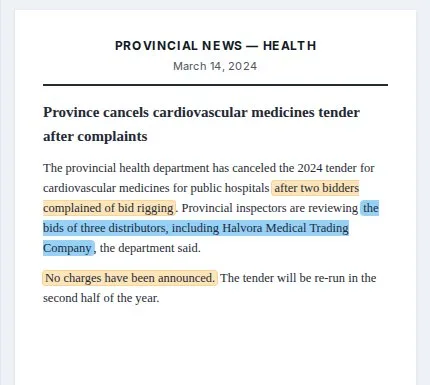
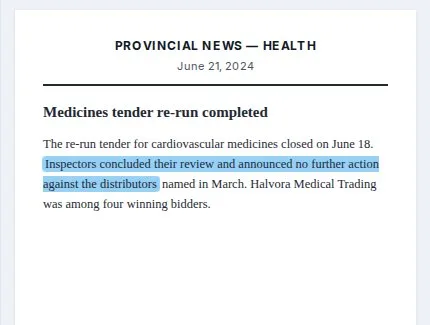
The first of those two articles, from March 2024, says a province canceled a cardiovascular medicines tender after bid-rigging complaints and that inspectors were reviewing three distributors, Halvora among them. The second, from June 2024, says inspectors closed the review with no further action, and that Halvora won in the re-run.
A reader who stops at March overstates the risk. A reader who never finds March misses something else: the firm answered "No" when asked whether it had been named in an inquiry in the last five years. The review closed cleanly, and the answer was still wrong.
How often are hits false? Vendors often say 90% or higher, usually with no study behind the figure.35 We found no independent measure for third-party screening. Count your own: hits per review, share cleared, and how many cleared hits a second reviewer would reopen.
09 · What has gone wrong
Five life sciences cases where distributors and intermediaries became the problem, and what each one teaches
In shortThese public resolutions cost from about $30 million to $519 million, and they keep showing the same few patterns: a partner owned by or tied to an official, margins that could fund payments, and warning signs nobody acted on. One company kept using a distributor already known to have paid bribes. Each case below names its outcome: a deferred prosecution agreement, a non-prosecution agreement, a guilty plea or an SEC settlement.
Five life sciences FCPA resolutions involving third parties range from $30.5 million to $519 million
Total agreed with US authorities, as reported
Teva Pharmaceutical, 2016$519M
Novartis and affiliates, 2020, about$347M
Fresenius Medical Care, 2019, about$231M
Philips, 2023, about$62.2M
Zimmer Biomet, 2017$30.5M
Source36,37,38,39,40,34,41 · Novartis is our sum: $112.8 million to the SEC plus $233.9 million in criminal fines. Philips, highlighted, is a books-and-records and controls case with no bribery charge.
Show the numbers
Item
Value
Teva Pharmaceutical, 2016
$519M
Novartis and affiliates, 2020, about
$347M
Fresenius Medical Care, 2019, about
$231M
Philips, 2023, about
$62.2M
Zimmer Biomet, 2017
$30.5M
Four terms these enforcement records use
Deferred prosecution agreement
DOJ files a charge in court and asks to postpone the case while the company shows good conduct. The company generally pays a penalty, cooperates and admits the relevant facts.1
Non-prosecution agreement
DOJ keeps the right to file charges and holds off during the term. Nothing is filed with a court, and the requirements are similar.1
Books-and-records charge
The FCPA has accounting provisions on accurate records and internal controls. A charge under them is separate from a charge of bribery.1
Disgorgement and monitor
Disgorgement takes back profit from the misconduct. A monitor is an independent third party who assesses and monitors whether the company keeps to the compliance terms of its agreement.1
Five public resolutions, and the lesson each one holds for a review
Case
What the source reports
The lesson for a review
Zimmer Biomet, Brazil, January 2017
A three-year deferred prosecution agreement on an internal controls charge, after Biomet breached a 2012 one; a guilty plea by a subsidiary on a books-and-records charge; and an SEC settlement. About $30.5 million in all, with an independent monitor.41,42 DOJ says Biomet, which Zimmer acquired in 2015, used "a distributor in Brazil whom Biomet knew had previously paid bribes on its behalf".43 DOJ moved to dismiss the deferred charge in February 2021.42
Keep a list of partners that failed or were terminated, and check against it. DOJ asks about this directly.4
Philips, China, May 2023
An SEC settlement on books-and-records and internal controls charges, about $62.2 million, without admitting or denying the findings. The SEC said special discounts to distributors "created a corruption risk", and it alleged efforts to influence hospital officials on specifications and false complementary bids. The company said DOJ closed its own inquiry with no charges.34
Discounts and margins are control questions in their own right. This case had no bribery charge.
Novartis and a former subsidiary, June 2020
Two deferred prosecution agreements with admitted facts. Novartis Hellas, $225 million, over staff of state-owned hospitals and clinics in Greece.37 Alcon Pte Ltd, about $8.9 million, on a books-and-records charge, over a Vietnamese distributor's "consultancy program" of payments to providers, including staff of state hospitals.38 A separate SEC settlement of $112.8 million, with three years of self-reporting, also covered South Korea, per one news report.39
A consulting program can carry the payment, and a clean headquarters policy does not reach a distributor by itself.
Teva, Russia, December 2016
A three-year deferred prosecution agreement with admitted facts, a guilty plea agreement for the Russian subsidiary, an SEC settlement and an independent monitor. DOJ says a Russian distributor and repackager was "owned, controlled and managed" by a high-ranking official able to influence Ministry of Health purchases, with its controlling shares in his spouse's name, and that payments ran through its high margins. A $283.2 million penalty and $236.1 million in disgorgement and interest.36,44
This is the ownership question at its plainest: who stands behind the firm you pay, whoever's name is on the shares.
Fresenius Medical Care, Angola and Saudi Arabia, 2019
A non-prosecution agreement in which the company admitted the facts: payments to publicly employed health officials, including joint venture shares offered in Angola and payments through a Saudi distributor. An $84.7 million penalty and $147 million in disgorgement and interest to the SEC, about $231 million, with an independent monitor. DOJ lists the agreement as concluded on March 1, 2023.40
Doctors on a public payroll can be officials. Shares count as well as cash, so look at equity held by people connected to officials.
We read the Teva, Fresenius, Novartis and Zimmer Biomet rows in the agreements and court filings DOJ publishes. We could not open sec.gov, so we did not read the SEC's orders: its amounts come from those documents or the cited reports, and the Philips row from a law firm's account of its order. These are public enforcement records, cited as such, and each states what its record says. They are separate from the fictional example, whose companies and people are invented.
Six everyday errors that lead a distributor review astray
The tier comes first
A first-look tier hardens into the final one because tracing finishes late, or never.
Answers filed unread
"Subject to discussion" and "after signing" pass a check that only looks for a filled-in box.
A translation with no original
A summary in English drops the sentence that mattered, and nobody can check it.
Conditions that stop at the memo
The approval says "cap the margin at 12%". The contract says 18%, and the invoices are paid at 18%.
A single point in time
The owner changes a year later. Nobody hears, because the check ended at signing.
No trail of the reasoning
The decision stands, and three years on nobody can show what was known or why it was accepted.
10 · After the decision
Keeping a distributor approval honest: conditions in the contract, monitoring, and what records to keep
In shortA condition only works if it reaches the contract and then the payment run. Prosecutors ask whether you manage third-party risk through the whole relationship, whether you have audit rights, and whether you have ever used them. Records raise their own questions: how long to keep them, and how to hold personal data about owners, relatives and news reports lawfully in several countries at once.
In the example, five steps carry the approval from signature to its next re-review
1Clauses approved
Legal counsel turns each condition into contract language.
Legal counselAfter the decision
2Conditions met
The firm signs the recusal or sells the stake, and corrects its questionnaire.
Country manager, the firmBefore signing
3Contract and release
Procurement releases the vendor only after the contract is signed.
ProcurementAt signing
4Watched each day
List checks, registry changes and invoices against the 12% cap.
Risk teamDaily
5Full re-review
High tier comes back after 12 months: October 7, 2027.
Risk lead12 months
Fictional example from this guide
Show the numbers
Step
What happens
Who
Time
Clauses approved
Legal counsel turns each condition into contract language.
Legal counsel
After the decision
Conditions met
The firm signs the recusal or sells the stake, and corrects its questionnaire.
Country manager, the firm
Before signing
Contract and release
Procurement releases the vendor only after the contract is signed.
Procurement
At signing
Watched each day
List checks, registry changes and invoices against the 12% cap.
Risk team
Daily
Full re-review
High tier comes back after 12 months: October 7, 2027.
Risk lead
12 months
How each red flag in the example becomes a contract clause and a control after signing
Red flag in the example
Contract clause
Control after signing
Owner linked to a tender board
Written recusal by the owner and confirmation of the official's recusal (stepping out of any decision that touches the firm), or sale of the stake before signing
Tender and owner monitoring; re-review on any registry change
Success fee and high margin
No fee tied to an award; margin capped at 12%; marketing only against a plan with receipts
Each invoice compared with the cap
Offshore account
Pay only to an account in the firm's name in the country of service
A bank detail change triggers a check in the payment system
Audit rights "subject to discussion"
Audit rights over books and records
An audit plan, and a record of audits done
False or incomplete answers
Anti-bribery clause with termination for breach; corrected questionnaire; annual certification
Certifications tracked, and reminders sent
Unnamed resellers
No sub-distributor without prior approval
Each reseller gets its own review
The questions DOJ asks about the relationship after signing
"Throughout the lifespan"
DOJ asks whether risk management runs across the relationship, or "primarily during the onboarding process".4
Audit rights, used
The question goes past having the right: "has the company exercised those rights in the past?"4
Red flags tracked
DOJ asks whether you track red flags and how they are addressed, and whether failed parties stay out.4
Data on vendors
The 2024 text adds how the company uses "available data to evaluate vendor risk" during the relationship.4
Records and personal data: four limits to set with counsel
Question
What the sources say
What to decide
How long to keep records
Sanctions records: at least 10 years under 31 CFR 501.601, amended in 2024.45 US anti-bribery charges: five-year limitations period, with ways to extend it.1
One period by record type, long enough to cover the longest duty that applies to you.
Allegations about individuals
GDPR Article 10: data on criminal convictions and offenses can be processed only under official authority or where law allows it, with safeguards.46
Which adverse media about a person you may store, who reads it and for how long, in each country.
Moving data across borders
Vietnam's Law 91/2025/QH15, in force January 1, 2026, asks for a transfer impact assessment filed within 60 days of the first cross-border transfer, and consent given for each purpose, per a law firm's summary.47
Where owner data lives, which transfer assessment applies, and whether consent is your legal basis.
Fairness to the person named
Our view: a relative of an official has done nothing wrong just by being related.
Plain wording in the file ("spouse of…"), a way to correct errors, and purpose limits.
11 · The trend, and what AI changes
Where FCPA cases cluster, which review steps suit AI, and what regulators expect of it in this work
In shortRecorded matters cluster in large markets that rely on public health systems. AI suits the reading, translating and comparing that eat analyst time, and it can get identity and citations wrong. The good-practice (GxP) quality rules life sciences people know best, such as Part 11 and draft Annex 22, mostly do not govern this work. DOJ's questions on AI do. There is no reliable public figure for the size of this market.
Stanford's count of matters is falling, and those with intermediaries track it closely
FCPA matters initiated per year, all and with an intermediary, 2015 through 2024
China, Brazil, India and Mexico lead the map of FCPA enforcement
Countries where bribes were offered or paid, FCPA enforcement actions, top five
China75
Brazil34
India26
Mexico26
Indonesia24
Source9 · Iraq and Nigeria also sit at 24, and Vietnam is at 13. Data through July 30, 2025. A count of enforcement shows where US cases arose, which is a different thing from where bribery is most common.
Show the numbers
Item
Value
China
75
Brazil
34
India
26
Mexico
26
Indonesia
24
Where AI helps in a third-party review, and where a person must stay
Automate the reading first; keep identity and decisions with people
Harm if it is wrong →
Prepare, then decide
Automate, then review
Leave manual
Automate
Reading answersTranslating newsPulling recordsComparing termsClearing a name hitSetting the final tierApproving the partner
Time it takes by hand →
Our reading of the sources4 · Our judgment. Your own risk view may differ.
Show the numbers
Item
Time it takes by hand (0–1)
Harm if it is wrong (0–1)
Reading answers
0.78
0.05
Translating news
0.78
0.29
Pulling records
0.78
0.17
Comparing terms
0.10
0.28
Clearing a name hit
0.55
0.66
Setting the final tier
0.10
0.72
Approving the partner
0.10
0.56
What DOJ, FDA and the EU say about AI in an anti-bribery review
Source
Status
Does it apply here?
DOJ's compliance evaluation guide
September 2024
Yes. It asks how AI risks are managed, whether a "baseline of human decision-making" exists, and how accuracy is tested.4
FDA AI draft guidance
January 2025, draft
No. It covers AI that supports regulatory decisions on drugs and biologics; operational efficiencies are outside its scope.48
EU AI Act
Annex III, the Act's list of high-risk uses: rules apply from December 2, 2027, after the AI Omnibus regulation moved the date.49
Scoring a company is not on the Annex III list. Our reading, and a tool that profiles individuals may need a closer look with counsel.
21 CFR Part 11
FDA scope guidance, 2003
Scoped to records under FDA's predicate rules (the FDA requirements that call for the record), which a commercial anti-bribery file generally is not.50 Signatures with a stated meaning are still sound practice.
FDA Computer Software Assurance
Final, February 2026
No. Its scope is computers and automated data processing in device production or quality systems.51
Draft EU GMP Annex 22
Draft, consultation closed October 7, 2025; EudraLex Volume 4, the EU's GMP rulebook, lists no Annex 22 on November 3, 2026.52
No. It concerns critical uses in good manufacturing practice (GMP), and restricts large language models there.53
The specific AI risks here. A language model can state a link between two people that no record supports, or merge two people who share a name. In a file about a named family, that error can harm someone and mislead whoever signs. So look for three protections in any tool: every link cites a record, unknowns are reported as unknown, and a named person confirms identity matches.
12 · How teams review today
How compliance teams run a distributor review today: who does what, and where 24 days go
In shortA country manager asks, an analyst or risk lead investigates, legal writes the clauses, and procurement releases the vendor. We found no published study of how long this takes; the estimate below puts a High review at about 24 days, and most of that time goes to waiting on the firm and tracing owners. Teams mix in-house work, outside investigators and third-party risk software, and most use more than one.
Country manager to chief compliance officer: who touches one distributor review
GM
Business sponsor
Often a country manager. Requests the partner, gives the business reason and supplies the draft terms.
Cares about: the tender date.
AN
Third-party risk analyst
Runs Medium and Low reviews, chases questionnaires and clears name hits.
Cares about: not spending the day on people born twenty years earlier.
RL
Third-party risk lead
Decides High reviews, owns the method and signs.
Cares about: seeing who stands behind the firm, with evidence.
LC
Legal counsel
Turns conditions into contract language and advises on law by country.
Cares about: conditions written as clauses, in time.
CCO
Chief compliance officer
Owns the program, decides exceptions and rejections, and reports to the board's committee.
Cares about: any red flag left open having a name on it.
PR
Procurement and finance
Release the vendor in the payment system, hold bank details and pay invoices.
Cares about: one clear signal that the vendor may be paid, and under what caps.
From request to a released vendor, with the hand-offs
Six stages and their hand-offs separate a business request from a released vendor
Waiting on the firm and tracing owners take half of a High review's days
An estimate for one High review by hand: 24 days
Waiting on the questionnaireReading questionnaire and termsTracing ownersScreening, name hits and local newsReport, conditions, decision
Days by hand6 days6 days6 days4 days
Illustrative · replace with your own numbers · No public figure exists. This is an estimated split for the guide's example, for you to replace with your own.
Show the numbers
Waiting on the questionnaire
Reading questionnaire and terms
Tracing owners
Screening, name hits and local news
Report, conditions, decision
Days by hand
6 days
2 days
6 days
6 days
4 days
Three ways teams staff these reviews, and what each one trades
Way
Good for
Where it falls short
In house, with spreadsheets and data subscriptions
Low volume, known markets, a team that knows the policy
Local-language reading, and evidence scattered across email and slides
Outside investigators for enhanced reports
Source inquiries and local knowledge a database cannot reach
Cost and turnaround per subject, so usually kept for the top tier. No reliable public price list was found
Third-party risk software
Questionnaire tracking, list screening, a register, renewals
Many tools store the workflow and still leave tracing and reading to people, so check what a tool actually does on your own hard cases
Part B · See it working
Botminds Third-Party Due Diligence on one distributor, from returned questionnaire to a signed approval with conditions
Part A described the work without naming a product. This part shows how Botminds does it, for a fictional drug company, Cobbleford Pharma, and a fictional distributor, Halvora Medical Trading. Every company, person, official, product, number and document in the screens is sample data. Software agents, each with one job, read, trace, screen and draft; people confirm and decide.
13 · One distributor, traced
October 7: Halvora's anonymous 30% becomes a company, then a person, then a tender board link, and the tier moves
In shortThis is the example from the top of the page, inside the product. Dana Okafor, the third-party risk lead, opens a questionnaire that scores 62, Medium. She traces ownership. Records show a British Virgin Islands company, its owner and that owner's husband on the tender board. The score reaches 82, and a rule makes the firm High. Each box opens the record it came from.
1
The review opens on what Halvora declared, and says so
Minh Tran, General Manager for Vietnam, raised this request on September 29 with draft terms and a reason: Halvora is the only distributor with tender registrations in all four provinces before the November round. The questionnaire went out the next morning in Vietnamese and English, and it came back on October 7 at 6:52 am.
Dana's home screen draws what the answers say: two named owners, "other investors" at 30%, a Singapore account and resellers to be named later. A note makes the status clear: this is only what Halvora declared.
Before the trace. The graph shows only what the firm declared, and the unknown 30% is drawn as unknown.
2
Dana clicks Trace ownership, and the graph grows in view
Each agent's step runs below the graph as it happens. The questionnaire reader turns 62 answers into claims. The ownership tracer reads the registry extract, then the offshore record. The screener runs six subjects against four sanctions lists and the PEP database. The adverse media reader goes through 214 articles in Vietnamese and English.
The risk tier reads "Not set" until the trace is complete, with the As traced bar filling in as each source lands.
The trace in progress. Each step says what it found. Here the tracer has reached Lotus Ridge Holdings, a British Virgin Islands company that took the 30% in March 2022.
3
The finished graph: red paths, a dashed official, and a tier that moved
This is the screen the whole review builds toward. The 30% is Lotus Ridge. Lotus Ridge is 100% owned by Thach Thu Hanh. She is the spouse of Mac Dinh Khoi, a deputy provincial health director and member of the board that approves the tenders Halvora would bid in. Officials are dashed. Red marks the path that matters.
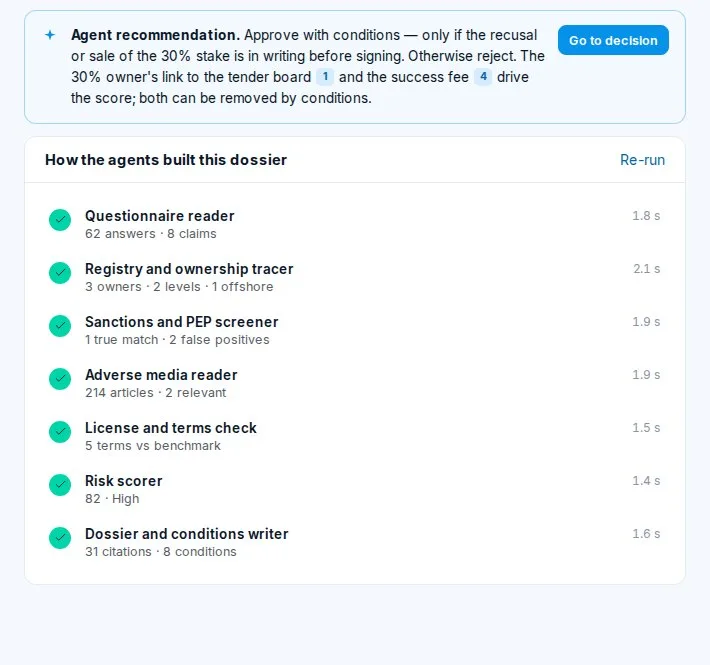
On the right, the score moves from 62 to 82, because three factors changed: government touchpoint +5.5, ownership +10 and adverse media +5. The rule "a government link makes a third party High" fires, and three answers are listed as contradicted by the graph: 3.1, 4.2 and 8.4.
The ownership graph, as traced. Everything in one view: who owns what, who is linked to whom, and how the tier moved.
4
One click flips back to the declared view
The As declared and As traced buttons switch the graph between what the firm said and what the records show. The difference between them is easy to put in front of a committee, a sponsor or the firm itself when it is asked to correct its answers.
The same firm, as declared. The officials and the offshore company disappear from the graph. The risk panel keeps both scores.
5
Every box opens the record behind it
Dana clicks the official's box and reads the PEP record: spouse, role, tender board since 2021, match score 0.93, and the reasons for the match. It also says what did not match: national ID was unavailable. The highlight shows which passage the graph relied on.
The PEP entry is sample data, as is every record here, and the province is never named.
The record behind a box. A sample PEP profile with the exact passages the graph cites highlighted.
14 · The evidence
Inside Halvora's dossier: seven red flags, each answer against the record, and the $216,000 question
In shortThe dossier, the review's written file, holds what a decision needs: the score by factor, seven cited red flags, what passed, each questionnaire answer against the evidence, screening hits to confirm and each term against policy. Agents propose. People confirm. The 31 citations each open a passage, so a reader can check any claim where it stands.
Why the score is 82. Four High, two Medium and one Low red flag on the left, each with numbered citations. Six factors add to 82 out of 100, from scorecard version 4. The recommendation comes with its condition: approve only if the recusal or sale is in writing before signing, otherwise reject.
How the dossier was built. Each step records its output: 214 articles and 2 relevant, one true match and two false positives, 31 citations and 8 conditions.
Owners traced to a person. The same facts as the graph, as a table for the file.
The two ownership records, and a caution about the second one
The registry extract. The national register names the members and shows the March 2, 2022 transfer of 30%.
The offshore record, as the sample shows it. A real public search of the British Virgin Islands register will not name a beneficial owner. That register is closed to the public, and access since April 1, 2026 depends on a legitimate interest.2 In a live review this evidence comes from whichever route you can use: certified records from the firm, a permitted register request or an investigator. If none works, the solution reports the owner as unknown.
Answer by answer against the evidence
The questionnaire, checked. Each answer becomes a claim with a verdict. This tab counts four answers as contradicting the evidence or policy (3.1, 4.2, 8.3 and 9.1) and three as incomplete. Answer 8.4, "No" to any inquiry in five years, sits under incomplete here because the review closed with no action; the graph lists it with the answers the news contradicts.
Hits to confirm. One PEP true match at 0.93, two sanctions name hits proposed as false positives on birth year, and one relevant news item. "Dispositions are suggestions until you confirm them." The screened sources sit below.
The news and its follow-up, side by side
March 2024. A sample article: a tender canceled after complaints, with three distributors' bids under review, and no charges announced.
June 2024. The follow-up: no further action. The solution looks for follow-ups before scoring, so this factor scores 5 of 10.
The term sheet against the benchmark and the policy
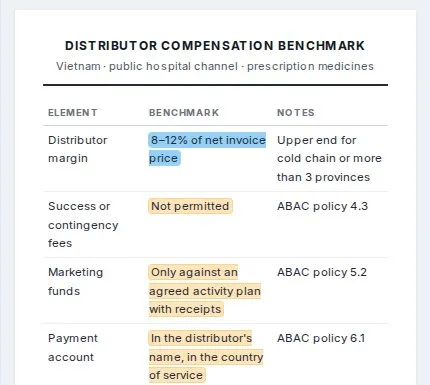
Terms against policy. Margin and success fee outside policy, the marketing fund needs a control, the Singapore account is outside policy, and 60-day payment terms are in range. The bars show the $216,000 a year above the benchmark's top.
The benchmark. Cobbleford's sample fair-market-value table for this channel. You supply your own.
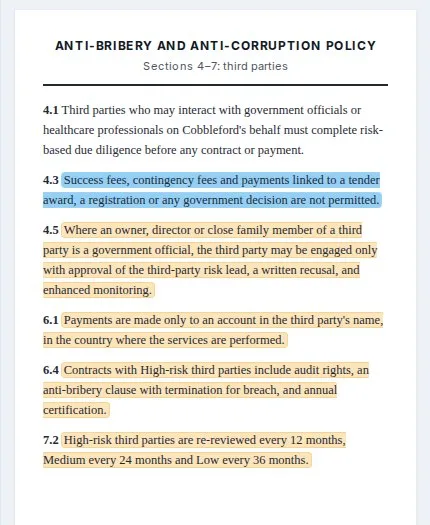
The policy. A company's sample policy, shown as the clause numbers the dossier cites. It is no regulator's text.
Seven red flags on one distributor: four High, two Medium, one Low
7red flags
High: official link, false answers, fee and margin, offshore account4
Medium: audit rights, 2024 tender review2
Low: unnamed resellers1
Fictional example from this guide
Show the numbers
Part
Value
High: official link, false answers, fee and margin, offshore account
4
Medium: audit rights, 2024 tender review
2
Low: unnamed resellers
1
15 · The decision
Approve only with conditions: how each red flag gets a condition, a signature and a contract clause
In shortThe dossier writer maps eight proposed conditions to seven red flags. Dana keeps them all and e-signs with a stated meaning. Clauses go to legal counsel before any contract, procurement releases the vendor only after signature, and Halvora goes on daily monitoring. A red flag left open goes to the chief compliance officer as an exception.
1
Dana chooses: approve with conditions, reject or escalate
The recommendation is plain: "Approve with conditions, only if the recusal or sale of the 30% stake is in writing before signing. Otherwise reject." She can follow it or overrule it. The agent recommends, and the signature stays hers. Rejecting tells the sponsor and records the reason, and escalating sends it to Omar Haddad, the chief compliance officer.
Your decision. Three choices, then conditions, and a line saying who gets what next.
2
Eight conditions, each tied to the flags it answers
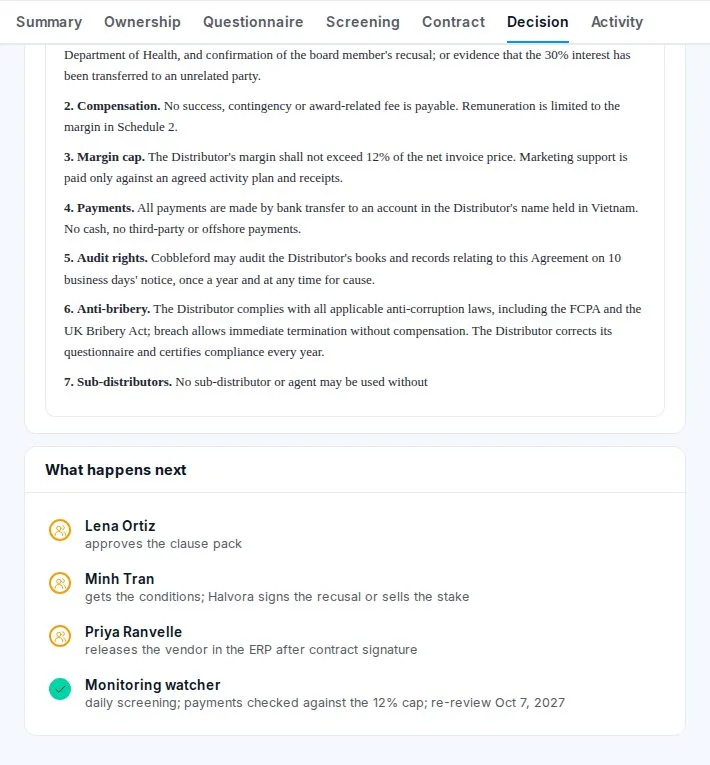
Written recusal or sale of the stake. No success fee. Margin capped at 12%, with the marketing fund only against a plan and receipts. Payment only to Halvora's account in Vietnam. Audit rights. An anti-bribery clause with termination, a corrected questionnaire and yearly certification. The resellers named and reviewed. Quarterly monitoring, with re-review in 12 months.
Conditions mapped to red flags. The bar shows 7 of 7 mitigated, and the tags show which condition answers which flag.
3
Drop a condition, and the screen names the flag left open
Here the payment condition is unticked. No other condition covers the Singapore account, so a warning appears: F4 is not mitigated, and approving with an open red flag goes to Omar Haddad as an exception. If a business reason is strong enough to keep a risk, someone senior puts their name on it. That record answers DOJ's question on how red flags are tracked and addressed.4
An open red flag. The warning names the flag and says who decides next.
4
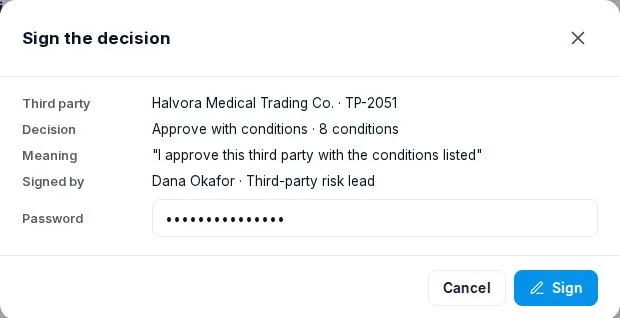
She signs, with the meaning of her signature
Her name, her role, the decision, the number of conditions and the meaning, "I approve this third party with the conditions listed", all sit on one small form, confirmed with her password. The record keeps them with the date and time.
Sign the decision. The meaning is stated before she signs.
5
The conditions become clauses, and the next steps are named
The dossier writer drafts a clause for each condition: conflict of interest, compensation, margin cap, payments, audit rights, anti-bribery, sub-distributors, monitoring. Lena Ortiz, legal counsel, approves them. Minh Tran takes the conditions to Halvora, which signs the recusal or sells the stake. Priya Ranvelle in procurement releases the vendor only after contract signature. The re-review falls due on October 7, 2027.
Signed, with the clause pack. Draft contract language for legal counsel to approve, tied to the conditions.
What happens next. Each next step has a named owner.
Who signs what on a third-party review: four roles and the four-eyes rule
Decides High tierThird-party risk leadE-signs with the meaning. Can approve with conditions, reject or escalate.
Decides Medium and LowThird-party risk analystConfirms screening hits and decides lower tiers. Clean Low reviews clear on a rule you can switch off.
Approves clausesLegal counselReviews the clause pack before any contract on a High-tier review.
Exceptions and rejectionsChief compliance officerDecides any approval with a red flag open, any sponsor override and any rejection. Owns the scorecard.
The four-eyes rule means whoever prepares never approves: agents read, trace and draft; analysts confirm; a named person signs. Scorecard and rule changes take effect only as an approved version, and every agent step and human action stays on the audit trail.
16 · The whole program
Beyond one distributor: the 18-review register, a consultant's success fee, daily monitoring and a dashboard for the committee
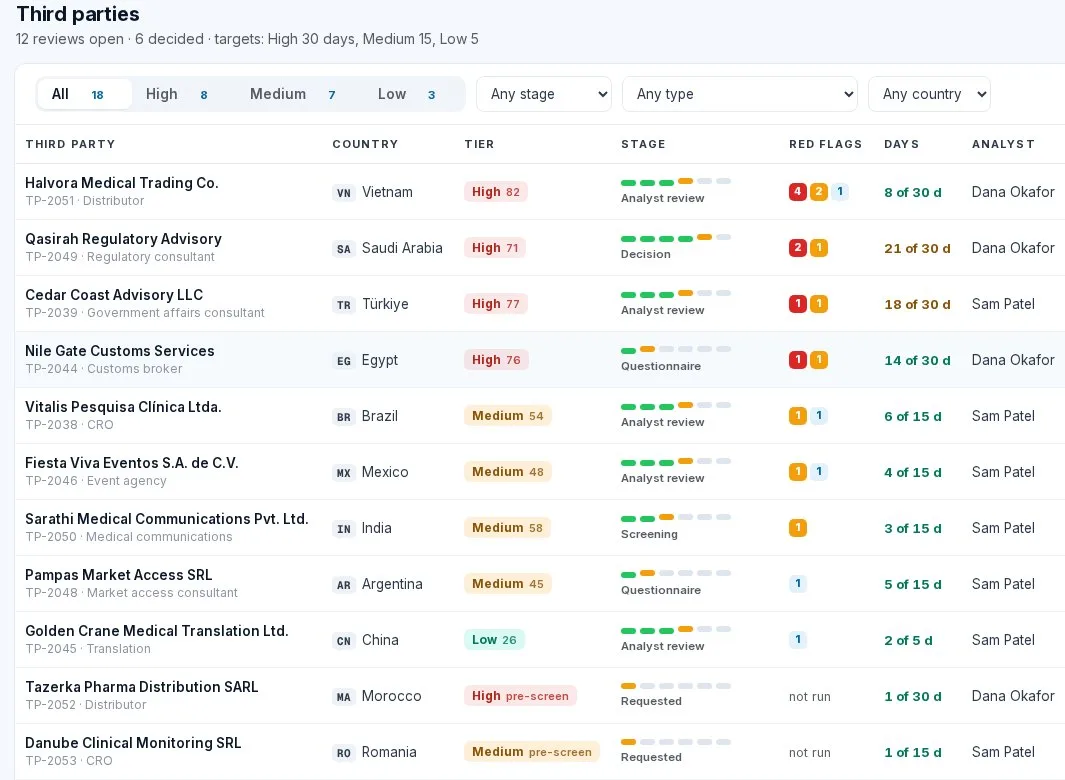
In shortHalvora is one of 18 reviews in the fictional year. The same method handles a Saudi regulatory consultant with a fee tied to approval, a register across 18 countries, 312 parties watched each day, and a dashboard for the compliance committee. Tiers, rules, re-review cycles and approvers are settings you control.
A different kind of third party. Qasirah Regulatory Advisory scores 71. A fee of 150,000 Saudi riyals falls due on registration approval, which makes it a success fee. The founder's brother works in the authority's pricing department, a link the firm disclosed. Its scope says "facilitate approvals" with no deliverables. The recommendation: hourly fees only, written recusal, named deliverables, audit rights.
The register. Twelve open and six decided: tier, stage, red flags, and days against a target that depends on tier. A first-look tier is marked pre-screen, so nobody mistakes it for a finished one.
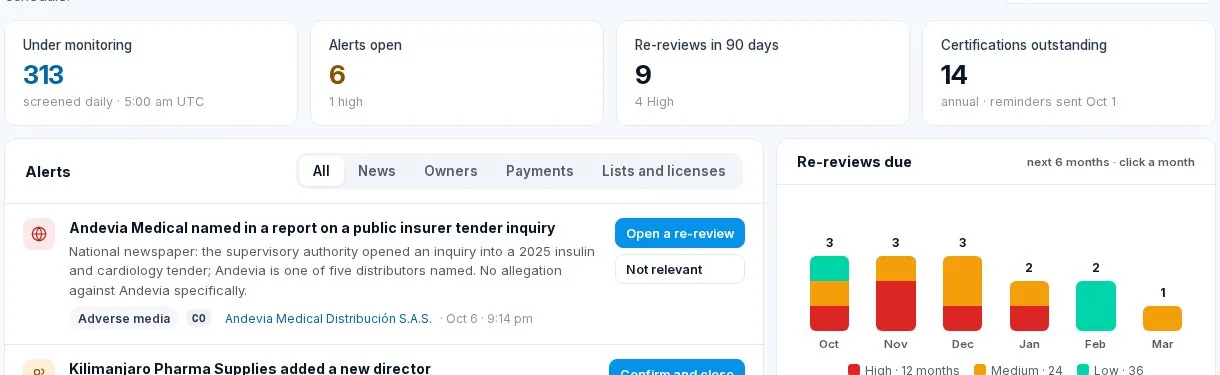
Monitoring. Approved parties are checked each day against list updates and news, with registry changes, license expiry, certifications and invoices alongside. The count reads 313 here because Halvora has just been added.
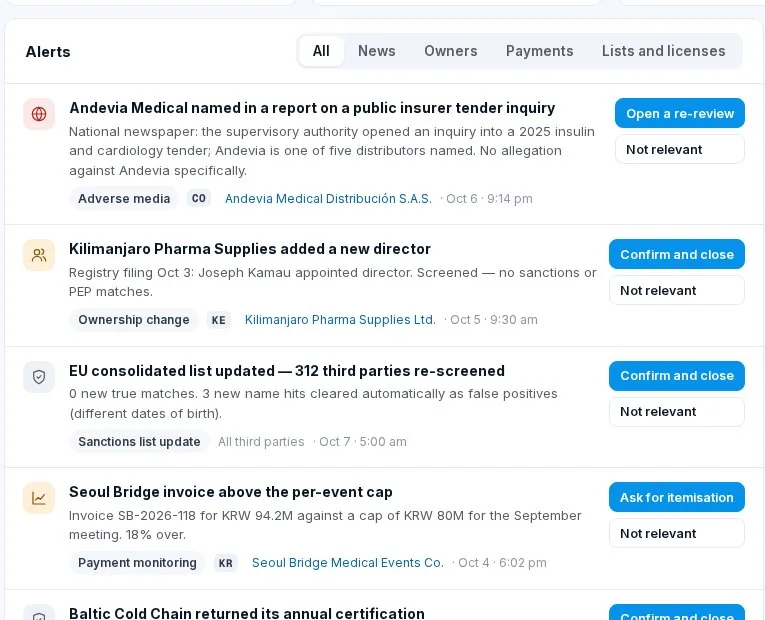
Alerts for a person to close. The first says Andevia is one of five distributors named in a report on an inquiry, "no allegation against Andevia specifically". An invoice 18% above an event cap opens another. The agent opens alerts; a person closes them.
The committee's dashboard, on sample data. Speed, risk found and what was done about it. The 12 days, 3.1 hours and by-hand comparisons are design targets and estimates, shown on sample data, and none is a measured customer result.
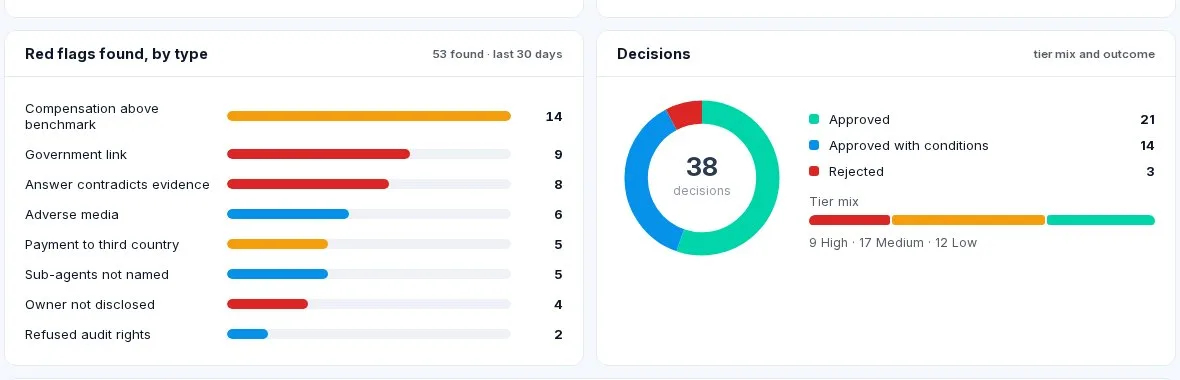
What the reviews found. Red flags by type, and how 38 sample decisions came out.
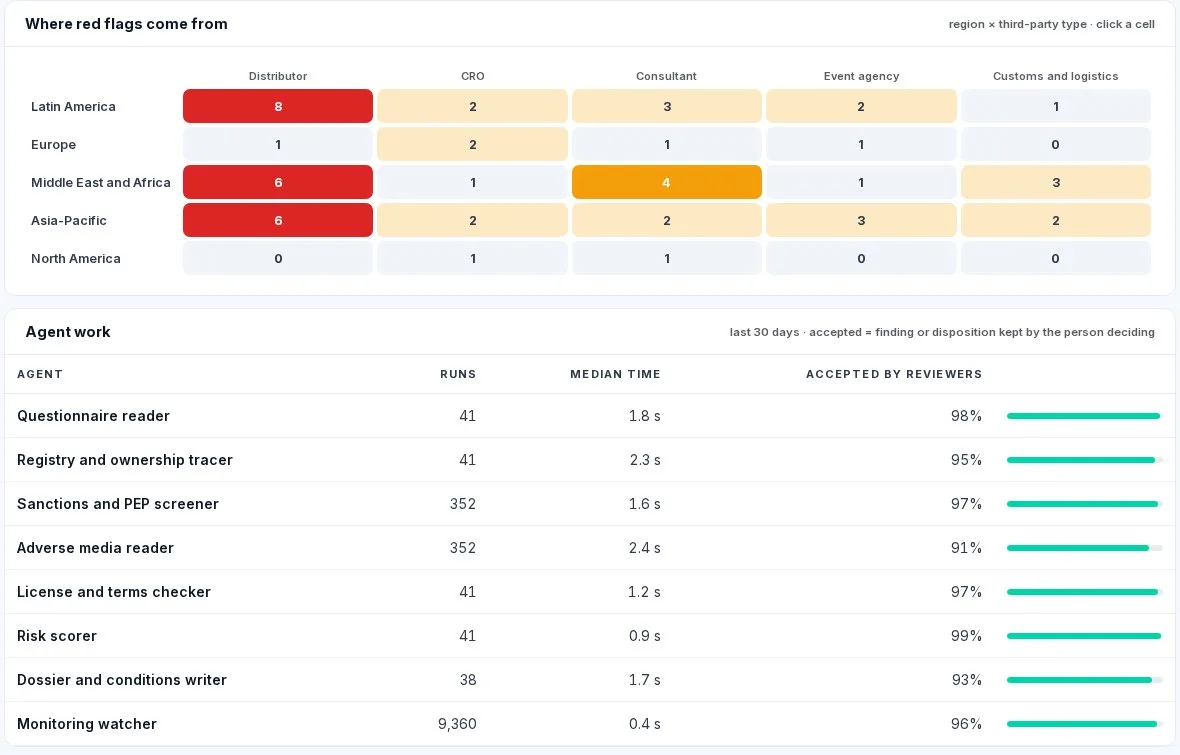
Where red flags come from, and how agents are doing. The heat table shows distributors standing out by region. The table below it shows how often reviewers kept each agent's finding, on sample data.
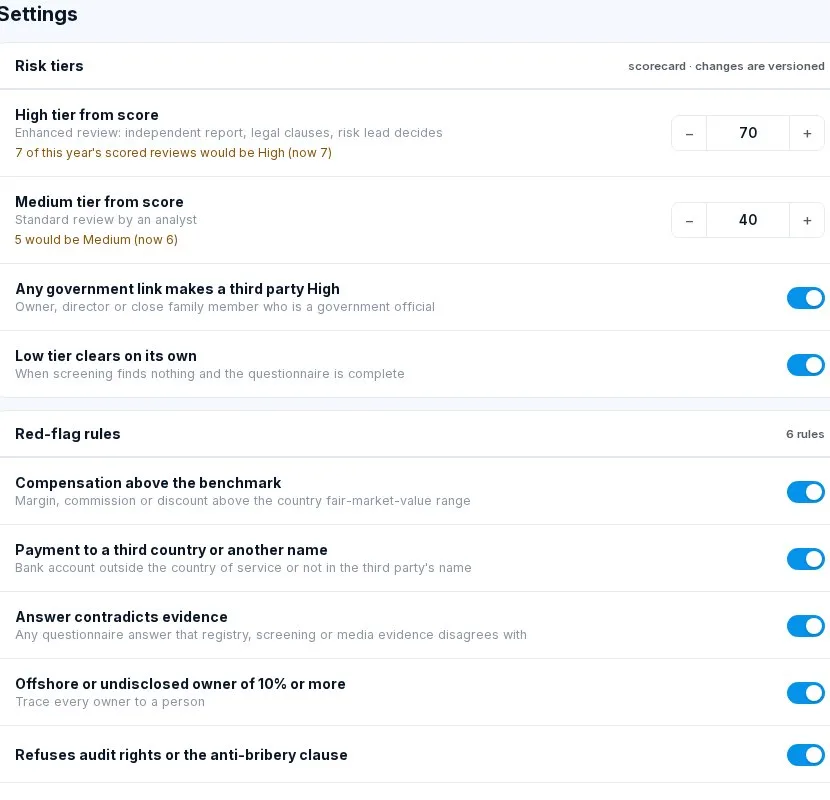
Your rules. Tier lines with a preview of what would move, the government-link rule, Low-tier clearing, and the red-flag rules. Changes are versioned.
On the sample dashboard, compensation above benchmark is the most common red flag
53 red flags in the last 30 days of the fictional year
Compensation above benchmark14
Government link9
Answer contradicts evidence8
Adverse media6
Payment to a third country5
Sub-agents not named5
Owner not disclosed4
Refused audit rights2
Fictional example from this guide
Show the numbers
Item
Value
Compensation above benchmark
14
Government link
9
Answer contradicts evidence
8
Adverse media
6
Payment to a third country
5
Sub-agents not named
5
Owner not disclosed
4
Refused audit rights
2
Fourteen of 38 sample decisions end in approval with conditions, three in rejection
38decisions
Approved21
Approved with conditions14
Rejected3
Fictional example from this guide
Show the numbers
Part
Value
Approved
21
Approved with conditions
14
Rejected
3
17 · Roles and systems
The eight agents behind a review, the records they read, and the design targets to hold them to
In shortEight agents read, trace, screen, compare, score, draft and watch, each with one thing it must never do. A person confirms every disposition, whether a hit is true or false, and decides every tier and approval. The solution works with the questionnaires, registries, screening lists and payment system you already use. Outcome figures here are design targets, measured when the solution runs on your reviews.
Eight third-party review agents, and what each must never do
Questionnaire reader
Reads the returned questionnaire, in any format or language, and turns each answer into a claim to check. Flags evasive answers.
Never fills in an unanswered question.
Ownership tracer
Reads registry extracts and company records, follows every owner of 10% or more to a person, and draws the graph with share, date and source.
Never assumes an unknown owner. It reports one.
Sanctions and PEP screener
Screens the entity, owners, directors and beneficial owners against the OFAC, EU, UK and UN sanctions lists and the PEP and relatives database, with match reasons.
Never confirms a disposition. A person does.
Adverse media reader
Searches news, court and regulator sources in the local language and English, sets aside namesakes, and looks for follow-ups.
Never drops the original language.
License and terms checker
Confirms the license fits the service, and marks each term within range, needing a control or outside policy.
Never estimates a missing term.
Risk scorer
Scores six factors, applies forcing rules and sets the tier from the graph and the answers together, showing every factor.
Never uses an unapproved scorecard.
Dossier and conditions writer
Writes the cited dossier, maps each flag to conditions, recommends a decision and drafts the clause pack.
Never decides, and never leaves a statement uncited.
Monitoring watcher
Re-screens approved parties daily, watches registries, licenses and certifications, and compares invoices with approved caps.
Never closes an alert.
What goes into a review, and what comes out
From the third party and the sponsor
Returned questionnaire, any format or language
Term sheet and business reason
From outside records and your policy
Registry extracts and ownership records
Sanctions and PEP lists
News, court and regulator sources
Compensation benchmarks and anti-bribery policy
Agents read, trace and draftEvery link and red flag cites a record
Unknown owners stay unknown
One person decides
Outputs
Ownership graph, as declared and as traced
Risk tier from the graph and the answers
Cited due diligence dossier
Approval with conditions, e-signed
Clause pack for legal counsel
Re-review schedule and daily monitoring
Systems a third-party review connects to
Supplier portal or emailQuestionnaires out and back
Registries and records servicesExtracts and company records
Screening dataSanctions, PEP, relatives
News, court and regulator sourcesLocal language and English
Contract repositoryTerm sheets and clauses
ERP, your finance and purchasing systemVendor release, invoices against caps
License registersValidity and expiry
Identity and accessRoles, single sign-on, e-signature
100%
of third parties risk-tiered before the contract is signed.
Design target
12 days
median to decide a High review, against a 30-day target. By hand, the solution's estimate is about 24.
Design target; by-hand figure estimated
3.1 hours
of analyst time on a Medium review, against an estimated 9 by hand.
Design target; by-hand figure estimated
Enterprise controls. Roles and four-eyes approval, a full audit trail, versioned rules, personal data kept for its purpose and exportable records, built to support your compliance work. Botminds is SOC 2 Type II audited, and its information security is managed to ISO 27001. No software can make a company "FCPA compliant"; your program does that, and this keeps its evidence.
Part C · Ready to automate?
Should you automate your third-party reviews? The costs, the return, your readiness and how to test it
This part speaks to you, the person deciding. It covers what a missed owner can cost, how to size the return on your own numbers, a scored readiness check, what to ask any vendor, including us, and a pilot you can run on past reviews.
18 · What a miss costs you
What a missed owner and a slow review cost a drug or device company, and how to find your own number
In shortPublished costs are settlements and fines, and they are large and rare. The costs you carry every month are quieter: analyst days, investigator fees, tenders lost to a late approval, and reviews people skip because they take too long. Almost none of this has a public benchmark, so measure it on your own last 20 reviews.
$62.2M
agreed with the SEC in 2023 in a case about distributor discounts in China, with no bribery charge and without admitting or denying the findings.34
Gibson Dunn, on the SEC's order
5%
of worldwide turnover, or €40 million, is the least a top bribery fine must reach under EU national laws due by June 2028.7
Directive (EU) 2026/1021
$2M
per violation is the FCPA's criminal fine for a company on the anti-bribery side, before other sentencing rules and any disgorgement.1
DOJ and SEC Resource Guide
Tracing, screening and reading are where a High review's days can come down; waiting on the firm stays
One High review, by hand and with the solution
By hand, estimatedWith the solution, design estimate
Waiting for the questionnaire6 days6 days
Reading questionnaire and terms2 days0.5 days
Tracing owners6 days0.5 days
Screening, clearing name hits3 days0.5 days
Local news and courts3 days0.5 days
Dossier, conditions, decision4 days3 days
Illustrative · replace with your own numbers · Estimates, from the solution's own design. Replace them with a count from your own reviews.
Show the numbers
By hand, estimated
With the solution, design estimate
Waiting for the questionnaire
6 days
6 days
Reading questionnaire and terms
2 days
0.5 days
Tracing owners
6 days
0.5 days
Screening, clearing name hits
3 days
0.5 days
Local news and courts
3 days
0.5 days
Dossier, conditions, decision
4 days
3 days
Where third-party review costs hide, and how to find your number in a week
Cost
Where it hides
How to find your number
Analyst and lead hours per review
Inside salaries, spread across email, spreadsheets and calls
Ask three people to log time on their next five reviews, split by the steps in section 12
Outside investigator reports
A compliance or legal budget line, paid per subject
Sum last year's invoices and divide by reports, then by tier
Screening and data subscriptions
Several contracts, some held by procurement or finance
List them, with what each is actually used for
Days from request to decision
In the sponsor's calendar, seen only when a tender is missed
Take the dates from your last 20 reviews, by tier, and count the ones past target
Reviews that happened after signing
Contract and vendor systems that nobody compares with the register
Match active vendors to reviews. Count contract dates ahead of decision dates
Money paid above approved terms
In the ERP, because approved caps often live in a PDF
Sample ten High-tier parties, and compare invoices with the approved margin and account
Costs a return calculator leaves out: investigations, monitors, lost tenders and more
An investigationOutside counsel, forensic accountants and senior time, whether or not it ends in a penalty. No reliable public average was found.
A monitorA resolution can require an independent monitor, as three of the five in section 09 did. You pay for it, and it sits inside your business.
A tender you cannot bidA slow review can miss a round, and a rushed one can cost you the market later. Both show up as lost sales, with no line of their own.
Your standing with regulatorsPrior resolutions count as aggravating under DOJ's 2026 policy, within five years or on similar misconduct.16
A person wrongly namedA relative or namesake wrongly tied to an official can suffer harm, and your file can become evidence in the dispute.
Reviews routed around youWhen the process takes too long, the business finds another way to engage the partner, and you learn of it later.
19 · Your return
Sizing the return on faster anti-bribery reviews: four levers and a calculator you fill in
In shortAnalyst hours and investigator fees can be counted. Speed and risk avoided mostly cannot, so leave them out of the sum and describe them separately. Every default below is an assumption. Change them to your own, and treat a result that only works on the optimistic inputs as a reason to run a pilot before you commit.
Four value levers in a third-party risk program
Medium reviews
Analyst hours on the volume tier
Reading, screening and clearing come off the analyst, who keeps the judgment.
Medium reviews × hours saved × hourly cost
High reviews
Lead and analyst hours on the hard tier
Tracing and first drafts come off the team, which keeps the decision.
High reviews × hours saved × hourly cost
Outside reports
Fewer basic reports bought
Keep investigators for source inquiries that need people on the ground.
reports × cost × share replaced
Not counted
Reviews finished before signing
Count how many more reviews finish before the contract is signed. It carries no dollar value here, and it may be the point of the whole exercise.
reviews decided before contract ÷ all reviews
Third-party review return calculator
No source publishes these inputs. Every default is an assumption, marked illustrative, except the 9 and 3.1 hours, which are the solution's estimate and design target.
Your volume and costHours per reviewOutside reports and running cost
Illustrative yearly value
High review hours saved, valued$0
Medium review hours saved, valued$0
Outside reports avoided$0
Yearly value after running cost$0
Hours freed for judgment0
Formulas: High reviews × (hours by hand − hours with automation) × hourly cost; the same for Medium; reports × cost × share replaced ÷ 100; total less running cost. A penalty avoided is not counted. Nothing you enter leaves this page.
Where to start: which third parties pay back first
Start where volume and bribery risk are both high: distributors in public tenders
Illustrative · replace with your own numbers · Replace with your own register counts.
Show the numbers
Item
Reviews a year (0–1)
Bribery risk per review (0–1)
Tender distributors
0.78
0.60
Registration consultants
0.10
0.56
Customs brokers
0.14
0.74
Event firms
0.78
0.28
CROs
0.78
0.12
Translators
0.12
0.20
20 · Readiness check
Is your third-party program ready to automate? Eight scored questions and one to reflect on
In shortPick the answer closest to your team today. Eight questions score 0 to 2, and the last is for reflection. The meter adds up your score as you go, and each question says why it matters and what a strong answer sounds like. A low score points to useful work you can start now.
1
Register of third parties
Do you have one list of active third parties, with owners and tiers?
Why it mattersYou cannot tier what you cannot list, and a vendor you pay but never reviewed is the gap that matters most.
A strong answer"One register, matched to the ERP vendor list each quarter."
2
Written tiering method
Is your scoring written down and approved, with its forcing rules?
Why it mattersSoftware applies the method you give it. A method in one person's head cannot be tested or defended.
A strong answer"Six factors, approved weights, a government-link rule, versioned each year."
3
Questionnaire
Is your questionnaire the same across countries, with numbered questions?
Why it mattersComparing an answer with evidence needs a stable question. Translations need the same numbering.
A strong answer"One numbered form by tier, in the languages we use, returned through a portal."
4
Access to ownership evidence
In your riskiest markets, do you know how you get ownership evidence?
Why it mattersRegisters changed in 2026. A tool can only read what you are able and allowed to get.
A strong answer"Registry data for our top ten countries, and certified records required where no register opens."
5
Compensation benchmarks
Do you hold a margin or fee benchmark for each country and channel?
Why it mattersWithout one, "excessive" is an opinion. DOJ asks whether pay fits the work and the region.
A strong answer"Finance and compliance approve a benchmark each year, for the channels where we use partners."
6
Baseline numbers
Do you know your days and hours per review, by tier?
Why it mattersNo public benchmark exists, so your own count is the only way to prove a change.
A strong answer"High median 24 days, Medium about 9 hours, counted on our last 20."
7
Link to contracts and payments
Do approved conditions reach the contract and the payment system?
Why it mattersA cap that lives in a PDF controls nothing. This is often the largest gap between a review and the money.
A strong answer"No vendor release without a decision, and invoices above the cap stop for review."
8
Owner, privacy and legal sign-off
Is a named person accountable, and have privacy and legal agreed how personal data is used?
Why it mattersFiles about owners and relatives raise privacy duties in each country, and pilots stall without an owner.
A strong answer"The third-party risk lead owns it, and privacy approved purpose, retention and transfers."
9
Every third party, known before signing · for reflection
If you could see the real owners of every partner before any contract, which relationships would you look at again first, and who would need to be in the room?
Why it mattersYour answer shows where the value lies, and which conversations with the business to have early.
A strong answerA short, specific list, for example: "tender distributors in five countries, with each country manager and legal."
0–6
Explore
Build one register, write the tiering method on a page, and trace five High-tier owners by hand. Those three steps improve your program on their own.
7–11
Ready to pilot
Replay 20 past reviews and compare tiers, owners and red flags against what your team found. Then run one country in parallel.
12–16
Ready to implement
Go live on one market and third-party type, with people deciding, then add markets as the measures hold.
21 · Questions for any vendor
What to ask a third-party due diligence vendor about owners, screening, citations and data
In shortBring your hardest past case and watch what happens. These questions test whether a tool reaches a real person, says when it cannot, cites what it claims and leaves decisions with your people. Ask us too. Each question says why it matters and what a strong answer sounds like.
A
Ownership and evidence
A1
Show me how you reach a person behind an offshore company. Where does each link come from, on this file?
Why it mattersRegisters differ, and several are closed. A tool that draws a link has to show its record.
Strong answerEach link opens a dated record, and the source is named by jurisdiction.
A2
What do you show when an owner cannot be found?
Why it matters"Nothing found" and "could not determine" are different statements to the person signing.
Strong answerAn explicit unknown, which raises a red flag and blocks a clean result.
A3
Can I set my own ownership threshold, and handle stakes that add up across family members?
Why it mattersLegal thresholds are often 25%; your policy may be lower, and family holdings can split on purpose.
Strong answerA setting, with chain multiplication and related-party grouping shown on screen.
B
Screening and news
B1
Which lists, updated how often, and what share of your hits do reviewers overturn, measured on whose data?
Why it mattersFalse positive claims are mostly unsourced marketing.35
Strong answerNamed lists, including the UK Sanctions List, with a method you can repeat on your own names.
B2
How do you handle local-language news, and do you keep the original beside the translation?
Why it mattersA reader must be able to check the sentence that mattered.
Strong answerThe original passage sits next to the translation, and follow-ups are searched before scoring.
B3
Who confirms a true match, and what is recorded?
Why it mattersA wrong match harms a real person and contaminates your file.
Strong answerA named person, the reasons for the match, and what was not matched.
C
Scoring, decisions and contracts
C1
Can I see every factor and change the weights, with a preview before they take effect?
Why it mattersA black-box score is hard to defend. DOJ asks whether your approach fits your risks.4
Strong answerYour scorecard, versioned, with a preview of how many reviews would move.
C2
How do conditions reach the contract and the invoice?
Why it mattersA condition that stops at the memo controls nothing.
Strong answerClauses drafted for counsel, with vendor release and caps connected to your ERP.
D
Data, AI and scale
D1
Where does personal data live, how long is it kept, and can I set that by country?
Why it mattersGDPR Article 10, Vietnam's 2026 law and record-keeping duties can pull in different directions.46,47,45
Strong answerRegions and retention by record type, set with your counsel, and written purpose limits.
D2
How do you stop a model inventing a link, and how do you test it?
Why it mattersDOJ asks about accuracy and a human baseline.4
Strong answerNo uncited statement in a dossier, plus measured results on your past files.
D3
What do I get when my auditor asks about one decision three years from now?
Why it mattersYour defense is the record of what you knew at the time.
Strong answerAn export of evidence, tier, conditions, signer and later alerts, in one place, from the scorecard version then in force.
22 · How to start
A 12-week pilot on your own distributors: replay 20 past reviews, then run one country in parallel
In shortStart by replaying past reviews whose outcomes you know, and measure whether the solution finds what your team found and anything it missed. Then run one country live in parallel for six weeks. Your people keep every decision. If the numbers do not hold on your own files, you have learned that cheaply.
Replay first, then run live beside your team, and decide at week 12
Your teamTogether
Baseline 20 past reviews: days, hours, findings
Privacy and legal agree purpose, retention, transfers
Load policy, scorecard, benchmark, questionnaire
Replay the 20 reviews, compare tiers and findings
One country live, in parallel with the team
Measure and decide
Week 024681012
Illustrative · replace with your own numbers
Show the numbers
Activity
From
To
Baseline 20 past reviews: days, hours, findings
0
2
Privacy and legal agree purpose, retention, transfers
0
3
Load policy, scorecard, benchmark, questionnaire
1
4
Replay the 20 reviews, compare tiers and findings
3
6
One country live, in parallel with the team
6
11
Measure and decide
11
12
Eight things to measure in a third-party review pilot
Measure
How
Bar to set before you start
Real owners reached
Compare with what your team established on the 20 replayed reviews
Every known owner found, or reported as unknown
Red flags found and missed
Two senior reviewers score the results blind
No High flag missed that the team had caught
Citations that hold
Open a sample of 50 and read the passage
Every cited passage says what the dossier says
Tier agreement
Compare final tiers, and read each disagreement
Each difference explained by a stated fact
Name hits overturned
Count proposals a person changes
No wrong true match accepted
Days to decision, by tier
Dates in the register, compared with baseline
Your own target, set in week 2
Hours per review
Time logs, compared with baseline
Your own target; the solution's design target is 3.1 hours on a Medium review
Reviews finished before signing
Contract dates against decision dates
All of them in the pilot country
The full working-session questions for your own team: 12 questions in four groups
Bring compliance, legal, procurement, finance, privacy and a country manager into one room.
1
Which partners come first
1
Which third-party types and countries come first, and why?
Why it mattersA narrow start gives clean measures.
Strong answer"Tender distributors in three countries."
2
How do existing partners get re-reviewed: all at once, or at renewal?
Why it mattersA backlog can swamp the first months.
Strong answer"High tier this year, the rest as each comes due."
3
What happens when a sponsor needs an answer before a tender closes?
Why it mattersThis is when reviews get shortened.
Strong answer"An expedited path, with the same checks and a named approver."
2
Where ownership evidence comes from
4
Which registries and data services do you already license?
Why it mattersAvoid paying twice, and learn your gaps.
Strong answerA list by country and purpose.
5
What will you require when a register is closed to you?
Why it matters2026 changed access in several places.
Strong answer"Certified records, or an investigator on High tier."
6
When do you still buy an investigator's report?
Why it mattersSource inquiries reach what no database holds.
Strong answer"When records stop, or a High flag stays unexplained."
3
Your anti-bribery rules
7
Who approves the scorecard and thresholds?
Why it mattersThe tier rests on them.
Strong answer"The CCO, each year, with a preview of what would move."
8
Do you allow success fees at all? In which situations?
Why it mattersThe answer decides how many flags you will raise.
Strong answerA written rule that names award-linked and approval-linked fees.
9
What must happen when a family link is disclosed honestly?
Why it mattersDisclosure is good behavior, and the risk remains.
Strong answer"Recusal in writing, enhanced monitoring, a named approver."
4
Who sees a file, and for how long
10
Who may read a file about an owner's family?
Why it mattersSponsors do not need every detail.
Strong answerRole-based views, with conditions passed on and personal detail held back.
11
How long do you keep each record type, in each country?
Why it mattersOFAC's rule is 10 years for sanctions records; a blanket shorter period may fall short.45
Strong answerA table agreed with counsel.
12
Who tells the partner that a condition was breached, and what happens next?
Why it mattersProsecutors ask about consequences, and whether failed parties stay out.4
Strong answerA named owner, with suspension and termination steps written down.
23 · Questions people ask
Third-party due diligence questions, answered
In shortShort, standalone answers to the questions people most often search, as of November 2026. None of this is legal advice.
What is third-party due diligence?
Third-party due diligence is the set of checks a company runs on an outside firm before and during a relationship, so that the firm does not bring bribery, sanctions or other legal risk with it. It usually covers who owns the firm, any links to officials, the business reason, the pay and past conduct. The result is a risk tier and a documented decision.
What is anti-bribery due diligence on a distributor?
Anti-bribery and anti-corruption (ABAC) due diligence on a distributor checks whether it could pay bribes on your behalf or pass money to officials. You trace its owners to real people, screen them, read local news, and compare its margin, fees and bank account with a benchmark and your policy. High-risk distributors get conditions in the contract and ongoing monitoring.
Does the FCPA require third-party due diligence?
The FCPA does not spell out a due diligence duty, but it reaches payments made through third parties when a company knows, or consciously avoids knowing, that money will reach an official. The US Justice Department's compliance evaluation guide says a well-designed program should apply risk-based due diligence to third parties. In practice, that is what prosecutors look for.
Has the FCPA been repealed or stopped being enforced?
No. An executive order paused enforcement in February 2025 and the US Justice Department issued narrower guidelines on June 9, 2025. The department announced eight FCPA and FCPA-related actions in 2025, according to the law firm Gibson Dunn, and the Securities and Exchange Commission brought none. The statute still stands, and the department was still resolving cases in 2026. Substantive anti-bribery charges generally have a five-year limitations period, and other countries are enforcing their own laws.
What are the red flags for bribery with a third party?
The US Resource Guide lists excessive commissions, unusually large discounts to distributors, vague consulting services, a partner in an unrelated line of business, ties to an official, a partner an official asked for, offshore shell companies and offshore bank accounts. A red flag calls for an answer and proves nothing alone. Record how you resolved each one.
What is a beneficial owner, and what percentage counts?
A beneficial owner is the real person who ultimately owns or controls a company. Many legal rules use 25%, including the EU's general test and Vietnam's, and the UK uses more than 25%. No anti-bribery law sets a threshold, so many companies choose a lower line, such as 10%, for higher-risk partners.
Can I look up who owns a British Virgin Islands company?
Not through a public register. The beneficial ownership register is closed to the public, and since April 1, 2026 access runs through a legitimate interest process tied to anti-money-laundering purposes, per law firm notes. A company vetting a partner usually asks for certified records from the partner itself, and treats a refusal as a red flag.
What is a PEP, and is working with one illegal?
A PEP, or politically exposed person, holds a prominent public role, and checks usually cover relatives and close associates. Working with a PEP or a relative of one is generally lawful. It does call for extra care, such as a written recusal from any decision affecting you, and monitoring.
What is the difference between a sanctions check and due diligence?
A sanctions check compares names with government lists, and a true match generally stops the deal. Due diligence is broader: owners, officials, business reason, pay and conduct. A firm can pass every sanctions list and still be high risk for bribery.
How often should third parties be re-reviewed?
No rule sets a period; the US Justice Department asks whether you manage risk across the whole relationship. A common scheme, used in this guide's example, is every 12 months for High, 24 for Medium and 36 for Low, with screening running in between. Any change of owner or an adverse news item should prompt an earlier look.
What does the UK Bribery Act require for adequate procedures?
Section 7 makes a commercial organization liable if an associated person bribes for its benefit, unless it proves adequate procedures. Ministry of Justice guidance sets six principles, one of which is proportionate, risk-based due diligence. The guidance says an intermediary helping you enter a foreign market will typically need much more checking than a low-risk supplier.
Can AI do third-party due diligence?
AI can read questionnaires, pull and compare records, translate news and draft a dossier, which saves time. It can also link the wrong person or invent a connection, so every claim should cite a record and a named person should confirm identity matches and decide. The US Justice Department asks how companies manage AI risk, test accuracy and keep a human baseline.
Does a good due diligence file protect a company from liability?
It cannot guarantee that. A good file shows what you knew, what you did about it and why, which matters to prosecutors and for the UK's adequate procedures defense. Ignoring what the file says can make things worse, because red flags you saw and left open become evidence of knowledge.
24 · One-page summary
Third-party due diligence on one page: the method, the November 2026 rules and the terms
Print this page
In shortThe whole guide on one screen: the method, the rules as of November 2026, the readiness bands and the terms.
The method
Keep one register of third parties, matched to what you actually pay.
Write the tiering method, its weights and forcing rules on one page, and have them approved.
Treat the questionnaire as claims, and check each one.
Trace every corporate owner to a person. Report unknown owners as a finding.
Screen people and firms, and clear name hits with stated reasons. Read local news, and find the follow-up.
Compare pay and payment routes with a benchmark and your policy.
A named person decides. Each red flag gets a condition, a clause and a control, or an exception with a senior name on it.
Monitor through the relationship, and keep the record of why.
Readiness: score 0–2 on eight questions: 0–6 explore · 7–11 pilot · 12–16 implement.
As of November 2026: FCPA in force, DOJ guidelines June 9, 2025 · DOJ compliance evaluation guide, September 2024 · DOJ enforcement policy, March 10, 2026 · UK Bribery Act section 7; UK failure to prevent fraud, September 1, 2025 · EU Directive 2026/1021, national laws due June 1, 2028 · BVI legitimate interest access, April 1, 2026 · Vietnam Decree 296, July 23, 2026 · FinCEN final rule, August 14, 2026, makes the US company exemption permanent · UK Sanctions List the only UK list since January 28, 2026 · ISO 37001:2025 transition by February 28, 2027.
14 terms
Third party
An outside firm or person acting for you or with you, such as a distributor, consultant, broker or CRO.
Intermediary
A third party that stands between you and a customer or official.
Foreign official
Under the FCPA, includes employees of state-controlled entities, which can include public hospitals.
Beneficial owner
The real person who ultimately owns or controls a company.
Look-through
Following ownership through each company until a person appears.
PEP
Politically exposed person, with relatives and close associates usually checked too.
Adverse media
News, court and regulator items about possible misconduct.
Name hit
A list entry that shares a name, cleared or confirmed on other facts.
Questionnaire
The firm's own signed answers about itself.
Risk tier
Low, Medium or High: how deep the review goes and who decides.
Forcing rule
A fact that sets the tier whatever the score.
Fair market value
What the service is normally worth in that place, used to judge pay.
Success fee
Pay that depends on winning a tender or an approval.
Clause pack
Contract wording that turns conditions into duties.
25 · Sources
Sources
Accessed November 2026. Regulatory status statements are as of November 2026. Where we could read only an excerpt of a source or a law firm's account of it, the entry says so.
U.S. Department of Justice and Securities and Exchange Commission, "A Resource Guide to the U.S. Foreign Corrupt Practices Act", second edition, 2020: instrumentality, pages 20 and 21; third parties and common red flags, pages 22 and 23; penalties and limitations periods. justice.gov
Appleby, "Navigating the New Legitimate Interest Access Regime for BVI Beneficial Ownership Information", April 8, 2026. applebyglobal.com
U.S. Financial Crimes Enforcement Network, Beneficial Ownership Information page, updated August 11, 2026: final rule effective August 14, 2026, making permanent the exemptions of the March 2025 interim final rule. fincen.gov
U.S. Department of Justice, Criminal Division, "Evaluation of Corporate Compliance Programs", updated September 2024: section E on third parties, pages 8 and 9; new technology, pages 3 and 4; data, page 13. justice.gov
Gibson Dunn, "2025 Year-End FCPA Update", January 8, 2026: action counts by period, eight DOJ actions and no SEC action in 2025, Executive Order 14209 of February 10, 2025, non-US enforcement. gibsondunn.com
15 U.S.C. 78dd-1, with its amendment history (latest Pub. L. 105-366, November 10, 1998), read November 3, 2026. law.cornell.edu
Directive (EU) 2026/1021 on combating corruption, Official Journal May 11, 2026: recital 27, Article 3, fines, Article 37 (transposition), Article 39. publications.europa.eu
UK Ministry of Justice, "The Bribery Act 2010: Guidance", Principle 3 and Principle 4 (due diligence), page updated January 22, 2025. gov.uk
Stanford Law School, Foreign Corrupt Practices Act Clearinghouse, Statistics and Analytics: intermediaries, industry and geography charts, database updated through July 30, 2025, read November 3, 2026. fcpa.stanford.edu
Gibson Dunn, webcast slides, "Managing Third Party Risk in a Shifting Regulatory Landscape", February 5, 2026, slides 6, 8 and 25. gibsondunn.com
Global Compliance News, "OECD's Foreign Bribery Report released: three fourths of cases involved intermediaries", December 7, 2014, a law firm's summary of the OECD report. We could not open oecd.org, so the report itself was not read. globalcompliancenews.com
MedTech Europe, Code of Ethical Business Practice, September 2024 edition, Chapter 10: Third Party Intermediaries. medtecheurope.org
Office of the Deputy Attorney General, "Guidelines for Investigations and Enforcement of the Foreign Corrupt Practices Act (FCPA)", June 9, 2025. justice.gov
UK Home Office, guidance on the offence of failure to prevent fraud, Economic Crime and Corporate Transparency Act 2023, in effect September 1, 2025: associated persons, large organizations, due diligence principle. gov.uk
UK government, "The UK Sanctions List", updated October 30, 2026: the only source for UK designations since January 28, 2026. gov.uk
Paul, Weiss, "DOJ Releases First-Ever Department-Wide Corporate Enforcement Policy", March 12, 2026, on the policy of March 10, 2026. paulweiss.com
Directive (EU) 2024/1640 on mechanisms against money laundering: public access to beneficial ownership information on a demonstrated legitimate interest, transposition by July 10, 2026. publications.europa.eu
Duane Morris Vietnam, "Vietnam introduces a new era of corporate transparency: Decree 296", August 6, 2026, on Decree 296/2026/ND-CP of July 23, 2026. duanemorris.com
DQS, "Revision 2025 of ISO 37001": published February 2025, transition by February 28, 2027. Clause 8.2 read only in excerpts of secondary guides. dqsglobal.com
U.S. Department of Justice, Department-Wide Corporate Enforcement Policy (text; the March 10, 2026 date comes from law firm memos). justice.gov
Reed Smith, "EU Anti-Corruption Directive now in force", on entry into force and transposition dates. reedsmith.com
Osborne Clarke, "French Anti-Corruption Authority issues precise and detailed guidelines on compliance programs", July 13, 2021, on Sapin II Article 17-II-4. osborneclarke.com
Demarest, "Decree No. 11,129/22, which regulates Law No. 12,846/13 (Anti-Corruption Law)", 2022. demarest.com.br
Jones Day, "China finalizes its first anti-corruption guidelines for the health care and life sciences industry", January 2025. jonesday.com
Hogan Lovells, "DOJ Issues First Declination under New Department-Wide CEP in FCPA Matter Involving Medical Equipment Manufacturer", 2026. hlc.com
Arnold & Porter, "Global Anti-Corruption Insights: Summer 2026", July 2026. arnoldporter.com
Regulation (EU) 2024/1624 on preventing the use of the financial system for money laundering: recitals 91, 107 and 108 on politically exposed persons, the 25% test and indirect shares. publications.europa.eu
UK government, "People with significant control (PSCs)", updated July 30, 2026. gov.uk
Office of Foreign Assets Control, FAQ 401, August 13, 2014, and FAQ 398, August 11, 2020, on the 50 Percent Rule. ofac.treasury.gov
Maples Group, "BVI Beneficial Ownership Information: Applications for Exemption from Legitimate Interest Access Now Available", March 5, 2026. maples.com
Duane Morris Vietnam, "Vietnam: Amended Law on Enterprises: what you must know", July 4, 2025, on Law 76/2025/QH15 and Decree 168/2025, both from July 1, 2025. duanemorris.com
Transparency International, Corruption Perceptions Index 2025, published February 10, 2026, and its country pages, read November 3, 2026. transparency.org
Gibson Dunn, "2023 Year-End FCPA Update", on the SEC's order of May 11, 2023. gibsondunn.com
Ethico, "Sanction Screening False Positives: The Hidden Cost of 90% Error Rates", February 10, 2026. A vendor article; it cites no study. ethico.com
U.S. Department of Justice, Deferred Prosecution Agreement and Statement of Facts, United States v. Teva Pharmaceutical Industries Ltd., No. 16-cr-20968 (S.D. Fla.), filed December 22, 2016. justice.gov
U.S. Department of Justice, Deferred Prosecution Agreement and Statement of Facts, United States v. Novartis Hellas S.A.C.I., No. 20-cr-538 (D.N.J.), June 25, 2020. justice.gov
U.S. Department of Justice, Deferred Prosecution Agreement and Statement of Facts, United States v. Alcon Pte Ltd, No. 20-cr-539 (D.N.J.), June 2020. justice.gov
CFO, "Novartis settles U.S. bribery charges", June 26, 2020. cfo.com
U.S. Department of Justice, Non-Prosecution Agreement and Statement of Facts, Fresenius Medical Care AG & Co. KGaA, February 25, 2019, announced March 29, 2019; agreement; DOJ case page.
Business Insurance, "Medical device maker Zimmer Biomet resolves US bribery probe, Mexico and Brazil", January 12, 2017. businessinsurance.com
U.S. Department of Justice, Government's Motion to Dismiss Superseding Information, United States v. Zimmer Biomet Holdings, Inc., No. 12-cr-80 (D.D.C.), filed February 5, 2021: the 2017 agreement, penalty, monitor and subsidiary's plea. justice.gov
U.S. Department of Justice, Superseding Information, United States v. Zimmer Biomet Holdings, Inc., received January 12, 2017. justice.gov
U.S. Department of Justice, Plea Agreement, United States v. Teva LLC (Russia), No. 16-cr-20967 (S.D. Fla.), filed December 22, 2016. justice.gov
31 CFR 501.601, records and recordkeeping, amended September 13, 2024 (89 FR 74834). law.cornell.edu
General Data Protection Regulation, Article 10, reading copy. gdpr-info.eu
Rouse, on Conventus Law, "Vietnam's new Personal Data Protection Law: what businesses need to know", August 8, 2025, on Law 91/2025/QH15, in force January 1, 2026. conventuslaw.com
FDA, draft guidance, "Considerations for the Use of Artificial Intelligence to Support Regulatory Decision-Making for Drug and Biological Products", January 2025. fda.gov
European Commission, "Regulatory framework on AI": the AI Omnibus, Regulation (EU) 2026/1744, in force July 27, 2026; Annex III rules December 2, 2027. digital-strategy.ec.europa.eu
FDA, Guidance for Industry, "Part 11, Electronic Records; Electronic Signatures: Scope and Application", September 2003. fda.gov
FDA, "Computer Software Assurance for Production and Quality Management System Software", final guidance, February 2026. fda.gov
European Commission, EudraLex Volume 4, read November 3, 2026: Annex 11 at its January 2011 revision and no Annex 22. health.ec.europa.eu
PIC/S and European Commission, draft Annex 22: Artificial Intelligence, consultation July 7 to October 7, 2025, section 1. picscheme.org
Next step
See it on your own third parties.
Explore the solution, or bring ten past reviews, your questionnaire and your anti-bribery policy, and we will trace the owners and compare the tiers with you.
We use essential cookies to make this site work, and cookieless, anonymised analytics to understand how it's used. "Accept all" also turns on Google Analytics, which sets cookies. Privacy policy