SOX controls automation, applied to regulatory reports, means software that collects control evidence, tests controls and tracks sign-offs for the controls behind the Call Report and the FDICIA management report, instead of people doing it by email and spreadsheet. The test of whether it works is not how many controls are "automated" but what changes for the person who signs: whether a self-reviewed reconciliation can still reach the CFO, whether evidence exists from the moment the control ran, and how many days of margin are left when the tree of sub-certifications is complete. Botminds' Regulatory Reporting Controls is built to move those measures, and this page sets them out so a bank can hold any product, ours included, to them.
SOX controls automation KPIs: seven measures under three questions
Is the signature safe?
Self-reviews reaching the attestation
control instances where preparer = reviewer, not re-reviewed before the CFO signs
0
Design target: zero. Any other number is a finding the CFO signed over.
Deficiencies by severity, and their age
count of control deficiencies, significant deficiencies, material weaknesses; days each has been open
4 · 0 · 0
All four decided; none above a control deficiency. Age matters more than count.
Is the evidence real?
Evidence captured on time
pieces captured when the control completed ÷ pieces the control library requires
702 pieces
All captured as the controls ran in the sample quarter. Late or requested evidence counts as a miss, even when it arrives.
Re-performance exception rate
items that fail re-performance ÷ items re-performed
1 ÷ 350
One timing exception, decided with a reason. A rate of zero over many quarters deserves a look at the sample.
Lineage coverage
top Call Report lines with a key control on every hop ÷ top lines traced
8 of 8
Uncovered hops found and closed count too: one in June, on brokered deposits.
Is it on time?
Day the tree is complete
day after the report date on which the last sub-certification is signed
Day 22
Against an owners' deadline of day 20 and a filing deadline of day 30.
Days of margin at attestation
30 − day the CFO attests
8 days
Design target. Margin is what lets the Controller act on what the tree says.
What is SOX controls automation for regulatory reports?
It is the same discipline as SOX 404 automation for a 10-K, pointed at a different set of reports. Part 363 makes the link: for FDICIA purposes, financial reporting includes the statements a bank prepares for regulatory reporting, not only its GAAP statements, and at $5 billion in assets and above, management's assessment of internal control must state that it covered controls over regulatory financial statements (12 CFR 363.1(c) and 363.2(b)(3)). A bank below that threshold still signs a Call Report every quarter and still needs to show examiners how its CFO knows the report is right.
Three kinds of work can be automated: collecting evidence from the systems where controls run, comparing that evidence against the control's own rules (who prepared, who reviewed, when), and re-performing the arithmetic of a control on a sample or in full. Two kinds cannot: deciding how serious a failure is, and signing. A product that blurs that line is selling something an examiner will not accept.
Can SOX controls be automated? The parts that can, and the parts that must not be
Most of the hours can; none of the judgment should. Section 302 puts the judgment on named people: the signing officers certify that they "are responsible for establishing and maintaining internal controls" and have disclosed significant deficiencies and material weaknesses to the auditors and the audit committee (15 U.S.C. 7241(a)(4)–(5)). Part 363 asks the CEO and CFO to sign the management report. No tool can carry that responsibility, and a Call Report's accuracy stays the bank's under the FFIEC's instructions whoever prepares it.
What automation can carry is the collection and checking that makes the signature informed. GAO's internal control standards describe ongoing monitoring as including "comparisons, reconciliations, trend analysis, data analytics" and note that it "may include automated tools, which can increase objectivity and efficiency" (GAO Green Book, para. 16.05). That is the right scope for SOX controls automation: more of the checking done continuously and by machine, so the people who decide see the exceptions, not the haystack.
The seven KPIs, and what each one costs to fake
A good KPI for a controls programme measures an outcome the CFO cares about and is hard to improve without improving the controls. The seven in the tree above meet that test to different degrees. Activity counts, such as "controls tested" or "evidence requests sent", fail it: they rise with effort whether or not anything is safer.
How each KPI can be gamed, and the check that stops it
| KPI | The cheap way to improve it | The check that stops the cheap way |
|---|---|---|
| Self-reviews reaching the attestation | Stop looking: no comparison, no self-reviews | Compute it from the sign-off log on every instance, not from owner attestations |
| Deficiencies by severity | Classify everything as a control deficiency | Severity proposed with written reasoning and decided by a named person; the audit committee sees anything above |
| Evidence captured on time | Count evidence "received" whenever it arrives | Compare the evidence's own timestamp with the control's sign-off time |
| Re-performance exception rate | Sample the easy items | A random sample with a recorded seed, and every flagged instance re-performed in full |
| Lineage coverage | Trace only the lines already known to be covered | Choose top lines by size and change each quarter, and report hops found uncovered |
| Day the tree is complete | Accept signatures with open issues | An owner cannot sign while their controls have open flags |
| Days of margin | Attest early and amend later | Count amendments; the OCC asks examiners to look at refilings and their root causes |
How do you measure control testing efficiency?
Measure coverage and delay, then hours. Coverage is the share of a control's population that was actually tested: 25 items out of a month's journal entries is a small share, every instance of a monthly reconciliation is all of it. Delay is the time between a control running and anyone checking it: a self-review found by internal audit in February is a self-review that sat under a Call Report filed in October. Hours per control tested comes last, because a cheap test with poor coverage is not efficient, only quick.
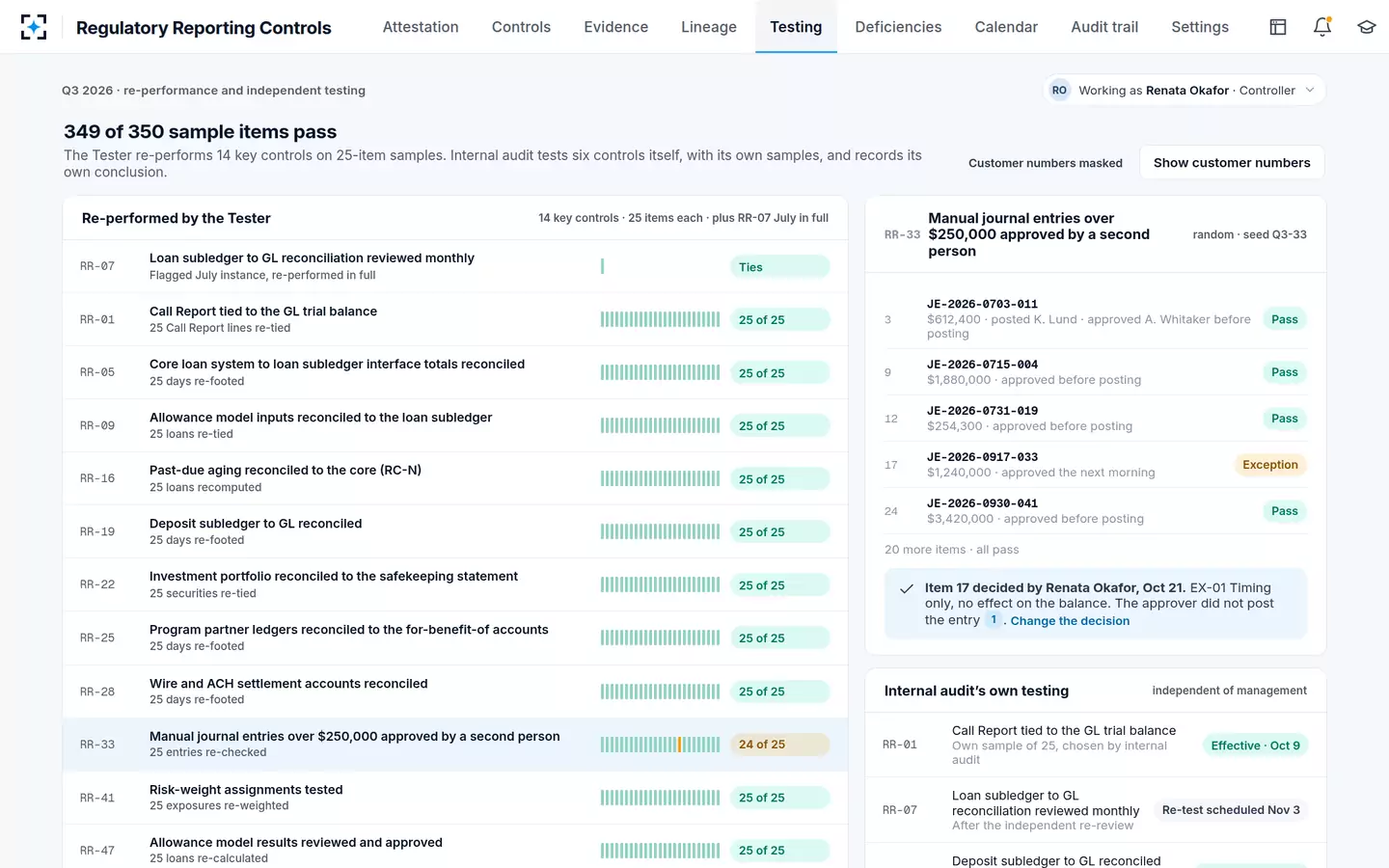
In the sample quarter, the testing agent re-performed 14 key controls on 25-item samples, 350 items in all, plus the flagged July instance of the loan reconciliation in full. 349 passed. The one exception was a manual journal entry of $1,240,000 approved the morning after posting, decided by the Controller as a timing exception. Internal audit tested six controls with its own samples and recorded its own conclusions; the agents' results did not substitute for them.
349 of 350 sample items pass, beside internal audit's own testing
What does SOX automation cost, against the work it replaces?
The honest comparison is with the hours the current process consumes, priced at a rate the audit committee will accept. Two public reference points help. The agencies estimate the FFIEC 041 Call Report itself at 55.56 hours per quarter on average (OCC, Federal Reserve and FDIC, Federal Register, December 11, 2025). And when the FDIC priced Part 363 compliance in its 2025 threshold rule, it used "a wage rate of $99.49 per hour" for credit-intermediation staff (FDIC final rule, 90 FR 55789). Neither counts the controls work behind the attestation, which is where most of the time goes.
Where a Controller's team spends a quarter's attestation, by hand and with agents (days)
A business case for SOX controls automation, term by term
Hours returned
days saved per quarter × hours per day × 4 × loaded hourly rate
On the estimate above, 16.8 days. At 8 hours a day and $99.49 an hour, about $53,500 a year.
Controller
Findings avoided
probability of a finding × its cost: remediation, re-testing, amended reports, examiner time
Hard to price; the deficiency and refiling counts in the KPI tree are the evidence.
CFO, audit committee
Licence and integration
licence + read-only connections to the systems controls run in + control library set-up
Six systems in the sample bank: general ledger, regulatory reporting system, core, tickets, access, imaging.
Finance systems
Validation and change
internal audit time to understand the tool + owners' time to change habits
Budget at least one quarter run alongside the existing process.
Internal audit
The first term is the easy one to compute and the smaller one to argue for. The second is where the case is made. A self-reviewed reconciliation caught in the same week costs an hour of an independent reviewer's time. The same break found by the external auditor at year-end costs re-testing, a deficiency the audit committee must hear about, and possibly amended reports. The OCC's examination procedures treat refilings as a sign of operational risk to be investigated, not a clerical event.
How do you show the value of control automation to an audit committee?
Show the same seven numbers every quarter, from the quarter before the change, and show the exceptions behind them. An audit committee that sees "self-reviews reaching the attestation: 3" in the baseline quarter and "0" afterwards, with the three named, has seen value. One that sees "evidence collection 87% automated" has seen a vendor metric.
The sample bank's quarter in the measures the audit committee sees
23of 23
sub-certifications signed before the CFO attested
22 of 23 on day 22; the last after an independent re-review
61of 61
key controls with evidence captured as they ran
Design target, met in the sample quarter
0
material weaknesses or significant deficiencies in 2026 to date
Four control deficiencies, all decided
The comparison only works if the baseline is real. Run the measures on the last quarter filed by hand before the new process goes live, with the same definitions; the go-live plan in control testing automation, live before the Part 363 year-end builds that baseline into the first month.
Six questions to put to any SOX controls automation product
Ask each one on your own quarter, not on the vendor's sample. A demonstration that cannot answer them on a past quarter's sign-off log and control library will not answer them in production.
What to ask before buying SOX controls automation for regulatory reports
- Where does each KPI value come from?
From system timestamps and user IDs, or from what owners typed into a form? Only the first measures the control.
- Does it compare preparer and reviewer on every instance?
Or only on the sample a tester picks? A monthly control has twelve instances a year; one self-review is enough.
- Does it show its arithmetic?
A re-performance that says "pass" without the balances, the reconciling items and their sources is a claim, not a test.
- Who can close a flag?
If the tool can close its own exceptions, or an owner can close a flag on their own control, the exception rate means nothing.
- Can it reach the Call Report line?
Controls on the general ledger are not enough; the mapping rule and the line on the schedule are where regulatory reports go wrong.
- What does the examiner receive?
A pack with every statement cited, customer data masked, released by a named person, or an export of everything?
Where Regulatory Reporting Controls fits, and where it does not
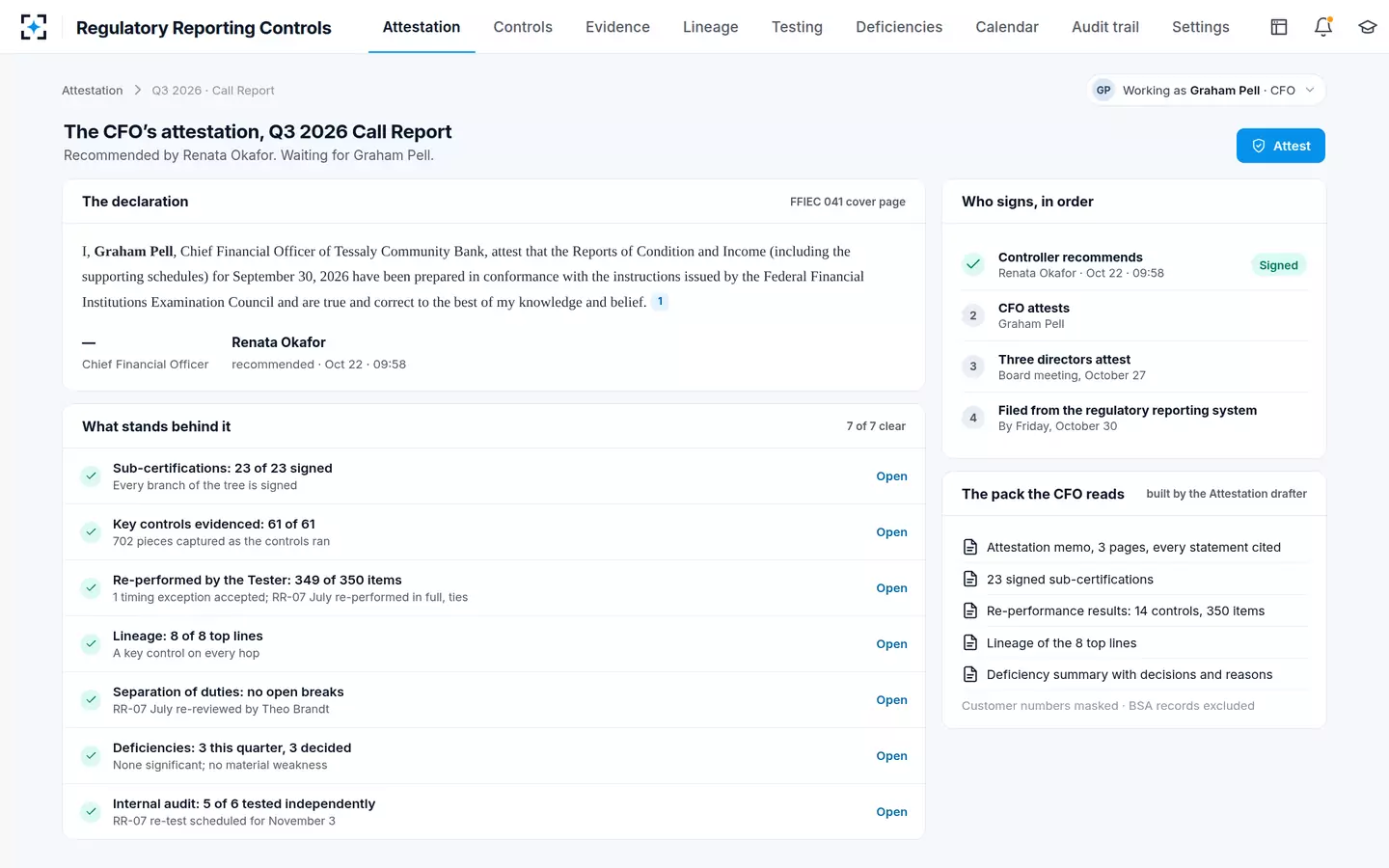
It fits a bank whose CFO signs a Call Report every quarter on the strength of sub-certifications from 20 or 30 process owners, whose key controls run in a general ledger, a regulatory reporting system, a core banking system, a ticketing tool, an access-management tool and a document store, and whose evidence today is gathered by request. It adds the checking in between: an agent that compares preparer and reviewer on every instance, a testing agent that re-performs key controls with its arithmetic shown, a lineage agent that names the control on every hop of the top Call Report lines, and a coordinator that runs the calendar.
The CFO attests when seven measures are clear, each one open to its evidence
It does not fit every need, and a buyer should know where the edges are. It is not a general governance, risk and compliance system of record for every SOX process in a holding company; it is built around regulatory reporting controls. It does not audit: internal audit keeps its own testing and conclusions, and the agents' work does not replace them. It does not decide: deficiencies are proposed with reasoning and decided by the Controller, and anything above a control deficiency goes to the audit committee. And it does not fix mappings or post entries; it flags what it finds and leaves the change to the person who owns it.
The questions to ask of any product in this space are the ones in the gaming table: where does each number come from, and can it be improved without the controls improving? For how the testing itself compares with sampling by hand, see AI control testing vs sampling by hand.
Questions people ask
What is the difference between automating evidence and automating testing?
Evidence automation collects proof that a control ran; testing automation checks whether it ran correctly, by comparing names and times or re-performing the arithmetic. A programme that only automates evidence is faster at gathering the same blind spots.
Which SOX controls should not be automated?
The decisions: classifying a deficiency, accepting a reconciling item as valid, approving a mapping change, and signing. Those need a named person who can be asked why. Automation should bring them the evidence and the exceptions, and record what they decided and the reason they gave.
Does automation reduce what the external auditor tests?
It may, but the auditor decides. Part 363's guidelines allow the independent accountant to rely on internal audit's work; reliance on management's own automated testing is a judgment the auditor makes on the evidence the tool keeps. Ask the auditor early which outputs they would want to see.
How long until the KPIs show anything?
One quarter for a baseline, run on the last quarter filed by hand, and one live quarter for a comparison. Measures such as deficiency age and lineage coverage need two or three quarters before a trend means anything.
What should a SOX automation business case include?
The hours returned at a loaded rate, the findings and amendments avoided, the licence and integration cost, and the time internal audit and owners need to adopt it. The seven KPIs belong in the case too, with the baseline values, so the committee can check a year later whether the case was right.