Data breach notification software companies fall into four groups: privacy incident platforms that track a case and hold a library of state laws, notification service providers that print and mail letters and staff call centres, forensic and data-review firms that find out what was taken and from whom, and newer agent-based tools that place each affected person in a state, apply each law and draft each notice. An insurer evaluating any of them should start from what none of them should do. Whether a cybersecurity event has been determined, whether a harm test excuses a notice, and which version of a rule applies are decisions for counsel. Good notification software makes those decisions faster and better documented; it does not make them.
The question matters more for insurers than for most companies because an insurer runs two sets of notices, to insurance commissioners and to residents, and the commissioner clocks are short. Botminds' Data Breach Notification Management is software in which five AI agents turn one incident into every notice owed, each with its deadline, statute and draft, and named people at the insurer decide and sign. This page describes the market by method rather than by vendor, then shows where the solution fits and where it does not, using its fictional sample incident: a ransomware attack on Wrenfield Mutual's claims-mail vendor that exposed 48,016 people in 20 states.
"Such a determination must be documented in writing and maintained for at least 5 years."
Fla. Stat. §501.171(4)(c), on a decision that no notice is needed
What do data breach notification software companies actually sell?
They sell four different jobs, and most insurers buy more than one. Telling them apart is the first step in an evaluation, because a demonstration of one rarely shows the others.
Privacy incident platforms keep the case: a timeline, tasks, documents and a library of state requirements that a person consults to decide what is owed. Notification service providers do the physical work after the decision: address hygiene, printing, mailing, email, call centres and credit monitoring enrolment. Forensic and data-review firms establish what happened and produce the list of affected people with the data elements exposed for each. Agent-based notification tools, the newest group, take the outputs of the other three and do the reasoning between them: who lives where, which laws that triggers, what each notice must say and when it is due.
The gaps sit between those jobs. A law library does not know who lives in Ohio; a data-review spreadsheet does not know Ohio's deadline; a mail house does not know which paragraph Massachusetts forbids. In most incidents a privacy analyst carries the answer from one to the next by hand, in a spreadsheet, while the clocks run. That carry is the work notification software is really being bought to remove.
The line every product has to draw: may do, must ask
Every decision in a notification either can be computed from the facts and the rules, or needs a lawyer's judgement. A product worth buying knows which is which and shows the line on the screen. The table sets out the eight decisions an insurer's incident turns on, what software can safely do with each, and who has to decide.
Eight decisions in a breach notification, and where software stops
| The decision | Software may | Who decides | Why it is a legal call |
|---|---|---|---|
| Has a cybersecurity event been determined? | Software mayRead the vendor notice, forensic report and ticket; lay out the facts, each with its source. | Who decidesCounsel records the determination and its time. It starts the commissioner clocks. | Why it is a legal callNAIC Model #668 §6.A; 23 NYCRR 500.17(a) |
| When did each clock start? | Software mayApply the start rule each statute names: the day after a vendor’s notice, discovery, or determination. | Who decidesCounsel confirms the dates the arithmetic rests on. | Why it is a legal callModel #668 §6.D(2); Cal. Civ. Code §1798.82 |
| Who is affected, and where do they live? | Software mayMerge duplicate rows into people and place each by last known address. | Who decidesClaims operations resolves minors, estates and missing addresses. A state is never guessed. | Why it is a legal callEach state’s breach law follows residence |
| Does this person’s data count here? | Software mayApply each state’s definition to the elements exposed, with the clause cited. | Who decidesCounsel owns the rules the agents apply and changes them when the law does. | Why it is a legal callDefinitions differ: medical data counts in FL and TX |
| Is the notice excused by a harm test? | Software mayFlag the states where a harm or risk test exists and assemble the evidence. | Who decidesCounsel decides, in writing, and the decision is kept. | Why it is a legal callFla. Stat. §501.171(4)(c); N.Y. GBL §899-aa(2)(a) |
| Is a notice not owed because of a count? | Software mayMark it not owed, showing the count and the threshold. | Who decidesCounsel reviews it with the plan; nothing else is marked not owed. | Why it is a legal call250 or more consumers, Model #668 §6.A(2) |
| What does each letter say? | Software mayDraft from the base letter, adding what each state requires and removing what it forbids. | Who decidesCounsel approves the wording; the privacy officer approves release. | Why it is a legal callM.G.L. c. 93H §3; Cal. Civ. Code §1798.82(d) |
| Does it go out? | Software mayPrepare the filing or the mailing job, and track the proof. | Who decidesA named person signs. Nothing is sent without it. | Why it is a legal callWho signs is the insurer’s own rule |
Two rows deserve attention because products blur them. "Not owed" can be computed when a count falls under a threshold, as when only 174 of an incident's people live in Delaware and its commissioner is owed a notice only at 250. It cannot be computed when a state lets a company skip the letters after deciding harm is unlikely. The first is arithmetic; the second is a legal judgement that some states require in writing. A tool that treats both the same way will mark notices "not owed" that a lawyer never decided to skip.
Why the determination date cannot be automated
The determination is the moment the law says the insurer knew enough, and it is a legal conclusion drawn from incomplete facts. The model law requires a prompt investigation that will, at a minimum, "Determine whether a Cybersecurity Event has occurred", assess its nature and scope, identify the nonpublic information involved and restore security. New York's superintendent must hear within 72 hours after determining that an incident occurred. Choosing that moment too early sends an incomplete notice; choosing it too late is the failure regulators have penalised.
Software can shorten the time between the facts arriving and counsel deciding. In the sample incident the forensic firm's 14-page summary, the vendor's notice and the security ticket were read and laid out, each fact against its page, before counsel recorded the determination at 15:10 on Tuesday 22 September. What the software cannot do is record that time itself, and a product that sets the determination from the first alert has moved a lawyer's decision into a configuration screen.
The vendor case shows why. Under the model law, a licensee's deadlines for an event at a vendor start from the vendor's notice, the day after it arrives, or from the insurer's own earlier knowledge. That rule fixes the start of the arithmetic; it does not tell anyone whether the vendor's notice described a cybersecurity event at all. Counsel still has to read it and decide.
Harm tests: the decisions that need a written reason
Several state breach laws let a company skip the letters if it concludes the breach is unlikely to cause harm, and the same laws demand the reasoning in writing. Florida excuses the notice if, after an investigation and consultation with law enforcement, the company "reasonably determines" the breach has not and will not likely result in identity theft or other financial harm, and it must send that written determination to the Department of Legal Affairs within 30 days. New York excuses an inadvertent disclosure by authorised people that will not likely lead to misuse or harm; the written determination is kept for five years and, where more than 500 New Yorkers are affected, sent to the attorney general within ten days. Delaware lets a company skip the free credit monitoring it otherwise owes for exposed Social Security numbers if it determines harm is unlikely.
These are exactly the decisions a regulator reads afterwards. They should be drafted with their evidence, decided by counsel, and kept with the incident, never inferred by a rules engine from the data elements alone. In Data Breach Notification Management the rules agent flags where a harm test exists and stops; only counsel records the decision.
What the agents can do on their own
The safe ground for software is everything that follows from the facts and the rules once counsel has fixed both. That is most of the work by volume: deduplicating tens of thousands of rows, placing each person in a state, applying twenty statutes, drafting dozens of notices and counting days. In the sample incident the agents turned 53,477 data-review rows into 48,016 people and a plan of 59 notices, 53 owed and 6 not owed, in 52 minutes after the determination.
One incident through Data Breach Notification Management: agents prepare, people decide
Agent
Incident intake agentReads the vendor’s notice, the forensic summary and the security ticket; sets out the facts, the exposure window and the dates every clock depends on.
Never: Sets the determination date
A person decides
Regulatory counselRecords the determination and its time, and decides any harm-based exception.
Agent
Affected-people mapperMerges duplicate rows into people, places each in a state by last known address, lists the elements exposed.
Never: Guesses a state for a missing address
Agent
Notification rules agentApplies each state’s breach law and insurance data security law; one cited notice per obligation.
Never: Marks a notice not owed except on a numeric threshold
Agent
Notice drafterDrafts the commissioner notices and each state’s letter, with the clause behind each paragraph.
Never: Sends anything
A person decides
Chief Privacy OfficerApproves and releases the letters; counsel signs the commissioner notices.
Agent
Deadline keeperRuns every clock, warns at 14 and 7 days counting print time, and keeps each proof.
Never: Marks a notice sent without a proof
By Botminds' own estimate for a multi-state incident, not counting the data review itself, the hand-built version of this work takes about 21 working days: two on the facts and clock starts, five placing people, five working out who is owed what, four drafting, three in counsel review and two chasing deadlines and proofs. With the agents doing the mechanical part the estimate falls to about five and a half, and counsel's review is the largest share that is left. That is the right shape: the time saved comes out of the carrying, not out of the deciding.
Data breach notification service provider or software: which do you need?
Most insurers need both, because they do different jobs: a notification service provider executes the notices, and notification software decides what notices exist and holds the proof. The question to ask is whether the software takes the provider's outputs, such as mailing jobs, returned mail and call-centre volumes, as inputs, so that "sent" means proven.
Notification service provider and notification software do different halves of the job
Notification service provider: A final mailing list and an approved letter.
Notification software for an insurer: The vendor’s notice, the forensic report and the data-review rows.
Notification service provider: Nothing about the law; it executes instructions.
Notification software for an insurer: Nothing on its own; it proposes, cites and drafts for counsel.
Notification service provider: Usually outside its scope.
Notification software for an insurer: Commissioner notices with the items the model law lists, and their updates.
Notification service provider: Prints the versions it is given.
Notification software for an insurer: Builds each state’s version from a base letter, citing each change.
Notification service provider: Mailing certificates and job reports.
Notification software for an insurer: Takes those proofs in and marks each notice sent only against one.
Is free data breach notification software enough?
For a small producer whose customers live in one or two states, a spreadsheet, the state attorney general's online form and outside counsel can be enough. Attorneys general such as Texas's publish online forms for the notices they receive, and the Federal Trade Commission publishes a model letter. What free tools do not supply is the reasoning across states: an insurer's commissioner thresholds, each state's definition of personal information, the start rule for each clock, and the arithmetic of print time against a deadline.
The cost of doing that by hand shows up as risk, not invoices. Texas sets a civil penalty of up to $100 for each person for each day a company fails to take reasonable action to notify, capped at $250,000 for one breach. A multi-state insurer that rebuilds its matrix by hand for every incident is paying for software either way, in analyst weeks or in exposure.
Questions to put to data breach notification software companies
The best evaluation is a real incident from your own files, run end to end, with your counsel watching where the product asks and where it assumes. These questions make the line visible.
Ten questions for any data breach notification software company
- Who records the determination date?
If the answer is the system, from the first alert, the product has taken counsel’s decision.
- Does it know insurance data security laws, not just breach laws?
Commissioner thresholds of 250 consumers, 72-hour and business-day clocks, the thirteen items the model asks for.
- How does it start a clock for a vendor’s incident?
The model counts from the day after the vendor’s notice; ask to see the rule and its source.
- What does it do with a person it cannot place?
A missing address should go to a person, never to a guessed state.
- When does it mark a notice “not owed”?
Only on a count below a threshold, shown with the count; never on its own reading of a harm test.
- Can it show why each paragraph of a letter is there?
Required, forbidden or your own policy, each with its clause.
- Who owns the rules library, and how is a change recorded?
Your counsel should be able to change a rule and see which incidents it touches.
- Does it count print and mail time against each deadline?
A 30-day letter that needs three business days to print is due to the printer earlier.
- What counts as sent?
A portal receipt, a confirmation number or a mailing job, not a status someone ticked.
- Can an examiner see everything in one export?
Every notice, its date, recipient, channel, count and proof.
Where Data Breach Notification Management fits, and where it does not
The solution is the reasoning layer between the vendors an insurer already uses. It reads the forensic firm's report and the data-review file, applies the insurer's counsel-reviewed rules, drafts every notice and keeps the clocks, and it hands mailing jobs to the print vendor and takes their proofs back. It is not a forensic firm, a mail house, a call centre or a law firm, and it does not try to be.
The first hour: five agents, from the determination to a cited plan
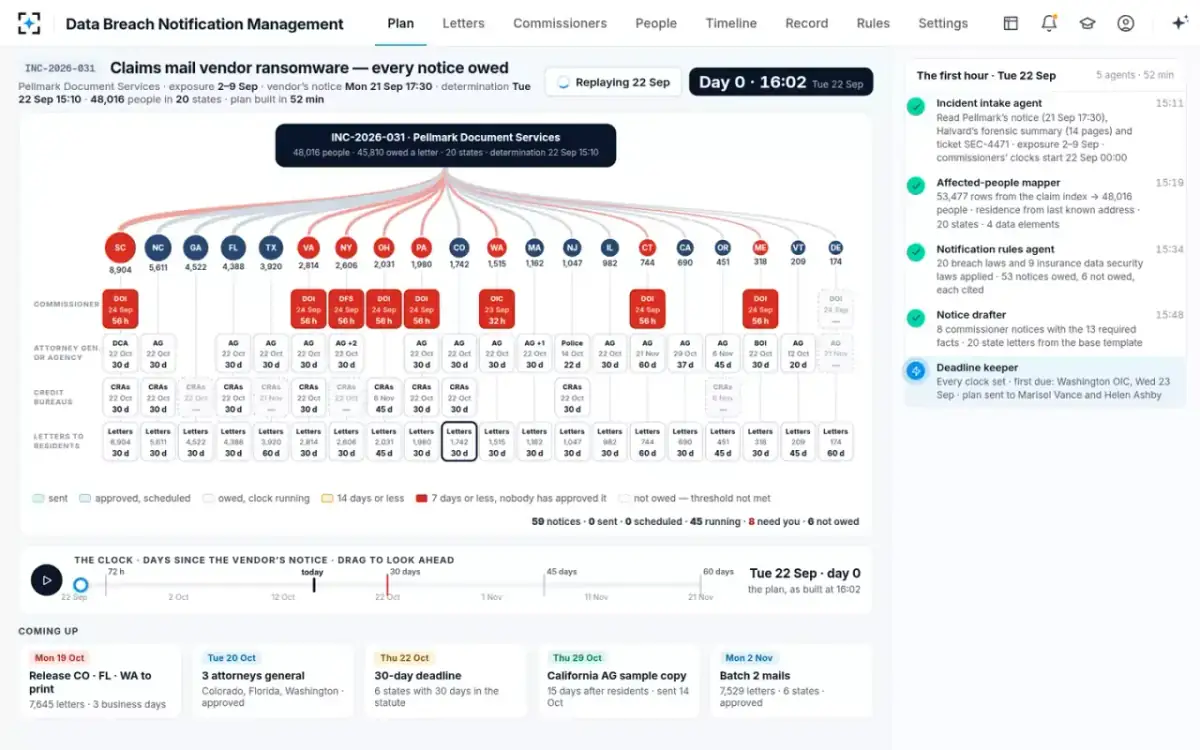
Every action ends in a request to a named person. The privacy officer sees what she is approving, the counsel approval behind it and the deadline arithmetic, and her signature records her name, the time and what it means.
Nothing leaves without a signature
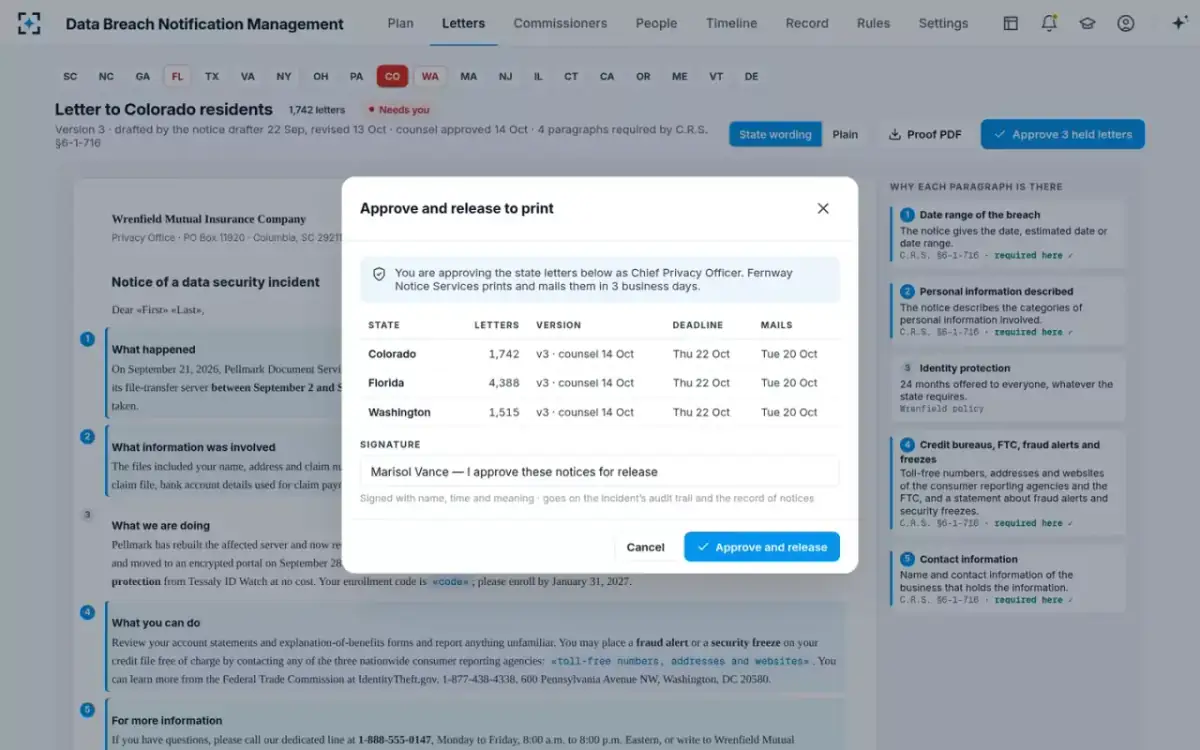
Two limits are worth stating plainly. The rules the agents apply are only as current as the insurer's counsel keeps them; the solution applies and cites them, but it does not monitor legislatures. And a NIST incident response profile recommends that notifications to law enforcement and regulators follow management approval, and that "Designated individuals should contact these parties": the solution routes every notice through a designated signer for that reason. For how the same incident looks as a matrix an analyst could keep by hand, see the breach notification matrix template.
Questions people ask
What is a data breach notification management system?
It is software that turns one incident into every notice the law requires, with a deadline, a statute and a draft for each, and keeps proof of what was sent. For an insurer it has to cover insurance commissioners as well as residents, attorneys general and credit bureaus.
Can software decide whether a breach must be notified?
It can compute the parts that are arithmetic, such as whether a state's count threshold is met. Whether a cybersecurity event has been determined, and whether a harm test excuses a notice, are legal judgements; Florida and New York require a harm-based decision to be written down and kept for five years.
Do data breach notification service providers handle regulator notices?
Their core job is the mailing, call centre and monitoring enrolment that follows a decision, so check the contract. Insurance commissioner notices are owed within days, under rules few mailing providers carry, and usually stay with the insurer's counsel.
How long does it take to build a notification plan?
By hand, Botminds estimates about 21 working days across a multi-state incident, not counting the data review. In the solution's fictional sample incident the agents built a cited plan of 59 notices across 20 states 52 minutes after counsel recorded the determination; counsel's review and sign-off still take days.
Does notification software replace outside counsel?
No. It replaces the carrying of facts between counsel, the forensic firm, the data-review vendor and the mail house. Counsel still owns the rules, the determination and every harm-based decision, and approves the wording of the letters.
Is there free breach notification management software?
Free tools exist for single tasks: attorneys general's online notice forms, federal model letters and spreadsheet templates. None carries an insurer's commissioner rules or computes each clock from its own start event, which is where multi-state incidents go wrong.