To automate the cyber underwriting process sensibly, automate the reading and matching, and keep the decisions. On a mid-market account the underwriter's time goes mostly on reading the application, the ransomware supplement, the outside-in scan, the penetration test and the loss history, and on putting each signed answer beside its evidence; the decision to quote, condition, refer or decline is a fraction of the hours. Software can do the first part reliably if it cites what it read. The second part carries the carrier's authority and should stay with a person. Botminds' Cyber Underwriting Risk Assessment is built on that split: five agents read and grade, and the underwriter decides, edits and signs.
Whether that is worth buying depends on the cost of one submission today, and on how many of them a desk handles. This guide builds the unit cost from Bureau of Labor Statistics wage data and Botminds' estimate of the hours, which you should replace with your own, then scales it with a fictional sample book of 418 submissions a quarter.
Where one cyber submission's hours go, by hand and with agents reading
By hand: 3.75 h
- Reading · 53%
- Matching answers to evidence · 20%
- Writing wording and note · 27%
Agents read and draft: 0.7 h
- Checking the reading · 36%
- Checking the matches · 21%
- Editing wording and note · 43%
Can cyber underwriting be automated? The reading can; the decision should not be
Most of a cyber submission's handling is mechanical once the controls are defined. Extracting an answer with its question number, mapping a scan finding to a control, noticing that the supplement counts 612 devices with EDR where the application says "all", and filling a library subjectivity with the right IP address are tasks with a right answer, which is what makes them automatable. Each can be checked, because each output cites its source.
The decisions are different in kind. Whether a contradicted MFA answer blocks the quote, becomes a pre-bind subjectivity or is overridden because the exposure is a honeypot the insured runs on purpose is judgment, and it is the judgment the carrier licenses the underwriter to exercise. A sound automated process puts a person at every point where the carrier's authority is used: quoting, binding, declining, relaxing a condition and contacting the insured.
How long does it take to underwrite a cyber submission?
There is no published industry figure, so build it from the steps. Botminds estimates three to four hours for a mid-market submission read by hand, split as the figure above shows: an hour and a quarter on the application and supplement, three-quarters of an hour each on the scan and penetration test and on matching, and an hour of writing. Small accounts on short forms should take less; large accounts with several penetration tests and excess layers take more.
Time your own desk before trusting anyone's estimate, ours included. Ten recent submissions, timed by step, give a better baseline than any vendor's average, and they become the comparison set when you test a tool. The hours as one underwriter's week experiences them are drawn in the cyber underwriter job description.
What does a cyber underwriter cost per hour?
Start from the wage and add what the employer pays on top. The BLS puts the median annual wage for insurance underwriters at $81,370 in May 2025 (BLS Occupational Outlook Handbook). It does not publish cyber separately, so treat the median as a reference point and use your own payroll where you have it.
Wages are not the whole cost. For full-time private industry workers in June 2026, wages and salaries "accounted for 68.5 percent of employer costs", and benefits for the remaining 31.5 percent (BLS Employer Costs for Employee Compensation, June 2026). Dividing the median wage by 68.5% gives about $118,800 a year in employer cost, or about $57 for each of 2,080 paid hours. That is our arithmetic on the two BLS series; an hour actually worked costs more, because paid leave is in the 2,080.
The unit cost of one cyber submission, term by term
Hours per submission
Reading + matching + writing
Botminds’ estimate: 3.75 h by hand, 0.7 h with agents reading. Replace with your own timed sample.
Head of cyber
Loaded hourly cost
Wage ÷ wage share of cost ÷ paid hours
$81,370 ÷ 0.685 ÷ 2,080 ≈ $57, from the BLS median and the June 2026 cost share.
Finance
Volume
Submissions read a year
Every submission read, not only those quoted: declines cost the same reading.
Underwriting operations
Tool cost
Licence + setup + validation
Include the hours your model-risk or audit team spends validating the tool.
Finance and model risk
Scaled to a desk, the numbers become a budget line. The fictional sample book graded 418 submissions between July and September 2026. At 3.75 hours each that is about 1,570 underwriter hours in a quarter, or about $89,500 at $57 an hour; at 0.7 hours each it is about 290 hours and $16,700. The difference, about $72,800 a quarter, is the hours term of the business case on these assumptions, before the tool's own cost.
How many cyber policies are written in the U.S., and is cyber premium still growing?
Policies are growing faster than premium, which is why the unit cost of reading matters more each year. The NAIC counts 5.84 million domestic cyber policies in force for 2025, up 33%, and domestic premium of $7.46 billion, up from $2.75 billion in 2020; including alien surplus lines insurers the market wrote $9.46 billion (NAIC, October 2026). The year before, domestic premium had fallen 2.3% while the count of policies held flat at about 4.37 million (NAIC Report on the Cybersecurity Insurance Market, 2025).
Divide one by the other and the average domestic premium per policy in force has fallen for three years running. Much of the recent growth is endorsements on other commercial policies, which the NAIC says now account for nearly two-thirds of policies in force, so the average mixes very different products. The direction still matters: a carrier reading more submissions for less premium per policy has to spend fewer hours on each.
Average domestic premium per U.S. cyber policy in force
What is the ROI of automating cyber underwriting? Four terms, one of them unpriced
The return has four terms, and the hours are the smallest one that can be priced with confidence. The first is the hours term above. The second is capacity: the same desk can read the submissions it now declines unread or quotes on a skim, which matters in a market adding policies by the million. The third is consistency: subjectivities written from an approved library instead of from memory, so the broker sees the same words for the same gap from every underwriter.
The fourth is the one that justifies the effort and that no public source prices: contradictions found before the quote instead of after a loss. In the sample quarter, 146 contradictions were found in 97 of the 418 submissions, and each became a subjectivity before the quote went out. What one disputed claim costs your carrier is a number your claims and legal teams hold, not one we can supply; put it in the case as their figure, or leave it out and let the hours carry the case alone.
There is also a data term that compounds. The U.S. Government Accountability Office reported that "Without comprehensive, high-quality data on cyber losses, it can be difficult to estimate potential losses from cyberattacks and price policies accordingly" (GAO-21-477, 2021). A process that stores every submission's grade per control builds the data that lets a carrier compare claims with the controls that preceded them. How price is built from those controls is in how cyber insurance premium is calculated.
Which parts of cyber underwriting can AI do safely?
The parts with a citable right answer. The comparison below sets each step of the process beside what an agent does in it and what stays with the underwriter.
Each step of the cyber underwriting process, divided
What the agents do: Read the submission on arrival; flag a missing supplement or scan and draft the request to the broker.
What stays with the underwriter: Decide whether the risk is worth the time before the quote date.
What the agents do: Extract every answer with its question number, page and signer; turn counts into numbers; never infer a blank.
What stays with the underwriter: Spot-check the citations that drive a grade.
What the agents do: Map each scan and penetration-test finding to a control; put it beside the signed answer; grade against the guide, citing both sides.
What stays with the underwriter: Judge whether the evidence is good enough for this risk.
What the agents do: Nothing: the agents never decide appetite.
What stays with the underwriter: Quote, decline or refer; keep, ask about or override each contradiction, with a reason.
What the agents do: Draft subjectivities and conditions only from the approved library, with assets and accounts filled in.
What stays with the underwriter: Edit any wording; move items between pre-bind and post-bind; send the letter.
What the agents do: Draft the note with every statement cited, and run the referral check.
What stays with the underwriter: Sign the note.
Where automating the cyber underwriting process goes wrong
Automation fails in this line in four recognisable ways, and each one turns a saving into a liability. The first is inference: a reader that fills a blank answer with the likely one, or rounds "Partly" up to "Yes", produces a cleaner scorecard that misstates what the applicant represented. The second is the uncited grade: a score or a red flag with no question number, page, finding or date behind it cannot be checked by the underwriter, defended to a referral reviewer or used in a subjectivity.
The third is free-written wording. A model that composes subjectivities in its own words will write a slightly different condition each time, and the variation the carrier was trying to remove comes back through the tool. The fix is the one a head of cyber would impose on a human desk: wording only from an approved, versioned library, with the assets and accounts filled in from the evidence. The fourth is the quiet one: rules that change without a version. If the EDR threshold moves from 95% to 98% and nobody can say which submissions were graded under which rule, the book's history stops meaning anything.
Each failure has a test. Hand the tool a submission with a blank answer and see whether it stays blank. Click a grade and see whether both sides open. Compare two subjectivities for the same gap on different files. Change a threshold and see whether open submissions are re-graded and the old version kept. A tool that passes all four is automating the reading; one that fails any of them is automating risk.
What to measure on your own files before buying a tool to automate cyber underwriting
Measure on closed submissions, where you already know the answer. Give the tool a set of submissions your desk has quoted, with your own grades held back, and count three things: contradictions it found that your underwriters found, contradictions it found that they missed, and contradictions they found that it missed. Time the underwriter's review of its output on the same files. That is the evidence a finance partner and a model-risk reviewer will both accept.
Seven measurements for a cyber underwriting automation business case
- Baseline hours by step
Time ten recent submissions: reading, matching, writing. Use your hours, not an estimate.
- Loaded hourly cost
Your payroll, or the BLS median ÷ the employer cost share as a cross-check.
- Submissions read a year, quoted or not
Declines and lost quotes cost the same reading.
- Agreement on closed files
Contradictions found by both, by the tool only, by the underwriter only.
- Review time on the tool’s output
The hours that remain are the hours you will pay for.
- Wording consistency
How many distinct wordings your desk used for the same gap last quarter.
- Validation cost
Model-risk and audit hours to approve the tool, and to re-approve it after changes.
Where Cyber Underwriting Risk Assessment fits in an automated cyber underwriting process
The solution covers the reading-to-draft part of the process, end to end, for submissions that arrive as documents. It does not run scans (it reads the one you order), price the risk (your rating plan does), or replace your underwriting system; it hands the underwriter a graded scorecard, drafted wording and a drafted note. Its design target is 25 minutes from documents to a graded scorecard. Setting it up on your own guide and wording library, and proving it on closed files, is the plan in a six-week go-live for a cyber underwriting platform.
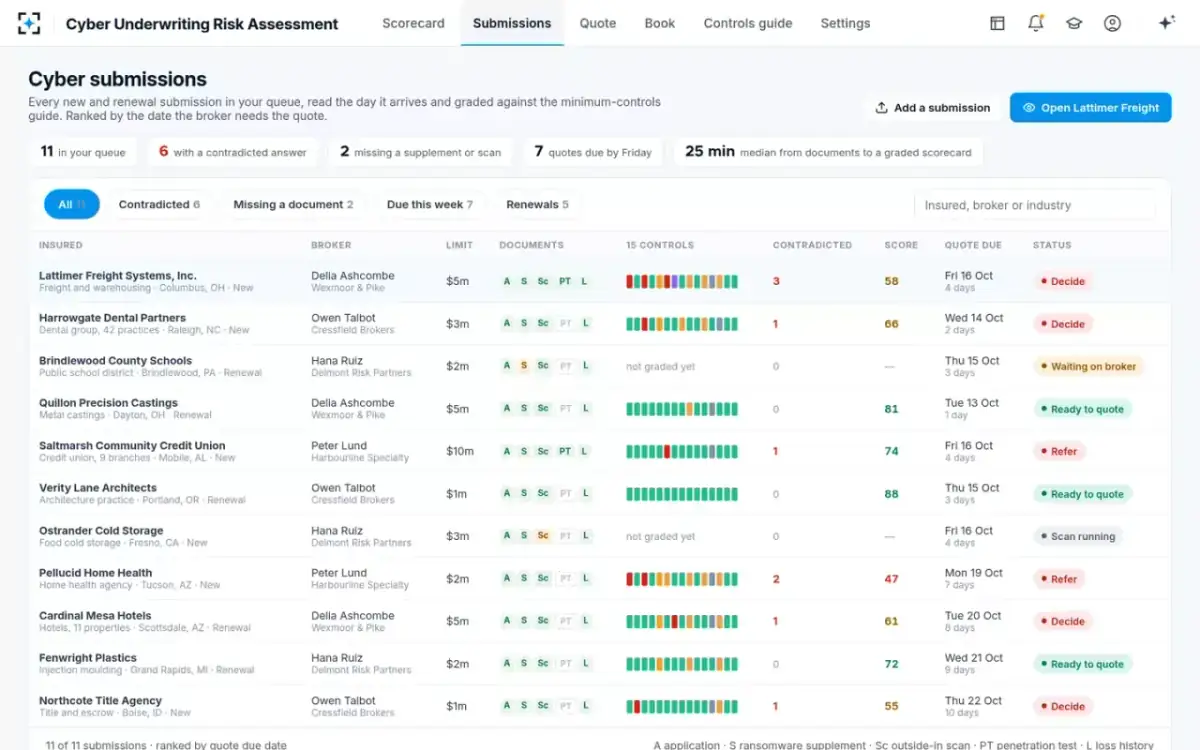
A queue read the day it arrives: what is missing, what is contradicted, what is due
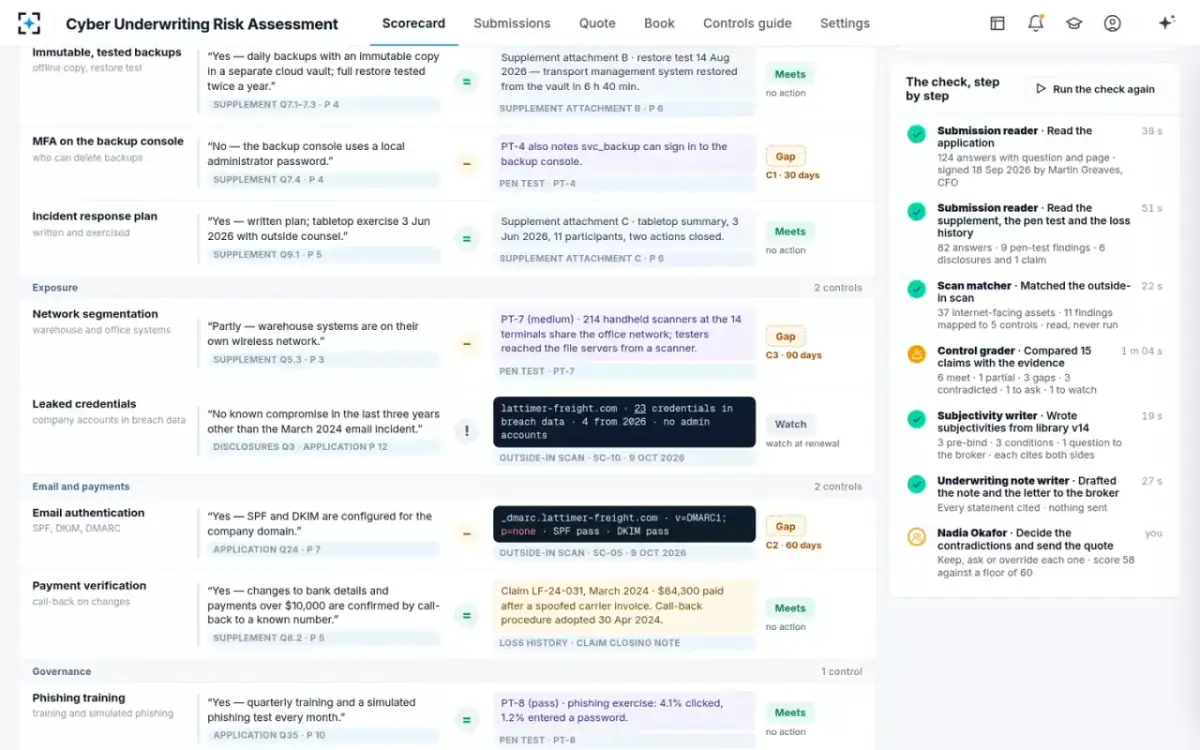
The run log: each agent's step and its time on one submission
Questions people ask
What does a cyber underwriter cost?
The BLS median wage for insurance underwriters was $81,370 in May 2025. With benefits at the June 2026 share for full-time private workers, the employer cost is about $118,800 a year, or about $57 per paid hour on our arithmetic. Your own payroll will differ by seniority and location.
Will automation replace cyber underwriters?
The BLS projects underwriter jobs to fall 4% from 2025 to 2035 as automated software spreads, while cyber policies grew 33% in 2025 alone. The likelier change is the one this guide describes: fewer hours reading, the same people deciding more submissions.
Can AI price cyber insurance?
Pricing comes from the carrier's filed or internal rating plan, and that should stay so. Agents can supply the inputs the plan uses, such as a graded control score, with each grade cited, but the price and its exceptions are the underwriter's.
What is the payback period for cyber underwriting automation?
Divide the tool's first-year cost by the hours term per quarter from your own baseline. On this guide's illustrative numbers the hours term is about $72,800 a quarter for 418 submissions; your volume, hours and wage rates will move it more than anything else.
Is cyber premium still growing?
Yes, after a dip. The NAIC recorded the U.S. market's first-ever fall in direct written premium in 2024, about 7% to $9.14 billion including alien surplus lines, and then $9.46 billion for 2025, with domestic policies in force up 33%.