A business loan comes with promises that last as long as the loan does: keep debt below a set multiple of earnings, keep enough cash to cover the payments, send the numbers every quarter. Covenant monitoring is how a lender checks those promises after the money is out the door. Each quarter it collects the borrower's figures, recalculates every test the way the loan agreement defines it, and acts when a test fails or a report is late.
This guide is for anyone who tracks, tests, signs or pays for covenant work: credit administration and portfolio monitoring analysts, relationship managers, credit officers, loan review, private credit portfolio teams, and the leaders deciding whether to automate it. No background needed.
Imagine you are a credit administration analyst at a regional bank in Columbus, Ohio. It is Monday, November 16, 2026. Third-quarter compliance certificates, the signed forms in which each borrower works out its own loan tests, were due on Saturday, 45 days after quarter end. Of the 168 due, 141 have arrived. One of them is from Halvorsen Industrial Coatings, a Dayton manufacturer with a $38.5 million credit line and term loan, already on the bank's watch list.
Its chief financial officer signed the certificate at 4:42 p.m. on Friday. It says fixed charge coverage, cash earnings divided by the year's loan payments, is 1.31x against a 1.25x minimum: "in compliance", no default. To reach that figure, Halvorsen "added back" $1,420,000 of costs from closing its Springfield plant, counting its earnings as if those costs had never been spent. Page 14 of the loan agreement, as changed by an amendment signed last December, limits that add-back.
Compliance certificate · Q3 2026
Springfield costs
Added back in full
Amount
$1,420,000
Covenant EBITDA
$11,130,000
Coverage
1.31x · "in compliance"
First Amendment · §1.1, clause (viii), p. 14
Cap
10% of base EBITDA
Allowed
$949,000
Covenant EBITDA
$10,659,000
Coverage
1.23x
1.31x as certified1.23x under the amendmentthe minimum is 1.25x.
Every other figure on the certificate ties to Halvorsen's statements. The difference is $471,000 of add-back above the cap, and it turns a pass into a breach. It also makes the certificate's "no default" statement wrong, which the agreement treats as a second default. The borrower can still cure it with $108,500 of new equity by December 7.
Re-testing the certificate from the statements, under the agreement as amended, finds the breach the week it happens, four months before the annual review would have.
What covenant monitoring is, and what examiners expect of it
The promises in a loan agreement, the certificate that reports on them, the arithmetic behind each test, what a breach sets in motion, the 2026 rules and the market, explained without selling anything. If you are new to commercial credit, start here.
01 · In plain words
What a loan covenant is, and why a lender checks it every quarter
When a bank lends to a business for five years, it cannot know what the business will look like in year three. So the loan agreement carries promises, called covenants, that hold for as long as the loan does. Some are about behavior: keep the plant insured, do not sell the main assets, send financial statements on time. Others are numbers: debt may not exceed 3.5 times a year's earnings, cash earnings must cover the year's loan payments at least 1.25 times, the business must keep $5 million of cash and unused credit.
Every quarter the borrower's finance chief fills in a compliance certificate: a signed form that works out each number test from the latest statements and declares whether the business passes. It is usually due 45 days after the quarter ends, the same window public companies have for their quarterly reports.1,2 The bank's job, called covenant monitoring, is to make sure the certificate arrives, to check that its arithmetic follows the agreement, and to act when a test fails or a certificate does not come.
Each test is built from words the agreement defines for itself. "EBITDA" (earnings before interest, taxes, depreciation and amortization) in a loan agreement is rarely the EBITDA in the borrower's statements: the agreement lists what may be added back, often with caps and end dates, and later amendments change the list. A certificate can tie to the statements line for line and still be wrong if it reads one clause more generously than the agreement allows. The OCC has asked examiners since 1998 to look at a bank's "practices to determine the ongoing accuracy and reliability of borrower certifications".3
A failed test is called a technical default. The borrower is still paying on time, but the bank gains rights it did not have the day before, from refusing new advances to demanding repayment. In practice banks use that moment to talk: the borrower fixes the problem, pays for a waiver, or agrees new terms. The value of the covenant depends on the bank finding the breach in the quarter it happens, while there is still something to talk about.
One borrower's covenant quarter, from agreement to decision
The loan closes with covenantsHalvorsen's March 2024 agreement sets four number tests, a 45-day reporting deadline and an equity cure. An amendment in December 2025 adds a capped add-back.
The borrower reportsThe third-quarter certificate and statements arrive at 4:42 p.m. on Friday, November 13, a day before the deadline.
The bank re-tests every covenantFrom the statements, under the agreement as amended. This is where the $471,000 above the cap is found, or missed.
The bank responds to what it findsA breach is confirmed, a reservation-of-rights letter goes out, and the cure, waiver or amendment is decided by the right person.
The rating and the annual review followThe breach feeds the risk rating, the exception report and the credit committee. Found late, it reaches them only at the annual review.
Step 3 is the subject of this guide. The people, companies and figures in this example are fictional.
Borrower-written certificates and other covenant surprises
The certificate is the borrower's own answer
The borrower picks the figures, reads the definitions and does the arithmetic. A bank that copies the certified ratio into its tracker has recorded what it was told.
Breaches are common
In any given year, "between 10 percent and 20 percent of firms report being in violation of a financial covenant", one study of public companies found.4 Missed payments are far rarer.
A waived breach still counts
The OCC's 2026 booklet lists "Covenant breaches (even if waived)" among the exceptions a bank should track.5 A forgiven breach stays on the record.
Silence can give rights away
A lender that knows of a breach and does nothing, or accepts late performance without a letter, risks having waived it by its conduct.6,7
A promise in the loan agreement. Banks use covenants, the OCC says, "to establish the circumstances in which the bank can terminate a commitment to lend or accelerate a loan".5
Compliance certificate
The borrower's signed quarterly calculation of each financial covenant, with a statement that no default exists.
Headroom
How far a result sits from its limit, as a share of the limit. 1.31x against a 1.25x minimum is 4.8% headroom.
Equity cure
A right in many agreements to fix a failed test by putting in new cash equity within a set number of days, a limited number of times.
Maintenance, incurrence and reporting: the promises a commercial loan carries
In shortBank loans mostly carry maintenance covenants, tested every quarter whether or not the borrower does anything. Bonds and many large leveraged loans carry incurrence covenants, tested only when the borrower takes a step such as borrowing more. Around both sit the reporting, insurance and conduct covenants that feed the tests and protect the collateral.
Most corporate lending is written on cash flow. Lian and Ma estimate that about 80% of the debt of the US nonfinancial firms they studied, by value, rests "predominantly on cash flows from firms' operations", with covenants that cap debt or debt payments at a multiple of earnings.8 That is why the same few ratios appear in almost every commercial agreement, each with its own defined terms.
Unrestricted cash + unused revolver availability, at quarter end
At least $5.0 million (§7.4)
Financial, minimum
Capital expenditures
Spending in the fiscal year to date
At most $6.0 million a year (§7.5)
Financial, maximum
Financial reporting
Certificate and statements by the due date
45 days quarterly, 120 days audited (§6.1)
Affirmative
Insurance
Evidence of cover on renewal
On expiry (§6.5)
Affirmative
Asset sales, liens, new debt
The bank's consent before the act
Per agreement
Negative
Halvorsen's covenants are from the fictional example. The formulas are the common shape; every agreement defines its own terms.
A weak quarter alone can break a financial maintenance covenant
How each kind of covenant is triggered, tested and cured
RarelySometimesUsually
Fails without any actTested every quarterCure in the agreementNeeds the statementsFinancial maintenanceUsuallyUsuallySometimesUsuallyFinancial incurrenceRarelyRarelyRarelySometimesReportingSometimesUsuallyUsuallyRarelyInsurance and collateralSometimesSometimesUsuallyRarelyNegative (sales, liens, debt)RarelyRarelyRarelyRarely
Our reading of the sources8,5,2 · Our reading of the research on loan covenants, the OCC booklet and a filed credit agreement; your agreements may differ.
Show the numbers
Fails without any act
Tested every quarter
Cure in the agreement
Needs the statements
Financial maintenance
Usually
Usually
Sometimes
Usually
Financial incurrence
Rarely
Rarely
Rarely
Sometimes
Reporting
Sometimes
Usually
Usually
Rarely
Insurance and collateral
Sometimes
Sometimes
Usually
Rarely
Negative (sales, liens, debt)
Rarely
Rarely
Rarely
Rarely
Covenant-lite and what it removes
A loan without financial maintenance covenants is called covenant-lite. It is common in large syndicated leveraged loans and has spread to some private credit deals; a 2024 Federal Reserve note reported industry commentary that some recent deals were "devoid of financial maintenance covenants".9 Covenant-lite removes the quarterly signal: the lender still gets statements, but a weak quarter gives it no right to renegotiate.
Most bank loans to middle-market and smaller companies still carry maintenance tests, which is why quarterly testing remains the core of a commercial bank's monitoring.
The OCC grades covenants as part of the loan. In the 2026 booklet's rating aid, strong financial covenants "allow the bank to renegotiate loan terms to reflect emerging weaknesses in a timely manner before credit deterioration". Weak ones "may permit significant deterioration in borrower performance or collateral position before a covenant violation or an event of default is triggered".5 The words "in a timely manner" assume someone is testing on time.
03 · The rules and their dates
What examiners ask about covenant tracking, and what changed in 2025 and 2026
Status as of October 2026
In shortNo regulation says how to test a covenant. Supervisors examine whether the bank has a system that tracks reporting, checks the borrower's certifications, logs every breach and waiver, and acts in time. The OCC rewrote its lending booklet in June 2026, the agencies replaced the model risk guidance in April 2026, and the OCC and FDIC withdrew the leveraged lending guidance in December 2025.
Three texts that frame covenant monitoring changed in seven months
Mar 1998OCC commercial loan procedures
Examiners assess borrower certifications and "systems for monitoring compliance with loan covenants". Still published.
May 8, 2020Credit risk review guidance
Review scope includes "Adherence to loan agreement covenants".
Jun 9, 2023Third-party guidance
Using a vendor does not remove the bank's responsibilities.
Dec 5, 2025Leveraged lending guidance withdrawn
OCC and FDIC rescind the 2013 guidance; each bank defines "leveraged loan" itself.
Apr 17, 2026SR 26-2 replaces SR 11-7
Spreadsheet arithmetic and fixed rules are outside the model definition; generative AI is out of scope.
Jun 25, 2026New OCC lending booklet
Lending and Loan Portfolio Risk Management replaces Loan Portfolio Management; covenant breaches "even if waived" are exceptions.
Credit administration includes "monitoring the status of required periodic borrower financial statements and loan covenant testing". Covenant breaches, waived or not, are financial exceptions; "Covenant breaches and waivers" is a management report; "covenant tracking" is on the request list.5
"Practices to determine the ongoing accuracy and reliability of borrower certifications that serve as justification for advancing funds"; "Systems for monitoring compliance with loan covenants".3
March 1998, still published
Fed, Commercial Bank Examination Manual
Loan covenant check sheets in the file and a tickler for missing information; violations "should be dealt with immediately to give credibility to the agreement"; waivers in writing.7
Current
Credit risk review guidance (SR 20-13)
Promptly identify loans with actual and potential weaknesses; review "Adherence to loan agreement covenants".10
May 8, 2020, current
SR 26-2 and OCC Bulletin 2026-13
Model risk guidance; "simple arithmetic calculations, such as those found within spreadsheets" and "deterministic rule-based processes" are outside the model definition.13,14
April 17, 2026
Leveraged lending
The OCC and FDIC withdrew the 2013 guidance; "Each bank should determine its own definition of a 'leveraged loan'" and should monitor such loans "throughout its life cycle".12
Rescinded by the OCC and FDIC December 5, 2025; the Federal Reserve's SR 13-3 is still posted16
Third-party guidance
"the use of third parties does not diminish or remove banking organizations' responsibilities".11
June 9, 2023, in force; a replacement was proposed September 11, 202617
Regulation B, 12 CFR 1002.2(c)(2)(ii)
Action "in connection with inactivity, default, or delinquency" on an account is outside the definition of adverse action.18
Current
The examiner's own questions
Reporting
"Does the bank have a system to monitor the timely submission of commercial borrower and guarantor financial statements and other items required in the bank's loan agreements?" (OCC, 2026 internal control questions).5
Exceptions
"Unidentified exceptions are often the result of errors, miscalculations, breakdowns in the pre- or post-closing review process, or system failures." A large number of them "could be indicative of less than satisfactory exception processes".5
A claim to correct. Some covenant software marketing still cites "SR 11-7 model validation". SR 11-7 was superseded on April 17, 2026. Under SR 26-2, the ratio arithmetic of a covenant test is outside the definition of a model, and generative AI tools that read agreements are outside the guidance's scope, left to the bank's own governance.13
04 · Certificates and deadlines
Compliance certificates at 45 days, audits at 120: what each delivery proves
In shortThe reporting covenant sets what arrives and when: quarterly statements with a certificate, an audited year-end package, often monthly borrowing base reports. Each delivery is the input for one round of tests. A late one is itself an exception, and until it arrives every covenant on that loan carries last quarter's result.
A typical filed credit agreement asks for audited annual statements "within 120 days after the end of each fiscal year" and quarterly statements "within 45 days after the end of each of the first three fiscal quarters", each with a certificate in which a financial officer states that "no Default or Event of Default has occurred and is continuing" and attaches "reasonably detailed computations demonstrating compliance".2 The 45-day window matches the SEC's deadline for quarterly reports from most public companies.1
Four test dates a year, each waiting on a delivery that can slip
A calendar-year borrower on a 45-day quarterly and 120-day annual schedule, in days from January 1
What the borrower calculated and certified, under its reading of the agreement
That the reading matches the agreement as amended
Interim statements
The figures the test should start from
Audit-level accuracy; year-end entries can move them
Audited statements
The year, tested by an outside accountant
Anything about the months since year end
Borrowing base certificate
Eligible receivables and inventory, usually monthly
Whether the collateral exists, without field exams
Insurance evidence
Cover in force on the date shown
Cover after the renewal date
Why the certificate wave is the hard part
Most agreements in a bank's book share one deadline, so certificates arrive together. In the fictional example, 141 of 168 certificates arrived between November 2 and November 14, and 38 came on the last business day. Every one has to be tested under that borrower's own agreement, in the same few days, while the late ones are chased. The Fed's manual explains why the right to the information matters: "With proper use of loan covenants, a bank can protect its right to receive additional or more frequent information if a borrower's financial condition deteriorates."7
A late certificate is an exception the day after it is due. The OCC lists "Stale financial statements, tax returns, or borrowing base certificates" as credit administration exceptions.5 A vendor's case study describes the practice it found across banks: "If deadlines are missed, even inadvertently, these situations are recorded as breaches."19 Whatever your policy, decide on day one and log it with an owner.
05 · Re-testing, worked
How to recalculate a covenant from the statements: EBITDA, coverage, leverage and headroom
In shortStart from the statements, build the trailing four quarters, apply the agreement's definitions as amended, then divide. Compare the result with the limit in force and with what the borrower certified, and record the headroom. Below, every line of Halvorsen's third quarter, from net income to 1.23x.
Fixed charge coverage = (Consolidated EBITDA − unfinanced capital expenditures − cash taxes − distributions) ÷ (scheduled principal + cash interest), all over the last four quarters
The trailing four quarters come from the last audited year plus this year to date, less the same months of last year. Halvorsen's are fiscal 2025 audited, plus nine months of 2026, less nine months of 2025.
Line
Definition used
Certificate
Re-test
Net income + interest + taxes + depreciation and amortization
§1.1, clauses (i) to (iv)
$9,490,000
$9,490,000
+ Stock compensation
§1.1, clause (v), non-cash
$220,000
$220,000
+ Springfield plant consolidation costs
§1.1, clause (viii), capped at 10% (First Amendment)
$1,420,000
$949,000
Consolidated EBITDA
Sum of the above
$11,130,000
$10,659,000
− Unfinanced capex, cash taxes, distributions
$2,140,000 + $690,000 + $400,000
$3,230,000
$3,230,000
Numerator
EBITDA less deductions
$7,900,000
$7,429,000
÷ Fixed charges
$3,780,000 principal + $2,250,000 cash interest
$6,030,000
$6,030,000
Fixed charge coverage
At least 1.25x (§7.2)
1.31x · pass
1.23x · breach
Fictional example. The bank applies the 10% cap to EBITDA before all add-backs ($9,490,000); read word for word, the clause also keeps stock compensation in the base, which gives a $971,000 cap and 1.24x, still a breach (section 6). Total leverage moves too: $30,300,000 of funded debt ÷ $10,659,000 is 2.84x on the re-test against 2.72x certified, still inside 3.50x.
One capped add-back explains the whole gap between 1.31x and 1.23x
Halvorsen's third quarter, certificate against the bank's re-test
CertificateRe-test from the statements
Springfield add-back$1.4M$949K
Consolidated EBITDA$11.1M$10.7M
Coverage numerator$7.9M$7.4M
Fixed charges$6M$6M
Fictional example from this guide
Show the numbers
Certificate
Re-test from the statements
Springfield add-back
$1.4M
$949K
Consolidated EBITDA
$11.1M
$10.7M
Coverage numerator
$7.9M
$7.4M
Fixed charges
$6M
$6M
Headroom: the distance to the limit
Headroom for a maximum = (limit − result) ÷ limit · Headroom for a minimum = (result − limit) ÷ limit
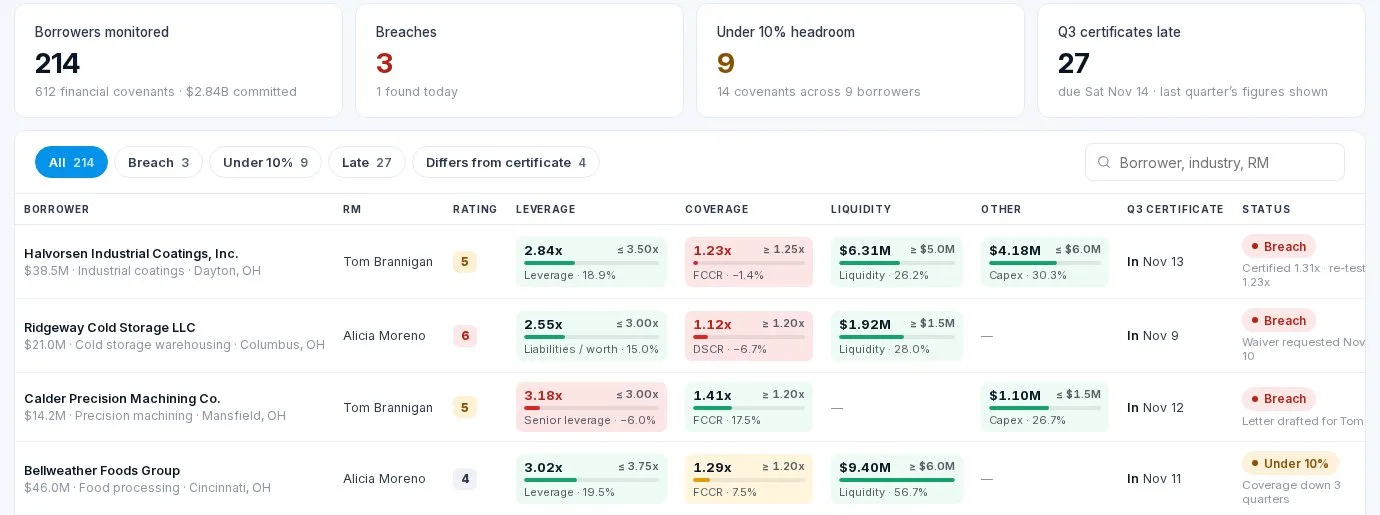
Halvorsen certified 4.8% headroom on coverage: (1.31 − 1.25) ÷ 1.25. On the re-test it has −1.4%. Its other three covenants pass comfortably: leverage has 18.9% headroom, liquidity of $6.31 million against $5.0 million has 26.2%, and capital spending of $4.18 million against a $6.0 million yearly cap has 30.3% left with a quarter to go.
Coverage is the only one of Halvorsen's four covenants with no headroom left
Headroom on the bank's re-test, third quarter of 2026
Capital expenditures$4.18 million against a $6.0 million yearly cap30.3%
Minimum liquidity$6.31 million against $5.0 million26.2%
Total leverage2.84x against a 3.50x maximum18.9%
Fixed charge coverage1.23x against a 1.25x minimum; 4.8% as certified-1.4%
Fictional example from this guide · Fictional example. Coverage is below its minimum, so it shows no bar.
Show the numbers
Covenant
Headroom
Capital expenditures
30.3%
Minimum liquidity
26.2%
Total leverage
18.9%
Fixed charge coverage
-1.4%
A coverage percentage is thinner than it looks, because taxes, capital spending and loan payments do not shrink when earnings do. Halvorsen's certified 4.8% would vanish if covenant EBITDA fell by $362,500, about 3.3%. The equity that cures the actual breach is the gap to the minimum: 1.25 × $6,030,000 = $7,537,500, less $7,429,000, which is $108,500.
Coverage fell three quarters running before it crossed the minimum
Halvorsen's fixed charge coverage as re-tested by the bank; the minimum is 1.25x
1×1.2×1.4×1.6×1.23×
Q4 2025Q1 2026Q2 2026Q3 2026
Fictional example from this guide · The covenant minimum, 1.25x, sits just above the last point.
Show the numbers
Fixed charge coverage
Q4 2025
1.52×
Q1 2026
1.44×
Q2 2026
1.36×
Q3 2026
1.23×
The trend carries more warning than any single quarter. Halvorsen's leverage rose in step, from 2.31x to 2.84x. A bank that tracks only pass and fail sees three green quarters and then a red one. A bank that tracks headroom saw it fall from 21.6% to 15.2% to 8.8% over three quarters, about 0.08x of coverage lost each quarter, and moved the borrower to its watch list in August.
06 · Add-backs and definitions
EBITDA add-backs and seven other clauses that decide whether a borrower passes
In shortMost differences between a certificate and a bank's re-test come from the agreement's defined terms: which costs may be added back, how far, for how long, what counts as debt, and which accounting rules apply. Each one should be read from the agreement as it stands on the test date, latest amendment first.
EBITDA add-backs are the adjustments the agreement lets a borrower make when it turns net income into covenant EBITDA: non-cash charges, one-off fees, restructuring costs, sometimes savings it expects to make. Each is a clause with its own limits. Lian and Ma point out that agreements may also compute EBITDA under accounting rules fixed at closing or under current rules, and that "floating GAAP" is common, so an accounting change can move a covenant with no change in the business.8
One expense, two ratings
An OCC appeal shows how much one clause can move. In a 2014 shared national credit exam, examiners treated a borrower's major maintenance expense as recurring and found leverage of 10.1x and fixed charge coverage of 1.12x. The bank added the expense back as non-recurring and got 7.5x and 1.33x. The appeals panel found leverage "10 times and high for the industry", but upheld the bank's pass rating on other grounds: a cash sweep, contracted margin and projected repayment of most of the debt within seven years.20
Adding back one maintenance expense moved leverage from 10.1x to 7.5x
One borrower in an OCC appeal, without and with the add-back
Examiners: expense treated as recurringBank: expense added back
Halvorsen: 10% of EBITDA before this add-back, a base that can be read two ways
2
Add-back windows
Costs incurred inside the dates the clause allows
Springfield costs only through December 31, 2026
3
Dollar baskets
Running totals across quarters
Agreement fees "not to exceed $250,000 in the aggregate"
4
What counts as debt
Leases, letters of credit, seller notes, guarantees
Finance leases left out of funded debt
5
Fixed charges and deductions
Unfinanced versus total capex; cash versus book taxes
Capex funded by a term draw counted twice
6
Step-downs
The limit in force on this test date
Leverage falls from 3.75x to 3.50x after two years
7
Accounting basis
Frozen or current accounting rules
A lease standard change that moves debt
8
Rounding and cures
Unrounded ratios; cure equity used only for its quarter
1.246x printed as 1.25x
Even the cap's base needs a decision. Halvorsen's amendment caps the add-back at 10% of Consolidated EBITDA "determined before giving effect to this clause (viii)".
Reading
Base
Cap
Coverage
Cure
Word for word: only the Springfield add-back is set aside, so clause (v)'s $220,000 of stock compensation stays in the base
$9,710,000
$971,000
1.24x · breach
$86,500
The bank's stricter reading, used throughout this guide: 10% of EBITDA before every add-back
$9,490,000
$949,000
1.23x · breach
$108,500
Fictional example. Both readings find a breach; they differ by $22,000 in the equity the bank asks for. Settle the reading with counsel before the letter goes out, record which one the re-test used, and apply it to every borrower with the same clause.
07 · After a breach
What happens after a covenant breach: notice, reserved rights, cure, waiver or amendment
In shortA breach is usually an event of default even though every payment is current. Lenders rarely accelerate. They reserve their rights in writing, let the borrower use any cure the agreement gives it, and then waive, amend or restructure, usually in exchange for a fee, tighter terms or limits on spending. Research finds most violations end in a renegotiation.
"The breach of a financial covenant means that the borrower is in technical default on the loan," Nini, Smith and Sufi write, "and that the lender has the right to demand immediate repayment of the entire loan."21 The Fed's manual is blunter: violations "should be dealt with immediately to give credibility to the agreement", and they "can often result in acceleration of the debt maturity".7
The quieter rights matter more day to day: on a credit line, covenants "allow the lender to monitor and reject or recall a drawdown if the covenant is violated".22 What lenders usually do with a breach is renegotiate. Michael Roberts found that "more than 75% of all covenant violations lead to a contract renegotiation".23
Most covenant violations end in a renegotiated loan
More than 75 in 100
covenant violations lead to a renegotiation of the loan, in a study of bank loans filed with the SEC
covenant violations lead to a renegotiation of the loan, in a study of bank loans filed with the SEC
75 of 100
A breach moves through five steps, and each one keeps or gives up the lender's rights
1Found and confirmed
The bank re-tests, confirms the result and logs the exception with an owner.
Credit administrationDays after the certificate
2Notice and reserved rights
A letter names the default and reserves every right; accepting payments is no waiver.
Relationship managerRight away
3Cure, if the agreement allows it
New equity counted toward the failed quarter only, within a set number of business days.
BorrowerSet by the agreement: 10 business days in one filed agreement
4Waiver, amendment or forbearance
A credit decision with a reason, a fee or concessions, recorded and counted.
Chief credit officer or committeeWeeks
5Rating, reporting, follow-up
The rating is reviewed; the breach stays on the exception report even if waived.
Credit officer, loan reviewNext committee
Our reading of the sources7,21,23,2,24,6 · Our reading of the Fed manual, the research and filed agreements. Your agreement and policy set the exact steps.
Show the numbers
Step
What happens
Who
Time
Found and confirmed
The bank re-tests, confirms the result and logs the exception with an owner.
Credit administration
Days after the certificate
Notice and reserved rights
A letter names the default and reserves every right; accepting payments is no waiver.
Relationship manager
Right away
Cure, if the agreement allows it
New equity counted toward the failed quarter only, within a set number of business days.
Borrower
Set by the agreement: 10 business days in one filed agreement
Waiver, amendment or forbearance
A credit decision with a reason, a fee or concessions, recorded and counted.
Chief credit officer or committee
Weeks
Rating, reporting, follow-up
The rating is reviewed; the breach stays on the exception report even if waived.
Credit officer, loan review
Next committee
What lenders demand after a covenant breach
Lenders charge for a breach mostly in control over the business, and little in price. In the violations Nini, Smith and Sufi studied, a breach raised the chance of a capital expenditure restriction by 14 percentage points, a 44% increase at the mean, while the interest spread rose by about 23 basis points.21 Their later summary: violations are "followed immediately with a decline in acquisitions and capital expenditures", lower leverage and payouts, and "an increase in CEO turnover".4
Equity cure terms: a filed agreement beside the example's
Term
A credit agreement filed with the SEC (2018)
Halvorsen's agreement (fictional)
Deadline
10 business days after statements are due
15 business days after the certificate is due
How often
At least two quarters in every four without a cure; five in all
Twice in all, never two quarters running
How much
No more than needed to comply
$108,500, the gap to 1.25x
Effect
Counts as EBITDA for that covenant only; no debt reduction assumed
Counts toward the §7.2 numerator for the failed quarter
Filed agreement, §7.02.2 Halvorsen's cure window runs from Saturday, November 14 to Monday, December 7, 2026, skipping Thanksgiving.
Waiver, amendment, forbearance, reservation of rights
Excuses one breach
Waiver
The lender gives up its rights over a named breach for a named period. One filed waiver letter excuses two covenant violations for one quarter on payment of "a non-refundable waiver fee in the amount of $5,000.00", and says nothing else is waived or amended.24
Changes the future
Amendment
A new limit, definition or step-down that every later test must read. Halvorsen's First Amendment, which added the capped add-back, is one.
Buys time
Forbearance or reserved rights
The lender holds off while keeping its rights. A practitioner's warning: "granting extensions, accepting late performance, or failing to enforce rights may inadvertently result in a waiver."6
Put it in writing. The Fed's manual, on asset-based loans: a waiver "should be formally communicated to the borrower in writing. The lender should avoid both not taking action for a period of time and not issuing a written waiver for a covenant violation." If a violation is later used to end the loan, "the lender is more vulnerable to lender liability".7
08 · How often breaches happen
How often borrowers breach loan covenants, compared with how often loans go bad
In shortStudies of public companies find that between a tenth and a fifth report a covenant violation in a given year, and up to a third of firms with a bank line breached at some point over several years. Loans that stop paying are far rarer. Violations have fallen since the 1990s as covenants loosened, and no public figure exists for private middle-market borrowers.
Covenant breaches are common; each study measures a different group
Share of firms reporting a covenant violation, by study and scope
Public firms, in a given year (Nini, Smith and Sufi)10% to 20%; upper end shown20%
Firms with a bank credit line, at any point 1996–2003 (Sufi)1 in 333%
Firms violating a net worth or current ratio covenant (Chava and Roberts)30% to 40%; upper end shown40%
Source4,21 · Different samples and periods; read each bar on its own.
Show the numbers
Item
Share of firms
Public firms, in a given year (Nini, Smith and Sufi)
20%
Firms with a bank credit line, at any point 1996–2003 (Sufi)
33%
Firms violating a net worth or current ratio covenant (Chava and Roberts)
40%
0.96%
of C&I loans at FDIC-insured banks were noncurrent at June 30, 2026; 1.25% at community banks.25
FDIC Quarterly Banking Profile, Q2 2026
~70%
fall in the annual share of US public firms reporting a covenant violation over twenty years.26
Griffin, Nini and Smith
5x
a typical bank loan is renegotiated five times, once every nine months, with covenants among the terms changed.23
Roberts, NBER
A breach is a signal that arrives long before a missed payment, which is what a covenant is for. Griffin, Nini and Smith found that about half of the fall came from fewer "false positives", breaches by firms that were not in distress, as covenants were set looser; another 30% came from fewer distressed borrowers.26 That makes each breach that does occur more informative, and covenants set close to a borrower's numbers more likely to trip when something has changed.
No public figure for middle-market borrowers. We found no regulator, survey or study that publishes how often private middle-market borrowers, the core of most bank covenant books, breach a covenant, or how often their certificates are miscalculated. Your own book is the only dataset: count breaches per quarter, and re-test a sample of past certificates (section 13 and Part C show how).
09 · What goes wrong
Ten ways a covenant program misses a breach or mishandles one
In shortBreaches are missed in four places: in the calendar, in the arithmetic, in the agreement's words, and in the response. The costly ones look fine on a tracker: a green cell copied from a certificate, an amendment nobody read into the workbook, a waiver that dropped the breach from the count.
#
Error
Why it happens
What catches it
In the calendar
1
A late certificate not logged
The borrower is paying; nobody wants to chase
An exception on day one, with an owner and reminders5
2
Annual, monthly and insurance deliveries forgotten
The tracker holds only the quarterly test
Every reporting obligation loaded from the agreement
In the arithmetic
3
The certified ratio copied as the result
Too many certificates in the same week
A re-test from the statements for every certificate3
4
The wrong four quarters
The trailing twelve months built by hand
Audited year + year to date − last year's same months
5
A broken workbook formula
Copied from borrower to borrower
One calculation per covenant type, tested
In the agreement's words
6
An amendment never read into the test
The workbook was built at closing
The register rebuilt whenever an amendment is signed
A reservation-of-rights letter on every confirmed breach7,6
10
A waived breach dropped from the exception count
The cell turns green when the waiver is signed
A waiver register; breaches counted "even if waived"5
Copied certificates and unread amendments are the misses to fix first
How late the breach is found →
Test for it
Fix first
Spot-check
Automate it
Copied certificateUnread amendmentAdd-back over capWaived by silenceLate not loggedWrong four quarters
How often it happens →
Illustrative · replace with your own numbers · Positions are our judgment; no public data ranks these errors. Measure your own with a back-test of closed quarters.
Show the numbers
Item
How often it happens (0–1)
How late the breach is found (0–1)
Copied certificate
0.75
0.80
Unread amendment
0.20
0.70
Add-back over cap
0.65
0.60
Waived by silence
0.20
0.30
Late not logged
0.72
0.25
Wrong four quarters
0.35
0.12
Why the arithmetic is the easy part
Dividing one number by another takes no skill. Deciding which numbers to divide takes the whole agreement, read with every amendment in date order. Amendments rarely restate the agreement; they change it by reference, a clause here, a number there. Roberts found covenants are among the terms "significantly modified during each renegotiation".23 A covenant workbook built at closing and never rebuilt tests the closing agreement forever.
10 · The risks
What a missed or mishandled breach risks: exam findings, lost rights, ratings and fairness
In shortA breach found late costs the bank its moment of leverage, can leave a weakening loan rated too well, and shows up in exams as an unidentified exception. A breach handled carelessly can waive the bank's rights or expose it to lender liability. Handling similar breaches differently for similar borrowers invites fair lending questions.
A breach found only at the annual review scores high on every kind of damage
Where each failure lands
LowMediumHigh
Exam findingRating too highRights weakenedLoss if it goes badBreach found a quarter lateMediumHighMediumMediumBreach found at the annual reviewHighHighHighHighLate certificate never loggedHighMediumMediumMediumBreach waived by silenceMediumMediumHighHighWaiver with nothing in returnHighMediumMediumMedium
Our reading of the sources5,7,10,21,6 · Our reading of the OCC booklet, the Fed manual, the credit risk review guidance and the research.
Show the numbers
Exam finding
Rating too high
Rights weakened
Loss if it goes bad
Breach found a quarter late
Medium
High
Medium
Medium
Breach found at the annual review
High
High
High
High
Late certificate never logged
High
Medium
Medium
Medium
Breach waived by silence
Medium
Medium
High
High
Waiver with nothing in return
High
Medium
Medium
Medium
Exams and ratings
Credit risk review should promptly identify "loans with actual and potential credit weaknesses".10 A breach is often the first hard evidence of a potential weakness; the Fed defines Special Mention as "potential weaknesses that deserve management's close attention".7 The OCC tells examiners not to criticize a loan "solely because it has an exception", but warns that a pattern of them can reflect "a critical lack of internal controls".5
Waived rights
The Fed lists "ready willingness to waive violations of key covenants ... without corresponding concessions on the part of the borrower" as a sign of weak credit risk management.7 A lender that delays without a written waiver or reservation is "more vulnerable to lender liability" if it later relies on the breach.7
Fair lending
Under Regulation B, "any action or forbearance relating to an account taken in connection with inactivity, default, or delinquency as to that account" is not adverse action.18 A response to a covenant default usually falls there. Fair lending law still applies to how the bank treats borrowers, so similar breaches should get similar responses, recorded with reasons. Ask counsel about tightening terms at renewal, which may fall outside the exception.27
Private credit and nonbanks
The OCC sees "signs that credit quality for some vintages, borrower types, and sectors of the private credit markets is weakening", and warns that restructurings and payment-in-kind "may mask underlying credit deterioration".28 Banks that lend to private credit funds depend on the funds' own covenant monitoring of their borrowers.
The Fed's manual adds a point on consistency that matters for both fairness and lender liability: "The lender should be careful to be consistent in all actions regarding the borrower."7
11 · The market
The loan books covenants protect: $2.96 trillion of C&I loans and a more leveraged middle market
In shortUS commercial banks hold almost $3 trillion of commercial and industrial loans, up about 10% in the year to September 2026. Borrowers outside the banks carry more debt, bank standards are looser than their long-run midpoint, and private credit defaults rose through early 2026 before easing. Looser terms mean wider add-backs and limits set further from today's numbers, so how each remaining test is read carries more of the lender's protection.
C&I loans at US banks grew about 10% in the year to September 2026
Commercial and industrial loans, all commercial banks, September of each year, $ billions, seasonally adjusted
2,2002,4002,6002,8003,0002,959.1
20192020202120222023202420252026
Source29,30 · From January 2025 the H.8 moved loans to nonbank financial firms out of C&I ($115.7 billion that month, smaller amounts later), so compare 2026 only with 2025.
Show the numbers
C&I loans ($ billions)
2019
2,370.5
2020
2,760
2021
2,416.8
2022
2,747.9
2023
2,761.3
2024
2,777.6
2025
2,691
2026
2,959.1
81%
of non-pass shared national credits are leveraged loans; nearly half of all $6.9 trillion of commitments are leveraged.31
Federal Reserve, FDIC, OCC · 2025 review
$1.4T
of bank loans to nondepository financial institutions, including private credit funds, at year-end 2025: 5.6% of industry assets.32
FDIC Risk Review 2026
2.41%
default rate in a law firm's index of 746 private credit loans in the third quarter of 2026, down from 2.73% in the first. The index counts financial covenant defaults as well as missed payments and bankruptcies.33,34
Proskauer Private Credit Default Index
Private credit borrowers carry more debt per dollar of earnings
Banks have loosened too. In the July 2026 Senior Loan Officer Opinion Survey, banks said their C&I standards "were easier than the midpoints of their historical ranges" for several loan categories, and reported narrower spreads.36 Looser standards usually mean wider add-back baskets and covenants set further from today's numbers, which makes each remaining test, and how it is read, matter more.
The 2025 withdrawal of the leveraged lending guidance leaves each bank supervised by the OCC or the FDIC to define its own "leveraged loan" and monitor it "throughout its life cycle".12 The Federal Reserve did not join, and its 2013 letter is still posted for the banks it supervises.16
12 · Automation and AI
Automating covenant testing: what software can take, and what the 2026 guidance leaves to you
In shortSoftware can keep the calendar, chase certificates, read agreements, spread statements, recalculate and draft letters. People should keep the decisions: confirming a breach, granting an extension, waiving, amending and rating. The 2026 model guidance puts covenant arithmetic outside the definition of a model and leaves AI that reads agreements to the bank's own governance.
The reading and the arithmetic suit software; the decisions stay with people
Each task in a covenant cycle, by how well it suits automation and what it needs
LowMediumHigh
Suits softwareNeeds judgmentNeeds a citationNeeds a signatureCalendar and remindersHighLowLowLowReading agreements and amendmentsHighMediumHighLowSpreading statementsHighLowHighLowRecalculating covenantsHighLowHighLowConfirming a breachMediumHighHighHighExtensions and waiversLowHighMediumHighLetters to the borrowerMediumMediumHighHighRisk rating changesLowHighMediumHigh
Our reading of the sources5,3,7,13 · Our reading of what examiners ask for; your policy decides who signs.
Show the numbers
Suits software
Needs judgment
Needs a citation
Needs a signature
Calendar and reminders
High
Low
Low
Low
Reading agreements and amendments
High
Medium
High
Low
Spreading statements
High
Low
High
Low
Recalculating covenants
High
Low
High
Low
Confirming a breach
Medium
High
High
High
Extensions and waivers
Low
High
Medium
High
Letters to the borrower
Medium
Medium
High
High
Risk rating changes
Low
High
Medium
High
What SR 26-2 says about covenant re-testing software
SR 26-2, April 17, 2026
A model "excludes simple arithmetic calculations, such as those found within spreadsheets, as well as deterministic rule-based processes and software where there are no statistical, economic, or financial theories underpinning their design or use". Generative AI and similar AI that acts on its own "are not within the scope of this guidance"; the bank's own risk management should set the controls.13
Third parties, 2023
Buying software or a service leaves the duty with the bank: "the use of third parties does not diminish or remove banking organizations' responsibilities".11 Due diligence, contract terms and ongoing monitoring of the vendor are the bank's.
Three ways agreement reading goes wrong
A system that reads agreements, or a person, can go wrong in three ways. The third is the most dangerous because the result looks complete.
Misreads a term
A cap taken from the wrong base
Protection: every term cites its section and page, so a reviewer can check the words behind each number.
Misses an amendment
Changes applied out of order
Protection: amendments read in date order; the latest wins and the older text stays visible.
Fills a gap
A plausible threshold the documents never set
Protection: nothing is filled in that the documents do not say; gaps go to a person.
A reader can only read what it is given, so gathering every amendment, consent and waiver letter stays a human job.
How to prove it on your own files. Re-test eight closed quarters and compare three numbers for each covenant: what the borrower certified, what the bank recorded, and what the re-test finds. If the re-test and a careful human check agree on all of N covenants, the "rule of three" puts the 95% upper bound on the disagreement rate at about 3 in N.37 Eight hundred clean results bound it near 0.4%; one quarter of 141 bounds it only near 2.1%.
13 · How teams monitor today
How credit administration monitors covenants today: who does what, and where the quarter goes
In shortAn analyst in credit administration keeps the calendar, chases certificates, keys statements, finds the definitions and recalculates, often for dozens of borrowers at once (71 in this guide's example). Relationship managers own the borrower and the letters; a credit officer decides waivers and ratings. By hand, most of the quarter goes to chasing and keying, and the recalculation is what gets squeezed.
Who handles a covenant breach, from analyst to committee
CA
Credit administration or portfolio monitoring analyst
Keeps the reporting calendar, chases certificates, spreads statements, recalculates covenants, logs exceptions, drafts the status report.
Cares about: getting every certificate tested in the week after the deadline.
RM
Relationship manager
Owns the borrower, gets the late certificate out of the finance chief, signs the letters, negotiates waivers and amendments.
Cares about: hearing that the numbers turned while there is time to talk.
CM
Credit administration manager
Owns the exception report to the credit committee and the evidence for examiners.
Cares about: a report that matches the credit files.
CO
Chief credit officer or credit committee
Decides waivers, amendments and rating changes, with approval authority independent of the relationship.
Cares about: the clause, the number and the cure behind each proposal.
LR
Loan review
Tests a sample of credits, covenant adherence among them, and reports to the board.10
Cares about: breaches the first line did not find.
A certificate's path to committee, in three hands
One certificate passes through three people before committee sees a breach
1Requested
Reminder to the borrower's finance chief before the due date.
AnalystT−10 and T−3
2Received or chased
Logged on arrival; late ones chased with the relationship manager.
Analyst, relationship managerDays to weeks
3Spread
Statements keyed; trailing four quarters built.
AnalystHours per borrower
4Recalculated
Definitions found in the agreement and amendments; each covenant re-tested.
AnalystHours per borrower
5Confirmed and answered
Breach confirmed; letter signed; waiver or cure decided.
Analyst, relationship manager, credit officerDays
6Reported
Exception report to committee; rating reviewed.
Credit administration managerNext committee
Illustrative · replace with your own numbers · Illustrative times for a bank testing quarterly by hand.
Show the numbers
Step
What happens
Who
Time
Requested
Reminder to the borrower's finance chief before the due date.
Analyst
T−10 and T−3
Received or chased
Logged on arrival; late ones chased with the relationship manager.
Analyst, relationship manager
Days to weeks
Spread
Statements keyed; trailing four quarters built.
Analyst
Hours per borrower
Recalculated
Definitions found in the agreement and amendments; each covenant re-tested.
Analyst
Hours per borrower
Confirmed and answered
Breach confirmed; letter signed; waiver or cure decided.
Analyst, relationship manager, credit officer
Days
Reported
Exception report to committee; rating reviewed.
Credit administration manager
Next committee
Chasing and re-keying: over half a quarter's covenant work
Chasing and re-keying take more than half of a quarter's covenant work by hand
Working days in one quarter's certificate cycle, one analyst covering about 70 borrowers
Chasing certificatesRe-keying statementsFinding definitionsRecalculating and checkingLetters and report
By hand, about 19 days56242
Illustrative · replace with your own numbers · An estimate for the fictional bank in this guide. No public source measures time per certificate; time your own next quarter.
Show the numbers
Chasing certificates
Re-keying statements
Finding definitions
Recalculating and checking
Letters and report
By hand, about 19 days
5
6
2
4
2
The shape explains the usual failure. Recalculation is a fifth of the time and the last step before the committee, so when the week runs out it is what gives: the analyst checks that the certificate arrived, reads the ratio the finance chief signed, and moves on. Every step before it is necessary; none of them tests anything.
Tickler and workbooks, monitoring service or re-testing tool
In house
A tickler and workbooks
A calendar system for due dates and a spreadsheet per borrower or per relationship team. Cheap and flexible, and still common: a vendor's case study notes that in several banks the process "still relies on spreadsheets and manual trackers".19 Weak points: copied formulas, workbooks built at closing, and certified ratios typed in as results.
Outsourced
A spreading or monitoring service
A provider keys statements and computes covenants to the bank's template. It moves the hours; the bank still confirms results and keeps the responsibility.11
Software
Tracking or re-testing tools
Modules in loan systems that hold covenants and due dates, and newer tools that read agreements and recalculate from statements. The difference that matters: whether they record what the borrower certified or test it.
Part B · See it working
Botminds Covenant Monitoring, one certificate at a time
Part A described the work without naming a product. This part shows how Botminds does it, at a fictional regional bank in Columbus, Ohio, that monitors 214 commercial borrowers and 612 financial covenants. Every company, person, number and document in the screens is sample data.
14 · One certificate, start to finish
Halvorsen's third-quarter compliance certificate: re-tested, a breach confirmed, a reservation-of-rights letter drafted
In shortThis is the example from the top of the page, inside the product. Over the weekend six agents re-tested 140 certificates from the borrowers' own statements. Halvorsen, on the watch list, waited for an analyst. Pooja Ranganathan starts its re-test on Monday morning, sees the coverage needle swing past the limit, opens the clause, confirms the breach and hands a drafted letter to the relationship manager.
1
The whole book as a wall of gauges
Monday, November 16. The home screen of Tamarack Commerce Bank's covenant desk is a wall of dials, one per covenant, ordered by who needs Pooja first. The needle is the bank's own re-test, a dashed needle is last quarter, and a blue mark on the rim is what the certificate said.
Halvorsen's four gauges still show the certificate's figures, labeled "not re-tested": the borrower is rated 5 and on the watch list, so its test waits for an analyst. Its coverage gauge reads 1.31x with 4.8% left.
The headroom wall. Each dial is one covenant: today's re-test, last quarter and the certificate's figure, with the borrowers that need the analyst first on top.
2
Six agents re-test it in 58 seconds
Pooja presses "Re-test from the statements". The certificate collector logs the package; the agreement reader reads the 142-page credit agreement and the 11-page First Amendment; the financial spreader builds the trailing twelve months and ties them to the statements to the dollar; the covenant tester recalculates four covenants.
The run log shows each step with what it found: "Springfield add-back $1,420,000 claimed, $949,000 allowed · coverage 1.23x against 1.25x".
The re-test. Certified against re-tested, the add-back above the cap, each agent's step with its time, and the certificate's own figures.
3
The needle swings into the red
On the wall, Halvorsen's coverage needle moves to 1.23x, past the 1.25x limit, and the gauge is stamped "Borrower-reported pass, recalculated breach". The certificate's blue mark stays at 1.31x, so the gap is on the dial itself.
The side rail lays out the recalculation line by line, certificate beside statements: the same $9,490,000 before add-backs, the same stock compensation, and the Springfield line struck through at $1,420,000 and replaced with $949,000.
Recalculated breach. The dial turns red while the certificate's mark stays at 1.31x; the rail shows every line from the statements.
4
The clause, one click away
Pooja opens the Springfield line. The definition of Consolidated EBITDA opens as amended on December 9, 2025, page 14, with clause (viii) highlighted: the add-back may not exceed ten percent of Consolidated EBITDA for the period, determined before the add-back.
The bank applies the 10% to EBITDA before every add-back, $9,490,000, the stricter of the two readings section 6 describes; read word for word, the base would also hold the $220,000 of stock compensation, for a $971,000 cap and 1.24x, still a breach. The amendment is 11 pages long. The bank's old workbook had been built from the 142-page agreement before it was signed.
The amended clause. The definition as it stands on the test date, with the First Amendment's cap highlighted and its page cited.
5
The analyst confirms, with the meaning of her signature
The covenant tester proposed the breach; only Pooja can declare it. She confirms that Halvorsen did not meet the fixed charge coverage covenant for the four quarters to September 30, 2026: 1.23x against 1.25x, where the certificate reported 1.31x.
Her signature records what it means, "I re-checked the calculation", and the time. The letter goes next to Tom Brannigan, the relationship manager; a rating change from 5 to 6 goes to Walter Hsu, the chief credit officer.
Confirm the re-test. What is being confirmed, the meaning of the signature, and who acts next.
6
A reservation-of-rights letter, ready to sign
The letter drafter fills the bank's template RR-03, approved by legal: the clause, the figures, both events of default (the failed covenant under §8.1(b) and the incorrect certificate under §8.1(c)), and the cure: $108,500 of cash equity under §7.3 by December 7, 2026.
The routing shows who has done what. Tom signs and sends it; Walter decides the rating and any waiver. The breach is on the committee report for Thursday, November 19.
Reservation of rights. Drafted from the approved template with the clause, the figures and the cure, routed to the relationship manager to sign.
Of 168 certificates due, 16 needed a person on Monday
Tamarack Commerce Bank's third quarter, two days after the due date
Certificates due168
Received141
Flagged by the re-test, or held for an analyst16
Breaches3
Fictional example from this guide · Fictional example. The 16 are 2 breaches, 9 borrowers under 10% headroom and 4 certificates that differ from the re-test, found among the 140 re-tested by Monday, plus Halvorsen, held for an analyst because it is on the watch list. Halvorsen's re-test found the third breach.
Show the numbers
Stage
Count
Certificates due
168
Received
141
Flagged by the re-test, or held for an analyst
16
Breaches
3
The solution's design targets are one day from certificate received to every covenant re-tested and confirmed, and 100% of covenants re-tested from the borrower's own numbers. They are targets, to be measured on your own book.
15 · Every screen
The rest of the covenant desk: differences that pass, late certificates, the register, the calendar and the report
In shortOne breach is the story. These screens show the rest of a quarter: a certificate that differs from the re-test but still passes, a late certificate, the whole book as a grid, the register read from the agreement, the borrower's four quarters, the reporting calendar, the exception queue, the committee report and the bank's own rules.
Differs, and still passes. Granger & Voss certified 2.38x; the statements say 2.41x because the certificate counted $2.1 million of capital leases where the agreement's definition of debt counts $2.4 million. Reported anyway: next quarter the gap may sit on the wrong side of the limit.
A late certificate. Kittredge's gauges gray out with last quarter's figure as a ghost. The finance chief promised Wednesday; the weekend log shows the reminders already queued.
The covenant monitor. Every borrower's covenants in one grid, each cell with its value, limit and headroom, filterable by breach, under 10%, late and differs from the certificate.
The covenant register. Every obligation read from 153 pages: limits, frequency, the cure right, reporting deadlines, insurance and events of default, each with its section.
The borrower. Coverage 1.52x, 1.44x, 1.36x, 1.23x; leverage rising beside it. Halvorsen moved to the watch list on August 14, after the third fall.
The reporting calendar. 141 of 168 in, 38 on the last business day; 27 late, each with its reminders and what the borrower said. Extensions are granted only by a person.
Breaches and exceptions. Every exception with its clause, owner and stage: Found, Confirmed, Notified, Waiver or cure, Closed.
Covenant status report. For the committee: results by status, headroom across all 612 covenants with the untested ones in a band of their own, open breaches and each relationship manager's book.
Your rules. Tight headroom, trend, the difference worth reporting, reminders, when late becomes an exception, and who may extend. Changes are versioned and on the audit trail.
Three in four certificates passed and agreed; one in six had not arrived
Tamarack Commerce Bank's 168 third-quarter certificates, by result
Passes, agrees with the certificate74%125
Late16%27
Under 10% headroom9
Passes, certificate differs4
BreachHalvorsen among them3
Fictional example from this guide · Fictional example, from the covenant status report.
Show the numbers
Result
Certificates
Passes, agrees with the certificate
125
Late
27
Under 10% headroom
9
Passes, certificate differs
4
Breach
3
16 · Agents, and who signs
Six agents collect, read, spread and re-test. The analyst confirms; the credit officer decides.
In shortEach agent has one job and limits it does not cross. None of them declares a breach, grants an extension, changes a rating or sends a letter. The credit administration analyst confirms every result; the relationship manager signs every letter; the chief credit officer decides waivers, amendments and any rating of 6 or worse.
Agreement reader to letter drafter: six covenant agents
Agreement reader
Reads each credit agreement and every amendment, in date order, into a covenant register: definitions, limits, step-downs, test frequency, cure rights, reporting deadlines and events of default, each cited to its section and page.
Never invents a threshold or definition that is not in the documents; the latest amendment always wins, and the older text stays cited.
Certificate collector
Keeps the reporting calendar, requests certificates and statements, sends reminders to the borrower's finance chief with the relationship manager copied, and logs every arrival and every day late.
Never grants an extension; only an analyst or the relationship manager can, with a reason.
Financial spreader
Spreads the statements into the bank's template and builds the trailing twelve months from the last audited year and the year to date.
Never alters a reported figure; ties to the statements to the dollar and reports any line that does not.
Covenant tester
Recalculates each covenant under the agreement's definitions, caps and exclusions included, compares it with the certificate line by line and works out headroom.
Never declares a breach; it proposes one, and shows every line it used.
Early-warning watcher
Trends headroom across quarters and flags any covenant under the tight-headroom setting, or any borrower whose headroom has fallen three quarters running.
Never changes a risk rating.
Letter drafter
Drafts reminders, reservation-of-rights and waiver letters from the bank's approved templates, citing the clause, the figure and any cure.
Never sends a letter without a person's signature; uses approved templates only.
Analyst confirms, RM signs letters, the CCO decides waivers
Confirms each resultCredit administration analystConfirms or rejects each proposed breach and difference, with a signature that records its meaning and time.
Signs and sendsRelationship managerSigns every letter to the borrower and grants extensions with a reason.
DecidesChief credit officerWaivers, amendments and any rating change to 6 or worse; the bank can choose its credit committee instead.
Agent steps and human decisions are kept apart on the audit trail. Settings changes are versioned. Every number in a test points to the statement, certificate or clause it came from, for the analyst, loan review and the examiner.
Pooja's covenant book and the Halvorsen CFO
Fictional, from the sample data
PR
Pooja Ranganathan · credit administration analyst
Covers 71 of the bank's 214 covenant borrowers.
"The certificate says compliant. Proving it takes me an hour a borrower."
DO
Denise Okafor · credit administration manager
Owns the covenant exception report to the credit committee and the examiners.
"If a breach sits in a spreadsheet until the annual review, that's my finding."
TB
Tom Brannigan · relationship manager
26 relationships, $310 million committed, Halvorsen among them.
"Tell me the day the numbers turn, while the CFO still wants to talk."
WH
Walter Hsu · chief credit officer
Approves waivers, amendments and every rating change to 6 or worse.
"Show me the clause, the number and the cure. Then I'll decide."
"We added back the Springfield closure. That's what the amendment was for."
17 · What goes in and out
Agreements and certificates in; a tested, cited and signed covenant record out
In shortThe solution reads the documents borrowers already send and the agreements the bank already holds, works to the bank's own credit policy, and leaves behind a covenant register, a re-test of every covenant with each line cited, an exception queue, drafted letters and a committee report. The bank's systems of record stay where they are.
From the borrower
Compliance certificates
Quarterly and audited statements
Borrowing base certificates and other reports
Insurance evidence
From the bank
Credit agreements, amendments, consents and waiver letters
Your spreading template
Watch-list and tight-headroom rules
Letter templates approved by legal
Agents collect, read, spread and re-testEvery covenant, under each agreement's own definitions, every quarter
The analyst confirms each result
Every number cites its page
Outputs
A covenant register for each borrower, read from the agreement
Re-tested results with headroom and trend
Breach, late-certificate and difference queue
Draft reminder, reservation-of-rights and waiver letters
The portfolio covenant status report
What changes for the team
Results to confirm, with the clause beside each line
Late certificates chased on schedule
Breaches found the week they happen
Loan system, agreements and spreads a covenant desk connects
Loan or core banking systemBorrowers, facilities, exposure, ratings
Document managementAgreements, amendments, past certificates
Spreading tool or templateStatement lines and earlier spreads
Borrower portal or emailRequests, reminders and arrivals
Credit committee reportingThe exception and status reports
Identity and accessWho confirms, who signs, who decides
For each, check whether it has an API, a file feed, or only screens, and who owns it.
Your agreements, spreading template and loan system, as they are
Your credit agreements
Read as they are, amendments included, with each term cited to its page. Nothing is retyped into a summary sheet.
Your spreading template
Statements are spread into your own lines, so covenants and ratios keep the meaning your analysts and committee know.
Your credit policy
Becomes settings: tight headroom, the trend rule, the difference worth reporting, reminders, lateness, who confirms, who signs, who decides.
Your loan system
Stays the system of record for facilities and ratings; results and rating proposals go back through your normal process.
Your loan review and examiners
Get every test with its clause and its source page, every exception with its owner and stage, every waiver with its reason.
Your borrowers
Send the same certificates and statements they send today, and get reminders that say exactly what is due and when.
Part C · Are you ready to automate?
Late breaches, analyst weeks and vendor claims: the covenant monitoring software decision
You test covenants, manage the people who do, or answer for the breaches they find or miss. This part is written for you: what late and missed breaches cost, what automating the re-test could return, whether your team is ready, and what to ask any vendor of covenant software, including us.
18 · What delays cost
What a breach found late costs you: analyst weeks, lost leverage and ratings that lag
In shortStart from your own numbers. Nobody publishes how long a covenant test takes or how often certificates are wrong, so the figures that matter are yours. A few published ones frame them: what an analyst hour costs, what lenders win when they act on a breach, and how rarely loans reach the point of missed payments.
$57/hr
a credit analyst's median pay, $83,510 a year, loaded for benefits at the 70% wage share of employer costs.38,39
BLS, May 2025 wages and June 2026 costs · our arithmetic
+14 pts
rise in the chance a loan carries a capital spending limit after a covenant violation, a 44% increase at the mean; the interest spread rises only 23 basis points.21
Nini, Smith and Sufi, FDIC working paper
0.57%
net charge-off rate on C&I loans at FDIC-insured banks in the first half of 2026: the losses covenants are meant to get ahead of.25
FDIC Quarterly Banking Profile, Q2 2026
The days go to chasing and re-keying, which software can take
Working days in one quarter's certificate cycle for one analyst, by hand and with automation
By hand (estimate)With automation (estimate)
Chasing certificates5 days2 days
Re-keying statements6 days0.2 days
Finding definitions2 days0.1 days
Recalculating and checking4 days0.3 days
Letters and report2 days0.5 days
Illustrative · replace with your own numbers · Estimates for the fictional bank in this guide, about 19 days by hand. Neither column is a measurement; time your own next quarter.
Show the numbers
By hand (estimate)
With automation (estimate)
Chasing certificates
5 days
2 days
Re-keying statements
6 days
0.2 days
Finding definitions
2 days
0.1 days
Recalculating and checking
4 days
0.3 days
Letters and report
2 days
0.5 days
What nobody publishes. There is no public figure for hours per compliance certificate, the share of certificates that are miscalculated, the share of banks that re-test rather than accept the certified ratio, the days from certificate to test, or the share of breaches found at the annual review instead of the quarter they happen. Vendor figures come without a dataset. Measure your own.
Timing ten certificates end to end next quarter
Cost
Where it hides
How to find your number in a week
Analyst time
Chasing, keying, hunting for definitions, recalculating
Time ten certificates end to end next quarter, by step
Waiting days
Certificates received but not yet tested
Median days from arrival to tested, from your tracker's dates
Accepted certificates
Certified ratios typed in as the result
Count last quarter's tests that were recalculated from statements
Late breaches
Breaches first noticed at annual review or by loan review
For last year's breaches, compare the quarter it happened with the quarter you found it
Missed amendments
Workbooks built at closing
Pick ten amended loans; check the workbook uses the amended terms
Exam findings
Unidentified exceptions, waivers without reasons
Your last two exam reports and loan review findings on covenants
Renegotiations missed and ratings moved too late
The renegotiation you never hadA breach found a quarter late arrives after the cash it was meant to protect has been spent.
The rating that moved too lateA weakening borrower kept as a pass, with the allowance and the committee report built on it.
The right you waived by silenceLate performance accepted with no letter can become a waiver the bank never chose.
The finding that repeatsUnidentified exceptions in one exam become a matter for the board in the next.
Your analysts' judgmentSpent on keying certificates instead of on the borrowers whose numbers turned.
19 · Your return
What automating covenant re-testing could return for your credit administration team
In shortPut in your own numbers. The calculator starts from a published analyst wage and asks you for the rest: how many borrowers you monitor, how often they report, hours per certificate today and after, and what the tool and your testing cost a year. Time saved is the part a calculator can count; breaches found a quarter earlier are usually worth more.
Every certificate re-tested, breaches found that week
Analyst time
Results arrive built, ready to confirm
Statements arrive spread and covenants recalculated, each line cited; the analyst confirms and works the exceptions.
certificates × hours saved × loaded hourly cost
Timeliness
Breaches found the week they happen
Every certificate tested on arrival, so the bank negotiates while the borrower still has choices.
breaches found in the quarter ÷ all breaches later found for that quarter
Accuracy
Every certificate re-tested
Add-backs, caps and debt definitions checked on every borrower, including the ones tested at 6 p.m. on deadline week.
covenants re-tested from source ÷ covenants due
Late certificates
Logged on day one
Reminders on schedule, exceptions opened the day after the due date, extensions only with a reason.
late certificates logged within one business day ÷ late certificates
Waivers
Counted, priced and reasoned
Every waiver with its approver, fee or concessions and the borrower's earlier waivers in view.
waivers with a recorded reason and concession ÷ waivers granted
Exams
Evidence already assembled
Each test with its clause and page, each exception with its owner and stage, ready for loan review and examiners.
hours spent assembling covenant evidence per exam
Certificates a quarter and the hours each one takes
Only the hourly cost is built from published figures: the BLS median wage for credit analysts, $83,510, divided by 2,080 hours and by the 70% wage share of employer costs.38,39 Every input marked illustrative is an assumption to replace.
Your bookHours per certificateYour cost
Illustrative yearly value
Certificates tested a year0
Testing time today, valued$0
Analyst time released, valued$0
After your yearly cost$0
Analyst hours released a year0
Borrowers needed to cover your cost0
Formulas, per year: Certificates = borrowers × certificates per borrower Testing time today = certificates × hours today × hourly cost Time released = certificates × (hours today − hours with automation) × hourly cost After your cost = time released − yearly cost Break-even borrowers = yearly cost ÷ (certificates per borrower × hours saved × hourly cost)
Not counted: breaches found a quarter earlier, ratings moved on time, waiver fees and concessions negotiated from a stronger position, and exam evidence. For many banks one breach found in its own quarter on one large loan outweighs the time saved.
The hours saved per certificate decide how big a book pays for the tool
Borrowers needed to cover $50,000 a year, at four certificates a year and $57 an analyst hour
Saves 1.5 hours a certificate146 borrowers
Saves 1 hour a certificate219 borrowers
Saves 0.5 hours a certificate439 borrowers
Illustrative · replace with your own numbers
Show the numbers
Hours saved
Borrowers
Saves 1.5 hours a certificate
146 borrowers
Saves 1 hour a certificate
219 borrowers
Saves 0.5 hours a certificate
439 borrowers
Try three books: 214 borrowers at 2 hours today and 0.5 after gives about $73,000 of time a year; 80 borrowers at the same hours gives about $27,000, below a $50,000 cost; 400 borrowers, a quarter of them reporting monthly, send 2,400 certificates a year (enter six per borrower) and give about $205,000. The count of certificates moves the answer more than any other input.
Start here20 · Readiness check
Covenant desk self-check: the share of certificates you recalculate, agreements in one place, written breach rules
In shortPick the answer closest to your team today. Eight questions score 0 to 2; the last is for reflection. The meter adds up your score as you go, and each question says why it matters and what a strong answer sounds like.
1
Volume
How many borrowers with financial covenants does your team monitor?
Why it mattersVolume times reporting frequency sets the certificate wave your analysts face after each quarter.
A strong answer"About 200, most quarterly, 40 with monthly borrowing base reports."
2
Re-testing today
What share of certificates do you recalculate from the statements, under the agreement's definitions?
Why it mattersExaminers ask about the "accuracy and reliability of borrower certifications".3 If you re-test few, automation changes what you know as well as how fast you know it.
A strong answer"We re-test all watch-list borrowers and a third of the rest; we know that is not enough."
3
Your baseline
Do you know your hours per certificate, days from arrival to tested, and how many breaches were found late?
Why it mattersNo public benchmark exists for any of them, so your own baseline is the only way to prove an improvement.
A strong answer"About two hours a certificate, eleven days on median, and two breaches last year found at annual review."
4
Documents
Can you put every agreement with all its amendments, consents and waiver letters in one place for each borrower?
Why it mattersSoftware can only read what it is given. A missing amendment produces a confident wrong test.
A strong answer"Yes for 90% of the book, in the document system; legal holds the rest and can send them."
5
Findings
Have examiners, loan review or audit commented on covenant tracking, late statements or waivers in the last two years?
Why it mattersFindings bring deadlines and budget. The OCC counts covenant breaches "even if waived" and stale statements as exceptions.5
A strong answer"Loan review found two breaches we had not logged and a waiver with no recorded reason."
6
Policy
Are your rules written down: tight headroom, when late becomes an exception, who confirms, who may extend, who decides waivers?
Why it mattersThey become settings. Rules that live in habits have to be settled before any tool can apply them the same way to every borrower.
A strong answer"In the credit policy, with a waiver fee floor and the chief credit officer for ratings of 6 or worse."
7
Owner and budget
Is there a named owner of covenant monitoring with a budget to change how it is done?
Why it mattersThe work crosses credit administration, relationship managers, the credit officer, legal and IT. Without one owner it stalls.
A strong answer"The credit administration manager owns it; the chief credit officer sponsors it."
8
Governance
Do you have a way to approve AI in credit work: vendor due diligence, a view under SR 26-2, human sign-off and an audit trail?
Why it mattersThe 2026 model guidance leaves generative AI to your own framework, and third-party guidance keeps the responsibility with you.13,11
A strong answer"Vendor management and model risk have a path for AI tools, and every breach needs a named person to confirm it."
9
Vision · for reflection
If an examiner picked ten borrowers tomorrow, what would have to be true for you to show, for each, the clause, the figures and who confirmed last quarter's result, in a minute each?
Why it mattersYour answer lists the gaps. Each gap is a candidate job for software: reading, chasing, spreading, recalculating or writing up.
A strong answerA short, specific list, for example: "every amendment read in, every test recalculated, every waiver with a reason, every late certificate logged on day one."
Low covenant-desk scores start with ten timed certificates
0–6
Explore
Measure first: time ten certificates, count how many you recalculate, and gather the amendments for your twenty largest borrowers. Start narrow, for example with a calendar that logs late certificates on day one.
7–11
Ready to pilot
Back-test eight closed quarters for 30 to 50 borrowers, then run one live quarter in parallel. Compare differences found, false alarms and analyst minutes with your current process, and keep your analysts confirming every result.
12–16
Ready to implement
Plan the full book: every agreement and amendment loaded, your policy as settings, letter templates approved by legal, links to your loan system and committee reporting, and the evidence an examiner will ask for.
21 · Questions for any vendor
How a covenant tracking tool reads agreements, re-tests certificates and keeps the calendar: sixteen checks
In shortAsk every vendor the same questions, us included. The answers show whether a tool tests covenants or only tracks them: what it reads, how it handles amendments and add-backs, what evidence you keep, who decides, and how you would measure it on your own files.
Ask
A good answer
A warning sign
What it reads
Does it read the full agreement and every amendment, or a summary sheet we key?
The documents themselves, in date order, each term cited to its page
"Your team sets up each covenant in a form"
How does it apply an amendment that changes a definition by reference?
Rebuilds the definition; the latest text wins and the older text stays visible
Amendments stored as attachments
What does it do where the documents are silent or unclear?
Flags it for a person; never fills a threshold in
A default value nobody chose
How it tests
Does it recalculate from the statements, or store the certified ratio?
Recalculates every covenant and compares with the certificate line by line
"The borrower's figures are imported"
How does it test add-back caps, windows and baskets?
Each add-back against its clause, with the base it used shown
Add-backs as one adjustment line
How does it build the trailing four quarters?
Audited year + year to date − last year's same months, as its own column
Annualized interim figures
Does it report differences that still pass?
Yes, above a threshold you set
Only pass or fail
Calendar and response
When does a late certificate become an exception, and who can extend?
Your setting; only a person extends, with a reason
Automatic grace periods
Who declares a breach and sends a letter?
Your analyst confirms; your relationship manager signs; templates approved by your legal team
Letters sent automatically
How are waivers recorded and counted?
Approver, reason, fee or concessions, earlier waivers; the breach stays counted
The covenant turns green when waived
Evidence and governance
Can every number in a test be opened at its source page?
Statement, certificate or clause, for the analyst, loan review and the examiner
A confidence score in place of a page
Who can change thresholds and approvers, and is it versioned?
The policy owner; versioned; on the audit trail
Settings any user can change
Which AI models do you use, where do they run, and does our data train them?
Named models, a region you choose, no training on your data, in writing
"Proprietary AI", no more detail
How should we classify each part under SR 26-2 and our third-party program?
A part-by-part answer your model risk team can use
"It's all a model" or "none of it is"
Proof
Will you back-test our closed quarters before we sign?
Yes: eight quarters, certificate, recorded result and re-test side by side
Demo files only
What will you report from that test?
Every disagreement with its cause, false alarms, analyst minutes
One accuracy percentage
We found no published independent test of any covenant software's accuracy, as of October 2026. A back-test on your own closed quarters is the fairest comparison, and the same test measures your current process.
22 · How to start
How to start: back-test eight closed quarters, then run one live quarter in parallel
In shortMeasure first, then re-test quarters you have already closed, where you know what happened, then run one live certificate wave beside your current process. Decide with four numbers. None of these steps commits you to a vendor.
Time ten certificates next quarter, by step, and count how many of your tests are recalculated from statements.
Gather 40 borrowers' files: agreements, every amendment, consent and waiver, and eight quarters of certificates and statements.
Back-test the eight quarters: certificate, recorded result and re-test side by side; read every disagreement.
Run one live quarter in parallel, with your analysts confirming every result.
Decide with four numbers: disagreements by cause, false alarms, days from arrival to tested, and analyst minutes per certificate.
A sixteen-week pilot ends on one live certificate wave
Your teamVendor
Time certificates; pull review findings
Gather 40 borrowers' agreements and eight quarters
Load agreements, policy and templates
Back-test eight closed quarters
Read every disagreement
Live quarter in parallel
Decide
Week 0481216
Illustrative · replace with your own numbers
Show the numbers
Activity
From
To
Time certificates; pull review findings
0
2
Gather 40 borrowers' agreements and eight quarters
1
5
Load agreements, policy and templates
3
7
Back-test eight closed quarters
6
9
Read every disagreement
8
11
Live quarter in parallel
10
15
Decide
15
16
Disagreements by cause and false breach alarms
Measure
How
Why
Disagreements by cause
Each re-test that differs from the recorded result, sorted: bank error, borrower error, new test wrong, both defensible
Shows what the old process missed and what the new one gets wrong
False alarms
Differences a careful reviewer rejects, in reviewer minutes
A tool that flags everything finds everything
Clean results
Covenants where every check agrees; apply the rule of three
800 clean results bound the error rate near 0.4%37
Days from arrival to tested
Median, from the calendar's own dates
The number that decides whether breaches are found in their quarter
Analyst minutes
Stopwatch from opening a certificate to confirming its result
The cost case rests on it
The full working-session questions: 15 questions in five groups
Bring credit administration, relationship managers, the credit officer, legal, loan review, model risk, vendor management and IT into one room. Each question says why it matters, and what a strong answer and a warning sign look like.
A
Borrowers, covenants and who confirms a result
A1
How many borrowers, covenants and reporting obligations do we track, by frequency?
Why it mattersMonthly borrowing base reports multiply the volume.
Strong answer · warning sign
Counts by type and frequency.
One number, nobody sure.
A2
Which borrowers would we keep on the current process, and why?
Why it mattersSyndicated loans where another bank is agent may need a different flow.
Strong answer · warning sign
A clear exclusion list.
"Everything, day one."
A3
Who confirms a result, and at what exposure does a second person look?
Why it mattersApproval limits become settings.
Strong answer · warning sign
Written limits by role.
"Whoever is free."
B
Amendments, waiver letters and two-way definitions
B1
Where are amendments, consents and waiver letters kept?
Why it mattersA missing amendment is a wrong test.
Strong answer · warning sign
One folder per borrower.
In relationship managers' email.
B2
How do we settle a definition that can be read two ways?
Why it mattersA cap's base can move the cure by thousands of dollars.
Strong answer · warning sign
Legal decides once, in writing.
Each analyst's reading.
B3
Do we spread statements to one template, and can tests use it?
Why it mattersCovenants should sit on the same lines as the credit memo.
Strong answer · warning sign
One template, versioned.
A workbook per relationship team.
C
Reservation letters, waiver terms and rating triggers
C1
Does every confirmed breach get a reservation-of-rights letter?
"All of it": then start with the calendar and the re-test.
23 · Frequently asked questions
Covenant breaches, headroom, add-backs, equity cures and waivers, each answered on its own
In shortThe questions credit teams and buyers search for most, each answered on its own.
What is covenant monitoring?
Covenant monitoring is a lender's work after a loan closes to check that the borrower keeps the promises in its loan agreement. It means keeping the calendar of what each borrower must deliver, collecting compliance certificates and statements, recalculating each financial covenant under the agreement's definitions, and logging and acting on every breach, late certificate and waiver.
What is covenant monitoring software?
Covenant monitoring software holds each loan's covenants and reporting deadlines, chases certificates, and flags breaches, tight headroom and late deliveries. The main difference between products is whether they only track the ratio the borrower certified or recalculate each covenant from the statements under the agreement as amended. Ask any vendor to re-test your own closed quarters to see which it does.
What is a covenant compliance certificate?
A compliance certificate is a form the borrower's financial officer signs each reporting period, showing the calculation of every financial covenant and stating that no default exists. It is usually due with the quarterly statements, often 45 days after quarter end, and with the audited statements, often 120 days after year end. It is the borrower's own calculation, which is why lenders re-test it.
How do you review a covenant compliance certificate?
Tie the starting figures to the statements for the same four quarters, read the definitions as amended on the test date, test each add-back against its clause, cap and window, rebuild debt and fixed charges as defined, and compare the unrounded result with the limit in force. Record every difference from the certificate, even when the covenant still passes.
What happens if a borrower breaches a loan covenant?
A financial covenant breach is usually an event of default even if every payment is current, which gives the lender rights such as refusing new advances or demanding repayment. Lenders usually reserve their rights in writing, allow any equity cure, and then waive, amend or restructure, often for a fee, tighter terms or spending limits. A study of bank loans filed with the SEC found that more than three in four violations lead to a renegotiation.
What is covenant headroom?
Covenant headroom is how far a result sits from its limit, as a share of the limit. For a maximum such as leverage it is (limit − result) ÷ limit; for a minimum such as coverage it is (result − limit) ÷ limit. A leverage ratio of 2.84x against a 3.50x maximum has 18.9% headroom. Each bank sets its own level for "tight" headroom, such as 10%, and watches those covenants more closely.
What are EBITDA add-backs in a credit agreement?
EBITDA add-backs are the adjustments a credit agreement lets a borrower make when turning net income into covenant EBITDA, such as non-cash compensation, one-off fees or restructuring costs. Each is a clause with its own limits: a dollar cap, a percentage cap, a date window. A certificate that takes an add-back beyond its limit overstates EBITDA and can turn a breach into a pass.
How do you calculate the fixed charge coverage ratio for a covenant?
Usually as covenant EBITDA less unfinanced capital expenditures, cash taxes and distributions, divided by scheduled principal plus cash interest, over the last four quarters. In this guide's fictional example, $7,429,000 ÷ $6,030,000 is 1.23x. Each term is defined in the agreement, and the definitions differ from loan to loan, so always use the agreement's own words.
What is an equity cure?
An equity cure is a right in many credit agreements to fix a failed financial covenant by contributing new cash equity, counted toward the failed quarter only, within a set number of business days. Agreements limit how often it can be used, such as twice in all or not in consecutive quarters, and how much may be counted.
What is the difference between a covenant waiver and an amendment?
A waiver excuses a specific breach, usually for one test date, and leaves the covenant as it was. An amendment changes the agreement going forward, for example resetting a ratio or adding a definition, and every later test must read it. Regulators still count a waived breach as an exception.
What is a reservation of rights letter?
A reservation of rights letter tells a borrower that the lender knows of a default and keeps all its rights, and that accepting payments or delaying action is no waiver. It protects the lender while a cure, waiver or amendment is worked out. Without it, accepting late performance can be argued to have waived the breach.
What is the difference between maintenance and incurrence covenants?
A maintenance covenant is tested every period whether or not the borrower does anything, so a weak quarter alone can break it. An incurrence covenant is tested only when the borrower takes a step it governs, such as borrowing more or paying a dividend. Bank loans mostly carry maintenance covenants; bonds and covenant-lite loans rely on incurrence tests.
Do banks have to report covenant breaches to regulators?
There is no separate filing, but examiners ask for them. The OCC's 2026 booklet lists covenant breaches "even if waived" as financial exceptions, names "covenant breaches and waivers" among management reports, and puts covenant tracking reports on its request list. Unidentified breaches found by examiners count against the bank's exception process.
Is covenant testing software a model under SR 26-2?
Its arithmetic and fixed rules fall outside the definition. SR 26-2, issued April 17, 2026 to replace SR 11-7, excludes simple arithmetic and deterministic rule-based software from its definition of a model, and puts generative AI outside its scope. AI that reads agreements is governed by the bank's own risk management and the 2023 third-party guidance, with people confirming results.
24 · One-page summary
Every amendment loaded, every covenant recalculated, every breach confirmed by a person: covenant monitoring on a page
Print this page
In shortThe whole guide on one screen: the method, the rules as of October 2026, the readiness bands and the terms.
The method
Load every agreement with every amendment, consent and waiver; read definitions as amended.
Keep the calendar; remind before the due date; log a late certificate the day after.
Spread the statements and build the trailing four quarters.
Recalculate every covenant, unrounded, against the limit in force; test each add-back against its clause.
Compare with the certificate; record every difference and the headroom and its trend.
Confirm a breach by a named person; reserve rights in writing; decide cure, waiver or amendment; review the rating; keep the breach counted.
Readiness: score 0–2 on eight questions: 0–6 explore · 7–11 pilot · 12–16 implement.
As of October 2026: OCC Lending and Loan Portfolio Risk Management issued June 25, 2026 · SR 26-2 replaced SR 11-7 on April 17, 2026 · leveraged lending guidance rescinded by the OCC and FDIC December 5, 2025 · OCC Commercial Loans procedures still ask about "the ongoing accuracy and reliability of borrower certifications".
12 terms
Covenant
A promise in the loan agreement to do, or not do, something.
Financial covenant
A number test, such as maximum leverage or minimum coverage.
Maintenance covenant
Tested every period whatever the borrower does.
Incurrence covenant
Tested only when the borrower takes a governed step.
Compliance certificate
The borrower's signed calculation of each covenant.
Covenant EBITDA
EBITDA as the agreement defines it, with its add-backs and limits.
Add-back
A cost the agreement lets the borrower add back to EBITDA.
Headroom
Distance from the result to the limit, as a share of the limit.
Technical default
A default with every payment current, such as a failed covenant.
Equity cure
New cash equity counted toward a failed quarter, within a deadline.
Waiver
The lender gives up its rights over one named breach.
Reservation of rights
A letter keeping every right while the breach is worked out.
25 · Sources
Sources
Accessed October 2026. Regulatory status statements are as of October 2026.
Nini, Smith and Sufi, "Creditor Control Rights, Corporate Governance, and Firm Value", Review of Financial Studies 25(6), 2012; authors' summary, Harvard Law School Forum, March 11, 2011. corpgov.law.harvard.edu
OCC, Comptroller's Handbook, "Lending and Loan Portfolio Risk Management", Version 1.0, July 2026. occ.gov
Billah, Gavant, Plotko and Wolgast, "Don't Panic: Five Smart Plays for Lenders When a Borrower Breaches a Covenant", ABF Journal, November 14, 2025. abfjournal.com
Federal Reserve, Commercial Bank Examination Manual, §2010.1, §2080.1, §2160.1 and classification definitions. federalreserve.gov
Lian and Ma, "Anatomy of Corporate Borrowing Constraints", March 2018 (Quarterly Journal of Economics, 2021). conference.nber.org
Cai and Haque, "Private Credit: Characteristics and Risks", FEDS Notes, February 23, 2024. federalreserve.gov
Federal Reserve, FDIC, NCUA and OCC, Interagency Guidance on Credit Risk Review Systems (SR 20-13), May 8, 2020. federalreserve.gov
Interagency Guidance on Third-Party Relationships: Risk Management, 88 FR 37920, June 9, 2023. federalregister.gov
OCC and FDIC, News Release 2025-119, rescission of the 2013 Interagency Guidance on Leveraged Lending, December 5, 2025. occ.gov
Federal Reserve, SR 26-2, "Revised Guidance on Model Risk Management", April 17, 2026, and attachment. federalreserve.gov
OCC Bulletin 2026-29, "Credit Risk: 'Lending and Loan Portfolio Risk Management' Booklet of the Comptroller's Handbook and Rescissions", June 25, 2026. occ.gov
Federal Reserve, SR 13-3, "Interagency Guidance on Leveraged Lending", March 21, 2013, revised November 13, 2014. federalreserve.gov
OCC Bulletin 2026-46, "Third-Party Risk Management: Proposed Guidance and Request for Comment", September 11, 2026. occ.gov
12 CFR 1002.2(c), Regulation B, definition of adverse action. law.cornell.edu
OCC, Bank Appeals summary, Appeal of Shared National Credit Rating, Third Quarter 2014. occ.gov
Nini, Smith and Sufi, "Creditor Control Rights and Firm Investment Policy", FDIC Center for Financial Research Working Paper 2007-01, November 2006. fdic.gov
Chodorow-Reich, Darmouni, Luck and Plosser, "Bank Liquidity Provision across the Firm Size Distribution", NBER Working Paper 27945. nber.org
Roberts, "The Role of Dynamic Renegotiation and Asymmetric Information in Financial Contracting", NBER Working Paper 20484, September 2014. nber.org
Waiver letter filed with the SEC as Exhibit 10.8 (Conifer Holdings), May 11, 2022. sec.gov
FDIC, Quarterly Banking Profile, Second Quarter 2026. fdic.gov
Griffin, Nini and Smith, "Losing Control? The 20-Year Decline in Loan Covenant Violations", Harvard Law School Forum, November 4, 2022. corpgov.law.harvard.edu
12 CFR 1002.9(a)(3), Regulation B, notifications to business credit applicants. law.cornell.edu
OCC, Semiannual Risk Perspective, Spring 2026. occ.gov
FRED, Commercial and Industrial Loans, All Commercial Banks (BUSLOANS), through September 2026. fred.stlouisfed.org
Proskauer, Private Credit Default Index, Q3 2026 release, October 27, 2026 (and the Q4 2025, Q1 and Q2 2026 releases). proskauer.com
Proskauer, "Proskauer's Q3 2023 Private Credit Default Index Highlights the Resilience of Private Credit in a Turbulent Economy", methodology: the Index includes loans with "a payment, financial covenant or bankruptcy default", 2023. proskauer.com
Banegas, Castelo, Degerli, Dobridge and Kennedy, "Private Credit and Leveraged Loan Markets: Similarities, Differences, and Substitution", FEDS Notes, August 11, 2026. federalreserve.gov
Federal Reserve, Senior Loan Officer Opinion Survey, July 2026. federalreserve.gov
Hanley and Lippman-Hand, "If nothing goes wrong, is everything all right? Interpreting zero numerators", JAMA 249(13), 1983. jamanetwork.com
BLS, Occupational Employment and Wages, May 2025, Credit Analysts (13-2041). bls.gov
BLS, Employer Costs for Employee Compensation, June 2026. bls.gov
Next step
See it on your own agreements and certificates.
Explore the solution, or bring a sample of your own credit agreements, amendments and last quarter's certificates, and we will re-test them with you, every figure linked to its page.
We use essential cookies to make this site work, and cookieless, anonymised analytics to understand how it's used. "Accept all" also turns on Google Analytics, which sets cookies. Privacy policy