Every quarter, the chief compliance officer of a drug or device company tells a committee of senior leaders where the risk of bribery and improper payments went up, where it went down, and why. The evidence sits in eight different systems that do not talk to each other. One question decides whether the report holds up: when a director points at a number, can you show where it came from?
This guide is for anyone who writes, reads or signs that report: chief compliance officers, compliance analytics leads, market compliance leads, investigators, internal auditors, committee members, and leaders deciding whether to automate the work. No background needed.
Imagine you are the chief compliance officer of a global medical device maker that sells in 12 countries, many of them through local distributors. The third quarter closed on September 30, and on October 15 you must tell the Compliance Committee what moved. In Brazil, four separate teams have each logged something.
On August 9, spend monitoring flags three credit notes, which reduce what a customer owes, to a distributor, Andara Distribuidora. They are coded "marketing support" and total R$ 184,000 (Brazilian reais), with no marketing agreement on file. On August 14, an anonymous hotline report passes on a claim that a purchasing manager at Hospital Santa Ludovina is paid for every Dravenzo stent order. On August 21, investigators open a case. On September 12, internal audit finds the distributor's margin at 22% against the 15% in its contract.
Counted by channel
This matter
4 reports
Brazil
23 reports
Counted once
This matter
1 issue
Brazil
14 issues
One allegation, still openWorded as an allegationuntil the investigation reaches a finding.
Careful reporting catches that four reports are one matter, says plainly that it is unproven, and can show the data query behind R$ 184,000 when a director asks.
The quarterly compliance risk report: its sources, its rules, its scoring and the people behind it
What goes into the report a chief compliance officer gives a committee, which rules ask for it, how a residual risk score is worked out, why reports and issues are different counts, and what changed in 2025 and 2026, explained without selling anything. If you are new to commercial compliance, start here.
01 · In plain words
What compliance risk reporting is: one honest account, each quarter, of where misconduct risk moved
A company that makes medicines or medical devices sells to doctors, hospitals and governments, and many of those buyers are public officials or spend public money. So the company runs rules about what it may pay a doctor for a talk, which distributors it may use, how it behaves in a public tender, and what it may give as a grant or a meal. This field is called commercial compliance. A chief compliance officer, or CCO, owns those rules. A Compliance Committee of senior leaders watches how well they work, and the board watches the committee.
Each quarter the CCO has to answer a simple question: where has the risk of misconduct gone up, where has it gone down, and why? The answer is a compliance risk report. It usually covers each country, or market, and each kind of risk, or risk area. It gives a score for each, explains the moves, names the matters behind them, says which fixes are late, and says where leaders should act.
The raw material sits in eight places: scores from yearly and quarterly risk workshops, results of tests on its controls (the checks meant to stop misconduct), the speak-up hotline, internal audit findings, spend monitoring alerts, the investigations log, the mitigation plans that list the fixes under way, and the register of due diligence, the checks on third parties such as distributors.
Each source has its own owner, its own format and its own way of naming a distributor. Where the report is built by hand, an analyst exports each one, matches them by eye and types the numbers into slides. That is where errors get in. The same matter arrives through three channels and gets counted three times. A data feed is missing, so last quarter's number stands in for it. Someone writes "about 20 distributors overdue", and nobody can say which 20. Boards are entitled to ask where a number came from, and prosecutors now ask whether compliance can reach its data at all.1
One quarterly report, from quarter close to the committee meeting
The quarter closesMarkets finish their risk workshops, and control tests, audits and plans are updated. In the example, this happens on September 30.
Eight sources are gatheredScores, tests, hotline, audit, monitoring, investigations, plans and the third-party register come together, each in its own format.
Reports become issues, and the moves get explainedReports about the same matter are merged, each score change is traced to a cause, and every sentence and figure is written and checked. This step is what this guide is about.
Market leads and the CCO reviewEach market lead checks its section. The CCO reads the whole report, asks for changes and signs.
The committee meetsThe report goes out, leaders ask their questions, and actions go into next quarter's plan. In the example, the meeting is on October 15.
The people, companies and figures in this example are fictional.
Why a hotline count is a poor measure of risk, and three more surprises
About half of all reports are substantiated
A report is substantiated when review finds it supported. NAVEX's 2025 benchmark, drawn from the hotline and incident systems it runs, puts the median rate at 46%, the highest it has recorded.2 So a rising report count may mean more misconduct, or more trust in the hotline. It tells you little on its own.
No rule gives you a format
The US Sentencing Guidelines say "report periodically".3 The Office of Inspector General (OIG) of the US Department of Health and Human Services says "no less than quarterly", in voluntary guidance.4 Neither gives a template or a scoring method, so each company builds its own and has to defend it.
A market average can hide its worst risk area
In the example, Brazil's average moves 2 points while one risk area moves 7. Only one market is rated High, yet five market and risk area pairs sit in the High band. The headline and the detail tell different stories.
Nobody publishes how long this takes
We found no public figure for the hours behind a quarterly report, or for the share of reports that repeat another channel. In the guide's example it takes three people about nine working days, and 31% of reports are duplicates. Treat both as prompts to measure your own.
Inherent risk, residual risk, report, issue: four words this work runs on
Inherent risk
How likely and how harmful a problem would be if your controls did nothing. Often likelihood times impact, on a 1 to 25 scale.
Residual risk
The risk left after your controls are counted. It moves when controls pass or fail their tests.
Report
One entry in one channel: a hotline call, an audit finding, a monitoring alert or an investigation. Easy to confuse with the quarterly report, the document this guide is about.
Issue
The matter itself. Four reports about the same payment are one issue.
Five questions a compliance committee report must answer, and the eight sources behind them
In shortA good quarterly report answers five questions: what moved, which issues drove it, how the fixes are going, where to focus, and what data is missing. No single system answers any of them. Each answer has to join at least two sources, and those sources rarely share a common code for market, party or quarter.
The five questions are simple to say. The hard part is joining the sources. To say why a score rose, you need the score, the control test behind it and the third-party register that shows the overdue reviews. To say which issues drove it, you need all four reporting channels matched to one another. To say whether a fix will help, you need the plan's status and the scoring rule.
OIG's guidance says a compliance risk assessment should "pull information about risks from a variety of external and internal sources", and that the compliance officer's reports should cover concerns received and investigations conducted.4
Every question in the report needs at least two sources
Which source answers which question in a quarterly compliance risk report
Our reading of the sources1,4 · Our classification. Your own sources may split differently.
Show the numbers
What moved
Which issues
Fixes
Where to focus
Data gaps
Risk scores
Main source
Not used
Not used
Main source
Supports
Control tests
Main source
Not used
Supports
Supports
Supports
Hotline
Supports
Main source
Not used
Not used
Supports
Internal audit
Supports
Main source
Supports
Not used
Supports
Monitoring alerts
Supports
Main source
Not used
Not used
Main source
Investigations log
Not used
Main source
Not used
Not used
Supports
Mitigation plans
Not used
Not used
Main source
Main source
Supports
Third-party register
Main source
Supports
Supports
Supports
Supports
The eight compliance data sources: who owns each, and what it counts
Source
Usual owner
What one row is
Where it trips you up
Risk assessment scores
Market compliance leads, with analytics
A market, a risk area and a quarter, with likelihood, impact and control rating
Workshops finish on different dates and use different judgments
Control testing results
Compliance monitoring, sometimes audit
One sampled test: pass or fail
Small samples, and a rating that lags the test
Speak-up hotline
Investigations or ethics office
One report, often anonymous, sometimes translated
Free text, with party names as the caller spelled them, and a reporter's identity to protect
Internal audit findings
Internal audit
One numbered finding in a report, often a PDF
Issued on the audit's calendar, which may fall after quarter end
Compliance monitoring alerts
Compliance analytics
One rule firing on a payment, credit note or expense
Many alerts are noise, and a country's feed can fail without anyone noticing
Investigations case log
Head of investigations
One case and its status
Access is restricted, and open cases must be worded with care
Mitigation plans
Whoever owns the fix
An action, with owner, due date and progress
"60% done" is often a guess, and a late plan can stay green
Third-party due-diligence register
Compliance, with procurement
A distributor or intermediary, its risk tier and next review date
Parties appear under trading names, and renewals may be kept on a manual calendar
Three documents that sound similar. The annual risk assessment is the exercise that sets the scores. OIG says it should happen at least annually.4 A disclosure log records every concern received, with dates, findings and actions.4 The quarterly risk report is the story built from both, for the people who must act on it. A report can be read in one sitting. The two records behind it are what an auditor reads next.
03 · The rules and their dates
What DOJ, OIG, the EU and Brazil expect of a compliance risk report, and what changed in 2025 and 2026
Status as of November 2026
In shortNo law sets out a quarterly compliance report. The expectation comes from what prosecutors at the US Department of Justice (DOJ) and the sentencing rules give credit for: a periodic risk assessment, reporting to the board, and data the compliance team can reach. The biggest recent changes are a narrower US approach to foreign bribery, one US corporate enforcement policy, and a new EU anti-corruption directive that national laws must carry by June 2028.
Five changes in 15 months reset what a compliance report has to watch
Feb 10, 2025US pauses FCPA enforcement
Executive Order 14209 pauses, for review, enforcement of the Foreign Corrupt Practices Act (FCPA), the US foreign bribery law.
Jun 9, 2025New FCPA guidelines
Enforcement resumes with senior sign-off on each new matter.
Sep 1, 2025UK failure to prevent fraud
Large organizations are liable for fraud by associated persons for their benefit, unless they had reasonable procedures.
Mar 10, 2026One DOJ enforcement policy
Department-wide, antitrust excepted.
May 11, 2026EU Anti-Corruption Directive
Published as Directive (EU) 2026/1021.
Nov 2026Today
Jun 1, 2028EU national laws due
Most provisions must be in national law by this date.
The people running the program "shall report periodically" on its effectiveness to high-level personnel and, as appropriate, the board, with direct access to it. The organization "shall periodically assess the risk of criminal conduct".3
Same wording in the manual effective November 1, 2026
DOJ, Evaluation of Corporate Compliance Programs
Is the risk assessment a "snapshot" or based on "continuous access to operational data"? Can compliance reach relevant data sources? How does it measure "accuracy, precision, or recall" of its analytics?1
Updated September 2024; no later version at DOJ's link on November 3, 2026
OIG, General Compliance Program Guidance
The Compliance Committee "should meet no less than quarterly". The board should meet the compliance officer "no less than quarterly", with time alone. Risk assessment "at least annually". Every disclosure logged.4
2023; voluntary and nonbinding by its own terms
Anti-Kickback Statute
A felony to pay anything of value to induce orders payable by a federal health care program: up to $100,000 and 10 years, as OIG's 2020 alert states.11
In force
FCPA guidelines
New FCPA matters need sign-off from the head of the Criminal Division or above. Prosecutors weigh non-exhaustive factors and focus on individuals.6
One path for voluntary disclosure, cooperation and remediation. When a whistleblower reports both inside the company and to DOJ, it gives the company at most 120 days to self-report; section 4 has the terms.8
March 10, 2026; replaces component policies, antitrust excepted12
EU Anti-Corruption Directive
Maximum fines reaching 5% of worldwide turnover or €40 million for bribery. Programs that are "genuine, effective and duly assessed" may reduce the penalty, and window dressing does not.9,10
In force May 31, 2026, the twentieth day after publication; national laws due June 1, 20289
EU Whistleblower Directive
Acknowledge a report within seven days and give feedback within three months. A reporter's identity stays with authorized staff unless they consent, with a narrow exception.13
Directive 2019/1937, in national laws
UK failure to prevent fraud
Large organizations are liable when an employee or other associated person commits a specified fraud for the organization's benefit, unless they had reasonable procedures in place.7
In effect September 1, 2025
Brazil, Law 12,846 and Decree 11,129
Fines from 0.1% to 20% of gross revenue. An effective program can reduce the rate by up to 5 points. Due diligence on third parties, and on donations and sponsorships, is named.14,15
Decree in effect July 18, 2022, as summarized by Demarest and Cleary Gottlieb
China, compliance guidelines from the State Administration for Market Regulation (SAMR)
Nine risk areas for health care companies, from hospitality and consulting fees to rebates, donations and free supply of devices.16
January 14, 2025; not legally binding, expected to guide enforcement
Delaware oversight cases
Boards must make a good-faith effort to monitor compliance that is mission critical.17 Officers owe a similar duty within their own areas, including acting on red flags. Liability needs bad faith.18
Clovis, 2019; McDonald's, 2023, later dismissed on other grounds
Which rules do not apply here. This is commercial compliance. GxP rules (good-practice rules for areas such as manufacturing and clinical trials), FDA's Computer Software Assurance guidance and the draft EU good manufacturing practice (GMP) annexes govern manufacturing, quality systems and related records, and section 11 explains where they stop. If your committee also receives quality or clinical compliance reports, those carry their own rules.
04 · Enforcement trends
Foreign bribery cases fell in 2025 while False Claims Act recoveries hit a record: how to read both
In shortA committee that reads only one chart will get the wrong idea. FCPA actions dropped to eight in 2025, with none from the Securities and Exchange Commission (SEC). False Claims Act recoveries, the money the US government wins back from fraud against its programs, reached more than $6.8 billion, with more than $5.7 billion from health care, and whistleblowers filed a record 1,297 suits. The legal risk moved to other laws and other countries.
FCPA actions fell to eight in 2025, about a third of the 2021-24 yearly pace
DOJ and SEC FCPA and related actions, average per year in each period, from the law firm Gibson Dunn's counts: 126, 164, 96 and 8
31.5 a year2013-16
41 a year2017-20
24 a year2021-24
8 a year2025
Source5 · Averages are our arithmetic on published totals for four-year terms.
Show the numbers
Period
Actions a year
2013-16
31.5 a year
2017-20
41 a year
2021-24
24 a year
2025
8 a year
The pause and the guidelines changed the odds of a US foreign bribery case. The statute still stands, and the conduct remains illegal. Gibson Dunn counts no SEC FCPA action at all during 2025.5 Yet the rest of the world moved the other way: the EU directive raises maximum corporate fines,10 the UK offense took effect in September 2025,7 and Brazil's fines run to 20% of gross revenue.14 A global company has to read these together.
Whistleblowers filed 1,297 False Claims Act suits in fiscal 2025, up from 980
New qui tam suits by fiscal year. Qui tam means a private person sues on the government's behalf.
More than $5.7 billion of the fiscal 2025 total of over $6.8 billion came from health care.19 Those figures cover all kinds of health care fraud, with kickbacks only a part. A specific example shows the commercial link: in April 2025 Gilead agreed to pay $202 million to settle civil claims over speaker programs. OIG's notice says Gilead admitted paying high prescribers "hundreds of thousands of dollars" in speaker fees, and cites luxury restaurants as venues.20
The record number of whistleblower suits is a reason to care about speed inside the company. Under DOJ's 2026 policy, when a whistleblower reports both inside the company and to DOJ, the company can still qualify for a declination, meaning DOJ closes the matter without charges, if it self-reports "as soon as reasonably practicable but no later than 120 days" after receiving the internal report and meets the policy's other requirements.8
The clock runs from the internal report. A quarter is about 90 days, so a hotline report that sits unconnected in one channel until the quarterly report uses up most of that window.
What this means for the report. Show your committee the rule changes by risk area and by market, and avoid a single "enforcement is down" line. OIG's guidance also asks the compliance officer to keep scanning between assessments for legal changes and enforcement actions, and to assess any new risk with the same method.4
05 · The six risk areas
Commercial compliance risk areas in pharma and medtech: speakers, distributors, tenders, grants, hospitality, loaned equipment
In shortThis guide's example tracks six risk areas, and published rule sets name most of them. Each has a recognizable pattern of misconduct, its own evidence and its own rules. Your own taxonomy may split or merge them.
Risk area
What goes wrong
Evidence to look at
Published warning signs
Health care professional (HCP) engagement
Fees above fair market value, speaker programs used as a reward, repeat audiences
Speaker fees, attendance lists, prescribing or order data, Open Payments (the US public database of industry payments)
OIG lists speakers chosen for high prescribing, pay tied to sales, repeat attendees, and venues such as wineries or golf clubs.11
Distributors and intermediaries
Large margins or credit notes that fund payments to officials, overdue due diligence, unapproved sub-distributors
Margins against contract, credit notes, reason codes, register review dates
DOJ and the SEC list excessive commissions, unreasonably large discounts to distributors, and vaguely described consulting agreements.21
Public tenders
A company drafting the specification, bidders coordinating, inside information shared with one bidder
Brazil's decree adds 1 to 5 points to the fine rate according to the value of government contracts affected.14
Grants and donations
A grant requested by a hospital with an open tender, sponsorships without proof of the event
Requests, recipient checks, attendee lists, timing against tenders
Brazil's decree names due diligence on donations and sponsorships.14,15 China lists donations, sponsorships and grants.16 The code of MedTech Europe, the device industry's trade body, warns that a tender under way at the same hospital may raise red flags.22
Hospitality and travel
Meals over limit, resort venues, travel for a spouse
Expense data, event pre-approvals, venues
OIG cites high-end meals and guests with no business reason.11 China lists hospitality.16 MedTech Europe's code sets criteria for events.22
Demo and loaner equipment
Equipment left at a hospital long past its term, which can work as a free gift
Asset records, return dates
China lists free supply of medical devices to institutions.16 MedTech Europe's code has a chapter on demonstration products.22
Third parties, distributors among them, are named in four of these five texts
How directly each text names each risk area
Not namedTouchedNamed
OIG speaker alertFCPA guideBrazil decreeChina guidelinesMedTech Europe codeHCP engagementNamedTouchedNot namedNamedNamedDistributors and other third partiesNot namedNamedNamedNamedNamedPublic tendersNot namedTouchedTouchedNot namedTouchedGrants and donationsNot namedNamedNamedNamedNamedHospitality and travelNamedNamedNot namedNamedNamedDemo and loanerNot namedNot namedNot namedNamedNamed
Our reading of the sources11,21,14,15,16,22 · Our reading. Brazil and China are read through law firm summaries, the other three at source. Each text is broader than this table.
Show the numbers
OIG speaker alert
FCPA guide
Brazil decree
China guidelines
MedTech Europe code
HCP engagement
Named
Touched
Not named
Named
Named
Distributors and other third parties
Not named
Named
Named
Named
Named
Public tenders
Not named
Touched
Touched
Not named
Touched
Grants and donations
Not named
Named
Named
Named
Named
Hospitality and travel
Named
Named
Not named
Named
Named
Demo and loaner
Not named
Not named
Not named
Named
Named
Distributors deserve their own attention in medtech. When a device maker sells through a distributor, money can leave through the margin, with no payment to an official showing on the manufacturer's books. That is why a 22% margin against a 15% contract is worth a line in the report.
DOJ's guidance asks whether a company knows the business reason for the third party, whether the contract describes the services, whether the work is done, and whether pay matches the work. It also asks about ongoing monitoring, "through updated due diligence, training, audits, and/or annual compliance certifications".1
06 · Residual risk scoring
How a residual risk score works: inherent risk times a control factor, worked through for Brazil
In shortRate likelihood and impact from 1 to 5 and multiply to get inherent risk. Multiply again by a factor for how well controls work to get residual risk. A score can jump without any new misconduct, because a failed control test moves the factor. No regulator publishes these numbers, so the method is yours to set and defend.
OIG points compliance committees to the enterprise risk framework from COSO (the Committee of Sponsoring Organizations of the Treadway Commission) and its 2020 compliance guide for method.4 Risk matrices of this kind are widely used in enterprise risk management.23 Here is the version in the guide's example, a fictional medical device maker.
Step one
Inherent risk
Likelihood (1 to 5) × impact (1 to 5). Brazil distributors: 5 × 4 = 20.
Step two
Control rating
Control tests set the rating. Strong 0.40, Adequate 0.60, Needs improvement 0.75, Weak 0.95.
Step three
Residual risk
Inherent × factor. In Q2: 20 × 0.60 = 12. In Q3: 20 × 0.95 = 19.
Step four
Market average
The average of six areas. Brazil: (12 + 19 + 15 + 11 + 12 + 9) ÷ 6 = 13.0.
The same inherent risk scores 8 or 19, depending only on how the control tested
Residual score for an inherent risk of 20 at each control rating, using this example's factors
Strong (× 0.40)8
Adequate (× 0.60)12
Needs improvement (× 0.75)15
Weak (× 0.95)19
Fictional example from this guide
Show the numbers
Control rating
Residual score
Strong (× 0.40)
8
Adequate (× 0.60)
12
Needs improvement (× 0.75)
15
Weak (× 0.95)
19
Look at what moved in Q3. Inherent risk did not change: the same distributors sell in the same market. The control rating fell from Adequate to Weak, because 7 of 19 distributor due-diligence reviews were overdue at quarter end, against 1 of 19 in Q2. So the honest sentence is that the company's protection got weaker. It says nothing yet about whether anyone paid a bribe. A reader who confuses those two ideas will misread the whole report.
Two of Brazil's six risk areas explain the whole rise
Residual score by risk area, Q2 and Q3 2026
Q2 2026Q3 2026
Distributors and intermediaries1219
Public tenders1015
HCP engagement1212
Hospitality and travel1212
Grants and donations1111
Demo and loaner equipment99
Fictional example from this guide
Show the numbers
Risk area
Q2 2026
Q3 2026
Distributors and intermediaries
12
19
Public tenders
10
15
HCP engagement
12
12
Hospitality and travel
12
12
Grants and donations
11
11
Demo and loaner equipment
9
9
Public tenders follow the same pattern. Inherent risk is 4 × 4 = 16. Adequate gives 9.6, shown as 10. Weak gives 15.2, shown as 15. Those rounded numbers feed the average, and that average decides the market's label. In this example, a market is rated High from 13.0, so Brazil crosses the line exactly.
One market is rated High, yet five cells sit in the High band or above
Q3 2026 residual score by market and risk area, for the six markets with the highest averages. Band names follow the example's legend.
Fictional example from this guide · Brazil holds two cells at 13 or above, China two and Mexico one. Only Brazil's average reaches 13.0.
Show the numbers
HCP
Distrib.
Tenders
Grants
Hospit.
Loaner
Brazil
10-12
17-25
13-16
10-12
10-12
6-9
China
13-16
13-16
10-12
6-9
10-12
6-9
Mexico
10-12
13-16
10-12
6-9
10-12
6-9
India
10-12
10-12
6-9
6-9
10-12
6-9
Türkiye
10-12
10-12
10-12
6-9
10-12
6-9
Colombia
10-12
10-12
6-9
6-9
6-9
6-9
What a grid can and cannot tell you. A paper in Risk Analysis found that risk matrices have poor resolution, can rate a smaller risk above a larger one, and depend on ratings that different people assign differently.23 A score of 13 against 12 means little by itself. Use the score to direct attention, show the facts next to it, and publish the method and factors to your committee. Show the highest cell as well as the average, so a market with one very bad area cannot hide behind five calm ones.
07 · Counting issues once
Hotline de-duplication: how 121 reports across four channels become 83 issues, and what a match window does
In shortThe same matter often reaches a company through several channels. Counted per channel, a market looks worse and the real driver hides. Merge on party, place, kind of allegation and a time window. Every merge rule makes two kinds of mistake, so measure both and let a person confirm the weak matches.
Start with volume. NAVEX reports a median of 1.57 reports per 100 employees in 2024, among the 4,077 organizations in its data that received at least 10 reports that year.2 For a company of 12,000 people, that works out at about 188 reports a year (our arithmetic, for illustration), before internal audit findings and monitoring alerts are added. NAVEX's 2026 edition says report volume is up 40% since 2020 among organizations that track all intake sources.24 Its medians sit behind a registration wall, so we quote the 2025 figures.
Public companies report the fewest hotline cases per employee, so benchmark against your own type
Median reports per 100 employees, 2024, by ownership type; all-organization median 1.57
Now take the example's quarter. Hotline, internal audit, monitoring and investigations sent 121 reports. Matching them gave 83 distinct issues, so 38 reports, or 31%, repeated an issue another channel had already raised. Monitoring produced the most repeats, because an alert often fires on a payment someone else has already flagged.
Monitoring produced 21 of the 38 duplicate reports
Reports in the example's Q3 2026, split by whether the channel raised a new issue or repeated one first seen elsewhere
New issueRepeat of another channel
Monitoring (54)3321
Hotline (31)247
Internal audit (22)175
Investigations (14)95
Fictional example from this guide
Show the numbers
Channel
New issue
Repeat of another channel
Monitoring (54)
33
21
Hotline (31)
24
7
Internal audit (22)
17
5
Investigations (14)
9
5
Party, place, allegation and a window: how report matching works
A usable matching rule looks for the same party (by tax ID or registered name, since callers misspell names), the same place, the same kind of allegation, and dates inside a set window. In the example, the window is 45 days, and the four reports about one distributor span August 9 to September 12: 34 days.
Choosing the window changes the count. Shorter windows split matters that unfold slowly. Longer ones can pull two separate matters together.
Narrowing the match window from 45 to 30 days adds four issues
Distinct issues from the same 121 reports, by match window, in the example
30-day window87 issues
45-day window83 issues
60-day window81 issues
Fictional example from this guide
Show the numbers
Window
Distinct issues
30-day window
87 issues
45-day window
83 issues
60-day window
81 issues
Two kinds of matching error, and how to score them
A wrong merge
Two separate matters become one, and one of them disappears from the count. This is the dangerous error. Measure precision: of the merges made, how many were right? If 38 merges include 2 wrong ones, precision is 95% (illustrative).
A missed merge
One matter stays as two, and the count looks worse than it is. Measure recall: of the true duplicates, how many were found? If 40 true duplicates exist and 36 are found, recall is 90% (illustrative).
These are the measures DOJ names. It asks how a company is "measuring the accuracy, precision, or recall of any data analytics models it is using".1 A person should confirm any match below a set similarity, and every merge should be reversible and logged, because the audit trail matters as much as the count.
08 · Wording and gaps
Writing about allegations, reporter identity and missing data in a board compliance report
In shortA committee report can damage people if it states an allegation as a fact, and it can expose a reporter if it says too much. It can also mislead by filling a gap with a guess. Three rules cover most of it: call an allegation an allegation, keep the reporter's identity in the hotline record, and write "none" or "not available" whenever that is what the data says.
Fewer than half of reports are substantiated, at the median
46 in 100
reports substantiated, global median, 2024. For retaliation reports alone, the median is 18 in 100.
reports substantiated, global median, 2024. For retaliation reports alone, the median is 18 in 100.
46 of 100
That number is why wording matters. If 46 in 100 reports are substantiated at the median, then a typical report is less likely than not to be proved when it is written up. Its status in the report has to say so, and the sentence should change only when an investigation reaches a finding.
The example's Brazilian matter: 34 days and four channels, still an allegation
Four teams logged one matter within 34 days, and none of them had the whole picture
Aug 9Monitoring alert
Three credit notes, R$ 184,000, coded marketing support, with no agreement on file.
Aug 14Anonymous hotline report
A claim about payments to a purchasing manager.
Aug 21Investigation opened
Possible improper payments through the distributor.
Sep 12Audit finding
Margin of 22% against 15% in the contract.
Oct 2Merge confirmed
The market lead confirms one issue.
Oct 13-15Interviews
Investigators interview the distributor's sales team.
Fictional example from this guide
Show the numbers
When
What
Aug 9
Monitoring alert
Aug 14
Anonymous hotline report
Aug 21
Investigation opened
Sep 12
Audit finding
Oct 2
Merge confirmed
Oct 13-15
Interviews
How to write it: phrases that hold up, and phrases that do not
Situation
Avoid
Write
An open hotline claim
"The distributor paid the purchasing manager."
"An allegation that the distributor passed payments to a purchasing manager, under investigation."
An audit fact and an allegation about the same party
"Audit confirmed the bribery."
"Audit found the margin at 22% against 15%. Whether it funded improper payments is under investigation."
A query returns nothing
Leaving the line out, or "no concerns"
"Investigations closed in Brazil this quarter: none."
A feed did not arrive
August's number, or an average of other markets
"Colombia's September monitoring feed was not received. Figure not available."
An estimate of a future score
"The area will fall to 12."
"If the control returns to Adequate, the scoring rule gives 12 (projection)."
A round number
"About 20 distributors are overdue."
"7 of 19 distributor reviews were overdue at September 30."
A hotline source
"A sales manager in Campinas told us…"
"Raised through the hotline." Details that could identify the reporter stay in the record.
Identity is a legal duty in many markets. The EU Whistleblower Directive says a reporter's identity must not be disclosed "beyond the authorised staff members competent to receive or follow up on reports" without explicit consent, and the same goes for anything from which it could be deduced.13 OIG says an entity should "always strive to maintain the confidentiality" of the reporter, while warning that the identity may have to be revealed in some cases.4
Both rules shape what any shared analysis may see. Ask counsel how legal privilege applies to investigation material before it reaches a committee paper.
09 · What goes wrong
Common compliance reporting errors, and what ignored distributor red flags have cost device makers
In shortHand assembly invites a set of errors in a compliance report: double counting, stale data, figures nobody can trace. The more serious failure comes later, when a warning is logged and nobody connects it. Published cases show medical device makers paying for distributor conduct in Brazil, and one paying again because it kept using a distributor it knew about.
Eight errors in a hand-built compliance report
Error
Why it happens
How to catch it
The same matter counted several times
Each channel has its own list and its own ID
Match on party, place, allegation and window. Report both counts.
A missing feed papered over
The deadline is close, and last quarter's number is right there
A load check per market and month. An explicit "not available".
A figure typed by hand
Numbers move from an export to a slide with no link back
Keep the query or the cell reference with every figure.
An approximate number
Exports disagree, so someone rounds to end the argument
Exact counts with a named date, and resolve the disagreement.
A cause assumed from a score
The score moved, and a likely story was written
Name the control test or rating change behind each move.
An allegation stated as a finding
Short summaries lose their hedges, or status changes go unnoticed
A status field read at drafting. Review by investigations.
A projection stated as a fact
Leaders want good news about a plan
Label it, and state what it assumes.
A late plan reported on time
Plan owners set their own status
Work out overdue from due date against the report date.
Figures nobody can trace and merged-away matters are the errors to fix first
Harm if it reaches the committee →
Serious, visible
Serious, hidden
Minor, visible
Minor, hidden
Untraceable figureAllegation as findingWrong mergeFeed papered overDouble countRounded number
How hard to spot →
Our reading of the sources1,4 · Our judgment, with no published ranking behind it. Place your own errors after reviewing two past reports.
Show the numbers
Item
How hard to spot (0–1)
Harm if it reaches the committee (0–1)
Untraceable figure
0.78
0.78
Allegation as finding
0.08
0.70
Wrong merge
0.72
0.62
Feed papered over
0.20
0.54
Double count
0.25
0.28
Rounded number
0.12
0.12
Medtech cases where distributor warnings went unheeded
2012
Biomet
Agreed to a $17.28 million criminal fine and disgorgement (giving up gains) of about $4.43 million plus interest, with a compliance monitor, an outside reviewer of its program. Payments to publicly employed doctors in Brazil went through a distributor, reaching 10% to 20% of the value of the devices bought. The SEC said executives and internal auditors at headquarters knew of them.25
January 2017
Zimmer Biomet, its successor
Agreed to pay $30.5 million. Prosecutors said that after the 2012 settlement the company kept using a third-party distributor in Brazil "known to have paid bribes to officials on its behalf". DOJ said Biomet had breached its agreement, in part by failing to maintain a compliance program.26
January 2017
Orthofix
Agreed to pay about $6.12 million to the SEC, which found that its Brazilian subsidiary used commercial representatives and distributors to make improper payments to doctors at government-owned hospitals.27
Cases involving Brazilian distributors cost two device makers more than $50 million between 2012 and 2017
US dollars, as published. Each resolution covers wider conduct than Brazil alone.
Why a committee should care personally. A Delaware court let an oversight claim against a biopharma board go forward in Clovis Oncology (2019), saying that for mission-critical compliance the board's oversight "must be more rigorously exercised".17 In McDonald's (2023), the court held that officers owe a duty to set up information systems and respond to red flags in their own areas, with liability limited to bad faith.18 We read both as reasons to keep a record of what was reported and what was done about it. Ask counsel how they apply to you.
10 · Scale and trend
The move from yearly snapshots to continuous compliance monitoring, and how far teams have come
In shortPayment data runs to millions of records, and US prosecutors now ask about analytics. Few teams call themselves advanced. We found no reliable public market size for compliance reporting software, so we show published volumes of payment data and reports.
$14.67B
in payments and other transfers of value, in 17.07 million published records, for Program Year 2025, in the US database of what drug and device companies pay doctors and others.28
Centers for Medicare & Medicaid Services, Open Payments
2.37M
hotline and incident reports in NAVEX's 2026 dataset, from more than 4,000 organizations.24
NAVEX, March 2026
2,402
occupational fraud cases in 143 countries and territories in the 2026 study by the Association of Certified Fraud Examiners (ACFE), with nearly half found through tips.29,30
ACFE, 2026
Only 9% of respondents called their compliance analytics advanced in 2023
Self-assessed maturity of data analytics for compliance and ethics. Global, all industries.
Advanced9%
Developing45%
Rudimentary24%
No analytics21%
Source31 · A 2023 survey, read through press coverage because the publisher's copy was closed to us. Developing is our subtraction: 69% rudimentary or developing, less 24% rudimentary.
Show the numbers
Maturity
Share of respondents
Advanced
9%
Developing
45%
Rudimentary
24%
No analytics
21%
DOJ's question about whether a risk assessment is a "snapshot" or based on "continuous access to operational data" points the way.1 So does its question about resources: is there "an imbalance between the technology and resources used by the company to identify and capture market opportunities" and those used to detect risk?1 A sales team with live dashboards and a compliance team with quarterly exports is the picture that question describes.
OIG makes the same point from the smaller end: even a spreadsheet can spot outliers, and larger entities "should run more sophisticated data analytics".4
11 · What AI changes
AI in compliance risk reporting: what DOJ asks, which GxP rules do not reach it, and where a person must decide
In shortSoftware can read eight sources, suggest merges and draft sentences. The rule that matters most is that it must never produce a number on its own: every figure should come from a stored query. DOJ asks directly how you govern AI in your compliance program. FDA's AI draft, GxP and draft Annex 22 mostly do not reach this work, and we say why below.
A language model is good at drafting and poor at arithmetic it has not been given. In a report like this, the failure that matters is a plausible, well-written number that no system produced. The clean design separates the two jobs. A query fetches each figure, read-only. The writer only places the result in a sentence. A check then stops the draft if any number has no query behind it. An empty result stays empty, since a model that is asked to fill a blank will often fill it.
Automate the reading and counting first; keep judgment about people with people
Volume of work →
Automate, sample
Person decides
Automate if easy
A person does it
Fetching figuresMatching reportsExplaining a moveDrafting sentencesWording allegationsApproving the report
Judgment needed →
Our reading of the sources1 · Our judgment. Your counsel and committee should set the line.
Show the numbers
Item
Judgment needed (0–1)
Volume of work (0–1)
Fetching figures
0.10
0.78
Matching reports
0.78
0.70
Explaining a move
0.76
0.58
Drafting sentences
0.20
0.34
Wording allegations
0.76
0.22
Approving the report
0.78
0.10
Text
What it says
What that means for a compliance report
DOJ, Evaluation of Corporate Compliance Programs
Are controls in place for AI used "as part of its compliance program"? What "baseline of human decision-making is used to assess AI"? How quickly can you detect and correct bad decisions?1
This applies directly. Keep a human baseline, test the tool and record the results.
FDA draft guidance on AI, January 2025
It covers AI supporting regulatory decisions on drugs, and does not address "operational efficiencies" that do not affect patient safety, drug quality or study reliability.32
Still a draft. Commercial compliance reporting looks outside its scope.
Useful reading on principles. It does not address commercial compliance reports.
EU AI Act
After the AI Omnibus, a 2026 EU law that changed the Act's dates, the rules for the high-risk uses listed in Annex III apply from December 2, 2027.34
Our reading: drafting a committee report falls outside Annex III. A tool that evaluates individual employees may not, so ask counsel.
21 CFR Part 11
FDA's scope guidance ties Part 11, its rule on electronic records and signatures, to records that other FDA rules require, known as predicate rules.35
A commercial risk report is usually no such record, in our reading. Signature controls are still good practice.
FDA Computer Software Assurance
Final guidance, February 2026, for computers and automated data processing in medical device production or the quality system.36
Outside this work, though its risk-based thinking is worth borrowing.
Draft EU GMP Annex 22
Says generative AI and large language models "should not be used in critical GMP applications". EudraLex, the EU's published collection of medicines rules, listed no Annex 22 on November 3, 2026, so it is still a draft.37,38
A manufacturing text that does not reach this work. It does affect any AI you run on GMP data.
ISPE GAMP guide on AI
Guidance from the International Society for Pharmaceutical Engineering (ISPE) for regulated computerized systems using AI.39
A sensible framework if your quality team asks.
The limits. Software cannot decide whether a matter is substantiated, what a director needs to hear first, or how to treat a person who may have done wrong. It can misread a translated hotline report. A similarity score is a guide to review, with no legal standing as a finding. We found no published, independent test of this kind of tool, so test any tool on your own past quarters.
12 · How teams report today
How compliance teams build the quarterly report today: who does what, and where nine days go
In shortIn the guide's example, a compliance analytics lead and two analysts assemble the report, with market leads, investigators and audit contributing and the CCO signing. Exporting, matching and explaining take most of the days in the example. Writing itself takes little. We found no survey of how many teams still assemble it by hand; the analytics figures in section 10 suggest many do.
Who touches a compliance risk report, from the chief compliance officer to internal audit
CCO
Chief compliance officer
Presents the report to the Compliance Committee and signs it. Has direct access to the board.
Cares about: being able to show where each number came from.
AL
Compliance analytics lead
Owns the feeds, the scoring rules and the build of the report, with two analysts in the example.
Cares about: fewer exports, and fewer arguments about whether two reports are one.
ML
Market compliance leads
Run each country's risk workshop, confirm which reports belong together, and own plans.
Cares about: naming the distributor, since "third parties" tells them nothing.
HI
Head of investigations
Owns cases and is often the only person who sees hotline reporter details.
Cares about: allegations being worded as allegations.
IA
Internal audit lead
Supplies findings and reads everything, often changing nothing. May re-perform a figure.
Cares about: being able to run the number again.
CC
Compliance Committee and board
Receive the report, question it and take actions. OIG suggests a quarterly rhythm, with time alone with the compliance officer.4
Cares about: what changed, what it means, and what they need to do.
From data close to a signed report, step by step
A hand-built report passes through six steps and five teams in about nine working days
1Export
Eight sources, each from its own system, then cleaned.
Analysts2 days
2Match
Hotline, audit, monitoring and investigation reports, by eye.
Analysts, market leads2 days
3Explain
What moved, by market and area, and why.
Analytics lead2 days
4Check plans
Status and overdue actions from each owner.
Analysts, plan owners1 day
5Write
Slides or Word, with figures typed in.
Analytics lead1.5 days
6Review and sign
Figures checked, CCO reads, signature.
CCO, investigations0.5 days
Fictional example from this guide
Show the numbers
Step
What happens
Who
Time
Export
Eight sources, each from its own system, then cleaned.
Analysts
2 days
Match
Hotline, audit, monitoring and investigation reports, by eye.
Analysts, market leads
2 days
Explain
What moved, by market and area, and why.
Analytics lead
2 days
Check plans
Status and overdue actions from each owner.
Analysts, plan owners
1 day
Write
Slides or Word, with figures typed in.
Analytics lead
1.5 days
Review and sign
Figures checked, CCO reads, signature.
CCO, investigations
0.5 days
Where the nine days go in a hand-built compliance report
Two-thirds of the days go on exporting, matching and explaining
An estimated split of nine working days, for one report across 12 markets and six risk areas
Exporting and cleaning2
Matching reports2
Working out what moved2
Writing with figures1.5
Checking plans1
Review and signature0.5
Illustrative · replace with your own numbers · An estimate, with no published time study behind it. Time your own next report.
Show the numbers
Step
Working days
Exporting and cleaning
2
Matching reports
2
Working out what moved
2
Writing with figures
1.5
Checking plans
1
Review and signature
0.5
Spreadsheets, managed services or software: four ways teams build the report
Way
How it works
Strength
Weakness
In-house, by hand
Exports, spreadsheets, slides
Full control, no new tool
Slow, and figures lose their link to the source
Outside services
A firm runs the risk assessment or managed monitoring
Benchmarks, method, extra hands
Costly each cycle; the narrative often still falls to you
Case and risk tools
Case management, spend monitoring, governance platforms
A good record per channel
Each stores its own part, and the join and the writing stay manual
A shared data layer with drafting
Software joins the sources, matches reports and drafts from queries
Traceable figures, days saved
Needs clean keys, a scoring method on paper and a new kind of review
Part B · See it working
Botminds Compliance Risk Reporting on one quarter across 12 markets, from data close to a signed report
Part A described the work without naming a product. This part shows how Botminds does it, for a fictional global medical device maker reporting 12 markets across six risk areas. Every company, hospital, person, number and document in the screens is sample data. The screens call the second risk area "Distributors & agents", the same group Part A calls distributors and intermediaries.
13 · One quarter, start to finish
Q3 2026: Brazil's rise from 11.0 to 13.0, explained, traced and signed nine days before the committee meets
In shortThis is the example from the top of the page, inside the product. Six agents read eight sources, merge 121 reports into 83 issues and draft the report. Lena Ortiz, the chief compliance officer, reads the movement, opens the query behind a figure, re-runs it and signs. Nothing is estimated, and every allegation stays an allegation.
1
The home screen shows where risk moved, as lines
Lena's home screen opens on the movement. Each risk area is a line from Q2 to Q3 on the 1 to 25 residual scale, with the High band from 13.0 shaded. Distributors climb from 12 to 19 and public tenders from 10 to 15, both in red, while the other four stay flat. The narrative sits beside the lines, one sentence at a time.
The row of small tiles at the bottom switches to any of the 12 markets, or to all of them.
Where compliance risk moved. Slope lines on the left, the narrative on the right, and the query for the selected figure below it.
2
Closing the quarter: sources in, duplicates merged, lines moved
The nightly refresh loaded the eight sources on October 5 at 10:00 pm. On the morning of October 6, the Query agent runs 214 read-only queries, the De-duplication agent resolves 121 reports into 83 issues, and the Risk movement analyst works out what moved. The Narrative writer and the Figure check follow.
The run is visible at the top of the screen, step by step, so nobody has to take it on trust.
Closing the quarter. The steps across the top run in order. The narrative panel waits for its figures.
3
"7 of 19": the query behind the sentence, re-run
The writer explains the steepest move: 7 of 19 distributor due-diligence reviews were overdue at quarter end, against 1 of 19 in Q2, and the control is now rated Weak. Lena clicks 7 of 19. The query opens under the narrative: its source, 19 rows, and the time it ran. She presses Re-run, and it returns the same value.
Dana Okafor, the internal audit lead, can do the same, read-only.
A figure, re-run. Read-only, with 19 rows from the third-party register and the same value returned.
4
No investigations closed, so the report says none
The last sentence for Brazil reads "Investigations closed in Brazil this quarter: None." Its query over the investigations case log returned 0 rows, and the screen labels it an empty result, reported.
Colombia's September monitoring feed was not received, so that figure is written as not available. Nothing is averaged, carried over or estimated, and that rule is locked in Settings.
An empty result, reported. Zero rows, and the sentence says so.
5
121 reports, 83 distinct issues
Hotline, internal audit, monitoring and investigations sent 121 reports in Q3. Matched on party, place and kind of allegation within a 45-day window, they are 83 distinct issues: 38 duplicates merged, 31%. Six are under investigation, owned by Omar Haddad. In Brazil, 23 reports resolve to 14 issues.
Issues, counted once. The channels that raised each issue appear as chips on a single row.
6
One distributor, four channels, counted once
Issue ISS-BR-031 joins an anonymous hotline report, a monitoring alert for three credit notes totaling R$ 184,000, an audit finding of a 22% margin against 15%, and an open investigation. The match has a similarity of 0.94, and Rafael Souza, the market lead for Brazil, confirmed it on October 2.
The report's sentence calls it an allegation, and an investigation is open. The issue's working title on this screen is shorter and reads more firmly than that, so review how your own titles are worded. The agents see the allegation only, because the reporter's details stay with investigations.
One issue, four channels. The linked reports with the matching words marked, plus who confirmed the merge. Split a report out if the match is wrong.
7
Five sections for the Compliance Committee
The report is written in five sections: what moved the risk, which issues drove it, mitigation status, where to focus and data notes. In short: average residual risk across 12 markets moved from 8.8 to 8.9, it rose in 5 of 12, and Brazil is the only market rated High. Of 42 open mitigation plans, 6 are overdue.
The check on the right reads 32 of 32 figures traced to a live query, with 2 empty results reported as such.
The quarterly report. Every underlined figure opens its query, and the numbered marks open source passages.
8
The rest of the report: plans, focus and a data note
Brazil's 15% distributor margin cap (MP-BR-09) is 6 days late. Where to focus says that completing the renewals would take the area from 19 to 12, marked as a projection from the scoring rules. That projection assumes the control rating returns to Adequate. Your own reviewers should test the assumption, since the sample workshop record says the margin control also failed.
The data note says Colombia's figure is not available, and that nothing was estimated or carried over from August.
Plans, focus and a data note. A projection is labeled, and a gap is stated.
9
She signs, with the meaning of her signature
Lena approves with the meaning "I approve this report for the Compliance Committee" and her password. Her name, the date and time and the meaning are recorded with the report. Approval locks this version as 1.0, and any later change makes a new version.
The report goes to the committee nine days before the October 15 meeting.
Approve and sign. The signer, the meaning and the password.
Of 121 reports, 83 are distinct issues and 6 are under investigation
The sample quarter, Q3 2026, across 12 markets
Reports in four channels121
Distinct issues after matching83
Issues under investigation6
Fictional example from this guide
Show the numbers
Stage
Count
Reports in four channels
121
Distinct issues after matching
83
Issues under investigation
6
The solution's design target is 36 minutes from data close to a drafted narrative, by hand about nine days. The sample dashboard shows those figures for its fictional quarters. Demonstrated at a global medtech manufacturer across three reporting periods. Measure your own.
14 · Every other screen
The risk map, market analysis, issue list, dashboard and settings, screen by screen
In shortOne market is the story. These screens show the rest: the view across all 12 markets, the heatmap, five guided analyses for one market, the other risk areas in the issue list, the dashboard, and the settings that hold your own policy.
All 12 markets. The lines become averages and the narrative rewrites: distributors rose most, from 9.4 to 10.3, led by Brazil and Mexico.
One other market: Mexico. Average 10.3 is below the High line, yet distributors sit at 15. Rebates of MX$ 2.1 million with no contract on file explain the move.
The risk map. 12 markets by six areas, each cell a live query. A gap chip marks Colombia.
The same map, by change. Most cells did not move, which helps a reader focus on the few that did.
What moved the risk. The first of five guided analyses, with its figures and queries on the right.
Which issues drove it. Brazil's 23 reports in four channels become 14 issues, with 8 in the two areas that moved.
Mitigation status. Five plans, one 6 days late. Overdue comes from the due date.
Where to focus. Ranked actions, with each projection marked as one.
Every area, every score. Inherent 20 and a Weak control give 19. The arithmetic is on the screen.
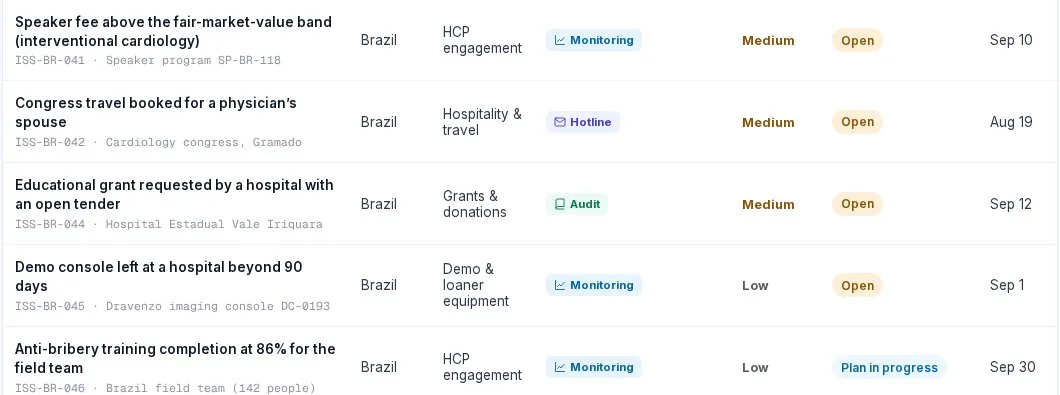
The other risk areas. Lower rows of the Brazil list: a speaker fee, a spouse's travel, a grant during an open tender, loaned equipment and training.
A source passage. The numbered marks in the report open the passage, here the sample audit report's findings 3 and 5.
A figure's query, on hover. Readers of the report see the same thing from any figure.
Signed and locked. Approved, with the time of signature, and ready to send.
The dashboard. How the report is produced and what it says. Sample figures.
Plans by market. Open and overdue plans, with each market's lead.
The eight sources. Refresh status per source, with the gap in view.
Rules and scoring. Your method, as settings. Never estimating a missing figure is locked.
Approvals and people. One approver, market reviewers, and a read-only role for audit.
Select a screen to open it larger. The company, distributors, hospitals, people and figures are fictional. The queries, audit passages and scoring factors are the product's sample content, to be replaced with your own.
In the sample, time from data close to a draft falls from 72 working hours to 36 minutes
Time to draft by quarter, on the product's sample dashboard: 9 days, 8 days, 2.5 hours, 52 minutes and 36 minutes. A working day counted as 8 hours.
72 hQ3 2025, by hand
64 hQ4 2025, by hand
2.5 hQ1 2026
0.87 hQ2 2026
0.6 hQ3 2026
Fictional example from this guide
Show the numbers
Quarter
Hours
Q3 2025, by hand
72 h
Q4 2025, by hand
64 h
Q1 2026
2.5 h
Q2 2026
0.87 h
Q3 2026
0.6 h
In the sample, Brazil pulls away from the other lines only in the last quarter
Residual risk by quarter, average of six risk areas, on the product's sample dashboard. High starts at 13.0.
BrazilMexicoAll markets
81012141310.38.9
Q3 2025Q4 2025Q1 2026Q2 2026Q3 2026
Fictional example from this guide
Show the numbers
Brazil
Mexico
All markets
Q3 2025
10.2
9.4
9
Q4 2025
10.6
9.7
8.9
Q1 2026
10.8
9.6
8.8
Q2 2026
11
9.8
8.8
Q3 2026
13
10.3
8.9
In the sample, distributors account for 24 of 83 issues
Distinct issues by risk area, Q3 2026
Distributors24
HCP engagement16
Public tenders13
Hospitality and travel13
Grants and donations9
Demo and loaner8
Fictional example from this guide
Show the numbers
Risk area
Distinct issues
Distributors
24
HCP engagement
16
Public tenders
13
Hospitality and travel
13
Grants and donations
9
Demo and loaner
8
15 · Agents, signers and systems
Six agents query, merge and draft; market leads confirm and the chief compliance officer signs
In shortEach agent has one job and limits it does not cross. They read the sources read-only, and none can change a score, an issue or a plan, approve anything or see who made a hotline report. People confirm the weak merges, review their own market and sign.
The six compliance reporting agents, and what each must never do
Query agent
Answers every number with one read-only query over the eight sources, and returns the value, query, row count and time.
Never fills an empty result with a guess, an average or last quarter's value.
De-duplication agent
Links hotline, audit, monitoring and investigation reports about the same party, place and allegation inside the match window.
Never merges below 0.85 similarity without the market lead, or moves reporter identity out of the hotline record.
Risk movement analyst
Attributes a market's change to risk areas, then to the control test or inherent rating behind it.
Never states a number without a query.
Issue driver analyst
Ranks distinct issues behind each moving area by severity, recurrence and channel count.
Never counts raw reports, or presents an allegation as a finding.
Mitigation and focus analyst
Reads plan status and due dates, flags overdue actions and works out the effect of finishing a plan with the scoring rules.
Never presents a projection as a fact.
Narrative writer
Writes the sentences beside the lines and the five report sections, with each figure a placeholder filled from a query.
Never releases a draft with an untraced figure: the figure check blocks it.
Who decides what in a compliance risk report: the four-eyes rule across five roles
Approves and signsChief compliance officerThe only approver. Signs by e-signature with its meaning, and approval locks the version.
Owns the methodCompliance analytics leadOwns sources, scoring factors and merge rules, and starts the run.
Confirms mergesMarket compliance leadConfirms low-similarity merges, reviews their market's section and owns plans.
Holds identityHead of investigationsThe only role that sees hotline reporter details. Owns cases.
Reads everythingInternal audit leadReads every figure and re-runs queries, read-only. Changes nothing.
The four-eyes rule means whoever drafts never approves: agents draft, people confirm and sign, and every query, merge and signature is on the activity trail, kept apart from people's actions. Every merge is reversible and logged. These are controls that support your own compliance program, and the regulatory and legal judgment stays yours. Botminds is SOC 2 Type II audited and manages information security to ISO 27001.
Lena, Maya, Rafael, Omar and Dana: the people in the screens
Fictional, from the sample data
LO
Lena Ortiz · chief compliance officer
Presents the quarterly report and signs it.
"If I put a number in front of the committee, I have to be able to show where it came from."
MC
Maya Chen · compliance analytics lead
Owns the eight feeds, the scoring rules and the run.
"Nine days of copy-paste, and the first question is always 'is this the same issue as the audit finding?'"
RS
Rafael Souza · market compliance lead, Brazil
Runs Brazil's risk assessment, confirms merges and owns plans.
"Tell me which distributor. 'Third parties went up' tells me nothing."
OH
Omar Haddad · head of investigations
Sees hotline reporter details and owns the cases.
"Write an allegation as an allegation until we have a finding."
DO
Dana Okafor · internal audit lead
Reads everything and changes nothing.
"Show me the query and I will re-run it myself."
From eight compliance sources to a signed report: what the solution reads and writes
Scores and tests
Risk assessment scores by market and risk area
Control testing results
Reports and registers
Speak-up hotline (allegation only)
Internal audit findings
Monitoring alerts
Investigations case log
Mitigation plans
Third-party due-diligence register
Agents query, merge and draftJoined on market, party and quarter, read-only
Every figure keeps its query
One person signs
Outputs
Residual risk slope chart per market and risk area
Risk map of every market and area
Distinct issues, each with its linked reports
Quarterly compliance risk report for the committee
Market analyses, added to the report if you choose
A stored, re-runnable query behind every figure
Systems a compliance reporting rollout connects to
Risk assessment files or toolWorkshop scores, by quarter
Control testingTests and samples
Hotline and case managementReports, without reporter details
Internal audit systemReports and numbered findings
Spend monitoringAlerts, credit notes, rebates
Third-party due diligenceRegister and review dates
Finance and sales systemsParty master data, tax IDs
Identity and accessRoles and separation of duties
The solution scales across markets, sources and quarters, inside the roles and access rules you set, with a full audit trail and export. For each system, ask whether it offers an API, a file feed or only screens, and who owns it.
Part C · Are you ready to automate?
Automating the quarterly compliance risk report: what weak figures cost, what it returns and how to test it
You run compliance, or build the report, or sit on the committee that reads it. This part is written for you: what errors and delays cost today, what automating the report could return, whether your team is ready, and what to ask any vendor of compliance reporting software, including us.
16 · What weak figures cost
What a hand-built compliance report costs you: analyst days, late warnings and figures you cannot defend
In shortThe hours are the smallest part. Three people for nine days comes to about $24,000 a report at an illustrative $110 an hour. The larger exposure is a warning that sat unconnected, or a number that fell apart when a director asked. Published penalties frame that exposure, and they say nothing about your own odds, so start from what you can measure.
$202M
settlement over speaker programs, April 2025, with about $176.9 million going to the US.20
HHS OIG, on the US Attorney's announcement
0.1–20%
of gross revenue: the range of administrative fines under Brazil's anti-corruption rules, before any reduction for a program.14
Decree 11,129/2022, per Demarest
5%
of worldwide turnover, or €40 million, as the top fine for bribery that EU national laws must reach by June 2028.9,10
Directive (EU) 2026/1021
Review stays at half a day; the time comes out of the five steps before it
Working days for one quarterly report across 12 markets and six risk areas
By hand (estimate)With the solution (estimate)
Exporting and cleaning eight sources2 days0.1 days
Matching reports across channels2 days0.2 days
Working out what moved2 days0.1 days
Checking plans and overdue actions1 day0.1 days
Writing the narrative1.5 days0.1 days
Checking figures, review and signature0.5 days0.5 days
Illustrative · replace with your own numbers · 9 days against 1.2. Neither is a measurement. Time your own next report, and measure the second column in a pilot.
Show the numbers
Step
By hand (estimate)
With the solution (estimate)
Exporting and cleaning eight sources
2 days
0.1 days
Matching reports across channels
2 days
0.2 days
Working out what moved
2 days
0.1 days
Checking plans and overdue actions
1 day
0.1 days
Writing the narrative
1.5 days
0.1 days
Checking figures, review and signature
0.5 days
0.5 days
What nobody publishes. We found no public figure for hours per quarterly report, the share of reports that repeat another channel, how often report figures contain errors, or how often a hotline matter was already visible in monitoring data. Vendors quote savings without an independent test. Measure your own.
Timing one quarterly report and tracing ten figures to find your baseline
Cost
Where it hides
How to find your number in a week
Analyst days
Exports, cleaning and retyping
Ask the team to log the last report's days by step, then time the next one
Figures you cannot trace
Numbers typed into slides
Pick ten figures from your last report. Time how long each takes to trace, and count the ones you cannot
Double counting
Four channels, four lists
Take one market's quarter and match every report by hand. Compare the two counts
Late connections
An alert and a hotline report about the same party, weeks apart
For your last five closed cases, find the first sign in any channel and the date the channels were linked
Gaps papered over
A missing feed filled with last quarter's value
List the feeds that arrived late in the past four quarters, and what the report said
Stale third-party checks
A renewal calendar kept by a local team
Pull overdue reviews by market and risk tier on one date
Questions between meetings
Each director's question restarts the export
Count ad hoc requests last quarter, and the hours spent on them
The missed connection, the lost credit, and other costs a reporting calculator misses
A warning nobody connectedEach channel saw a part. By the time they were linked, the conduct had run for another quarter.
The disclosure window you used upDOJ's 2026 policy counts 120 days from an internal whistleblower report. A slow link eats into it.
Your credibility with the committeeOne wrong figure makes directors doubt the others. You pay for that for several quarters.
A person named too earlyAn allegation written as a fact can damage someone who turns out to be cleared.
What leaves with your analystThe method, and the unwritten knowledge of which feed is always late.
17 · Your return
What automating the quarterly report returns: analyst days, market lead hours and duplicate chasing against the tool's cost
In shortPut in your own numbers. Every default marked illustrative is an assumption to replace. On the defaults, hours alone cover a yearly cost of $100,000 from about six markets, by a modest margin, so the case rests on traceable figures and earlier connections. For a small program, a better spreadsheet and a written method may serve you well.
Analyst days, traceable figures, earlier links: where compliance reporting can pay back
Analyst time
Days out of the build
Exports, matching and first drafts come off the team, which keeps the review.
reports × people × days saved × hours × hourly cost
Market leads
Less chasing per market
Leads confirm weak matches and read a draft, with no spreadsheet to fill in first.
reports × markets × hours saved × hourly cost
Investigations
Duplicates merged early
Fewer reports are triaged twice by different teams.
reports × duplicates × hours saved × hourly cost
Defensibility
Every figure traced
A director's question takes a minute, and an auditor can re-perform a number.
share of figures traced; minutes to trace ten figures
Earlier warning
Channels linked sooner
Reports about one party are linked within days, well before quarter end.
days from first signal to linked issue, on past cases
Frequency
A view between meetings
With the join automated, a monthly look costs little extra.
requests answered without a new export
Reports a year, people on the build and markets: your compliance reporting numbers
No source publishes these inputs. Every default is an assumption, marked illustrative.
The reportMarkets and duplicatesYour cost
Illustrative yearly value
Report building today, valued$0
Analyst time released, valued$0
Market lead time released, valued$0
Duplicate chasing released, valued$0
After your yearly cost$0
Hours released a year0
Committee reports to cover your cost, rounded0
Formulas, per year (reports = committee reports): Building today = reports × people × days by hand × hours × hourly cost Analyst time = reports × people × (days by hand − days with automation) × hours × hourly cost Market leads = reports × markets × hours saved × hourly cost Duplicates = reports × duplicates × hours saved × hourly cost After your cost = the three released amounts − yearly cost Reports to cover your cost = yearly cost ÷ value per report
Not counted: penalties avoided, earlier links between channels, or lost credit with your committee. Released hours are value only when you decide what they are for, such as more testing, faster triage or a monthly view.
Hours alone pass $100,000 a year from about six markets on these defaults
Yearly value of time released, before cost, with the calculator's defaults and duplicates scaled to market count
4 markets$96.1K
12 markets$123.6K
30 markets$185.6K
Illustrative · replace with your own numbers
Show the numbers
Markets reported
Yearly value, before cost
4 markets
$96.1K
12 markets
$123.6K
30 markets
$185.6K
A company reporting 12 markets clears a $100,000 cost by about $24,000 on these defaults. A company reporting four markets once a year, with a clean register and one analyst, has little to gain from software, and a written method and a shared spreadsheet will serve it better.
Start here18 · Readiness check
How ready your compliance team is: markets, data keys, a written scoring method, traceable figures and sign-off
In shortPick the answer closest to your team today. Eight questions score 0 to 2, and the last is for reflection. The meter adds up your score as you go, and each question says why it matters and what a strong answer sounds like.
1
Markets and channels
How many markets and reporting channels does your report cover?
Why it mattersThe join is the hard part. With few markets and one channel, a spreadsheet can hold it.
A strong answer"Twelve markets, four channels, and distributors in most of them."
2
Shared keys across sources
Can you match a distributor across your hotline, audit, finance and due-diligence data?
Why it mattersMatching rests on party identity. Without tax IDs or a party list, every merge is a guess.
A strong answer"The register holds tax IDs for all active parties, and finance uses the same list."
3
A written scoring method
Are likelihood, impact, control factors and thresholds written and approved?
Why it mattersSoftware applies the rules you give it. Regulators ask what your methodology is.
A strong answer"One page, approved by the committee in January, with the factors and the High line."
4
Your baseline
Do you know the days the quarterly report takes, and how many hotline, audit and monitoring reports repeat another channel?
Why it mattersNo public benchmark exists, so your own numbers are the only way to prove a change.
A strong answer"About 9 days, and a hand count of one market showed 30% duplicates."
5
Tracing a figure today
If a director points at a figure in your last report, how fast can you show its source?
Why it mattersThis is the question the report has to survive. The answer shows how far you have to go.
A strong answer"Within the hour, from a saved file and its filter."
6
Hotline data and reporter identity
Can you separate the allegation from the reporter's identity before any shared analysis?
Why it mattersEU law limits who may see identity, and any analysis must respect it.
A strong answer"The hotline exports allegation fields only, and counsel and privacy have reviewed it."
7
Owner and budget
Is there a named owner of the report with the budget and authority to change how it is built?
Why it mattersThis work crosses compliance, audit, finance and investigations, and it stalls without one owner.
A strong answer"Our CCO sponsors it, and the analytics lead runs the pilot."
8
Who approves, and how AI is governed
Have legal, investigations and audit agreed what software may draft, what people must confirm, and who signs?
Why it mattersDOJ asks about controls on AI in compliance programs, and about the human baseline.1
A strong answer"Software drafts, market leads confirm weak merges, the CCO signs, and audit tests a sample each quarter."
9
A live view of compliance risk · for reflection
If your committee could see risk move every month, with every figure traceable, what would you do differently, and what would have to be true of your data?
Why it mattersYour answer lists the gaps. Each is a job to do, for people or for software.
A strong answerA short, specific list, for example: "move test results to monthly, add tax IDs in three markets, and agree an escalation path."
A low score means writing the scoring method before anything else
0–6
Explore
Write the scoring method on one page, build a party list for your riskiest market, and trace ten figures from your last report. Those three steps improve the next report on their own.
7–11
Ready to pilot
Replay two past quarters and score the merges, the figures and the wording against what you know now. Then run one live quarter in parallel with your usual report.
12–16
Ready to implement
Plan all eight sources, your scoring rules and merge thresholds as settings, roles across markets, audit access and a monthly view for the committee if it wants one.
19 · Questions for any vendor
What to ask compliance reporting software about traced figures, merges, reporter identity and empty results
In shortAsk every vendor the same questions, us included. The answers show where each number comes from, how merges are tested, who sees what, and how you would measure the tool on your own past quarters.
Ask
A good answer
A warning sign
Figures
Where does each number in the draft come from?
A stored, read-only query you can open and re-run from the sentence
"The AI summarizes your data"
What stops a number with no source?
A check that blocks the draft, listing the figure
A reviewer is expected to notice
What happens when a feed is missing or a query returns nothing?
The report says none or not available, and that rule is locked
It carries over or estimates to keep the chart whole
Counting issues
How do you match reports about the same matter?
Party by tax ID or name, place, allegation and a window you set
A similarity score with no explanation
What precision and recall have you measured, and how?
Reported on labeled data, by language and channel, with a human baseline
One accuracy figure
Who confirms a weak match, and can it be undone?
A named lead below a threshold you set; each merge is logged and reversible
Merges are final
Wording
How are allegations kept from reading as findings?
Status drives the wording, and investigations can review it
A style guide only
How are projections labeled?
Marked in the sentence, with the rule and what it assumes
Projections read like results
People and identity
Can the software see who made a hotline report?
No: allegation fields only, with reporter details staying in the hotline
Full export into the model
Can it change a score, an issue or a plan?
No, its access is read-only
"It keeps your data up to date"
Who can approve?
A named person, by e-signature with meaning, and the version locks
Auto-publish on a schedule
Your method and data
Whose scoring method does it use?
Yours, as settings with an owner and a date
A vendor score you cannot see
Which AI models do you use, where do they run, and do our records train them?
Named models, a region you choose, no training on your data, in writing
"Proprietary AI", no more detail
What can you say about GxP, Part 11 and Annex 11?
Which controls support your compliance, and what you must validate yourself
"We are Part 11 certified"; no product can be
Proof
Can we replay two past quarters before we sign?
Yes, on your exports, with your own hand count as the baseline
Demo data only
What will you report from the test?
Figures traced, merge precision and recall, wording errors, hours
A customer quote
We found no published independent test of any vendor's accuracy on compliance report drafting or hotline matching as of November 2026. A replay on your own past quarters is the fairest comparison, and it also measures your current process.
20 · How to start
Replay two past quarters against your own hand count, then decide on four numbers
In shortWrite down your scoring method, count one market by hand, replay work you have already finished, and run one live quarter in parallel. None of these steps commits you to a vendor, and the method and the hand count improve your next report either way.
Trace ten figures and time one report, so you know how long a director's question takes today.
Write the scoring method on one page, with factors and thresholds, and have your committee approve it.
Match one market by hand for two past quarters: the reports, the issues and your reasons. This is your test set.
Replay those quarters, then run one live quarter in parallel, with your usual report still going to the committee.
Decide with four numbers: figures traced, merge precision, merge recall and wording errors, along with the hours saved.
A sixteen-week pilot ends with one live quarter compared side by side
Your teamVendor
Trace ten figures; time one report
Write the method; hand-count one market
Clear hotline fields with counsel and privacy
Connect exports; set scoring and merge rules
Replay two past quarters
Score merges, figures and wording
Run one live quarter in parallel
Decide with the committee
Week 0481216
Illustrative · replace with your own numbers
Show the numbers
Activity
From
To
Trace ten figures; time one report
0
2
Write the method; hand-count one market
1
5
Clear hotline fields with counsel and privacy
1
4
Connect exports; set scoring and merge rules
3
7
Replay two past quarters
6
9
Score merges, figures and wording
8
10
Run one live quarter in parallel
10
15
Decide with the committee
15
16
Figures traced, merge precision and recall, wording: how to score a compliance reporting pilot
Measure
How
Why
Figures traced
Open every figure: does its query run and return the same value?
This is the point of the exercise, and anything below all of them needs explaining
Merge precision
Of merges made, the share your investigators agree with
A wrong merge can hide a matter from the count
Merge recall
Of the true duplicates in your hand count, the share found
A missed merge inflates a market. Run a second person to see how much humans disagree
Wording errors
Allegations as facts, projections as results, gaps left unstated, per report
One of these can do more harm than any count error
Identity leak test
Plant reporter details in a test export and search every output for them
Reporter details should never appear, and the test is a simple pass or fail
Hours and days
A log by step, for one quarter, including review
The business case rests on them
The full working-session questions: 15 questions in five groups
Bring compliance, investigations, internal audit, finance, privacy and IT into one room. Each question says why it matters and what a strong answer looks like.
A
Your markets, sources and report calendar
A1
Which markets and risk areas does the report cover, and is that list agreed?
Why it mattersThe taxonomy sets every chart that follows.
Strong answer"Twelve markets, six areas, reviewed each January."
A2
When does each source close, and which one is always late?
Why it mattersA late feed needs a rule, set before the deadline.
Strong answer"Audit reports land mid-quarter; monitoring closes on day 5."
A3
Who else reads this: the audit committee, the board, regulators under an agreement?
Why it mattersA monitor or corporate integrity agreement may set its own reporting terms.
Strong answer"Committee quarterly, and a summary to the board's audit committee."
B
Scoring rules, thresholds and control ratings
B1
Who sets the control factors, and when did they last change?
Why it mattersChanging a factor moves every score, which needs its own note.
Strong answer"The analytics lead proposes, and the committee approves, each January."
B2
What makes a control Weak, and is it based on a test?
Why it mattersA rating with no test behind it cannot be explained.
Strong answer"Below 70% pass on the sampled test, recorded with the sample."
B3
Do we report the highest cell as well as the average?
Why it mattersAverages can hide one very bad area.
Strong answer"Both, and any cell in the High band is named."
C
Party keys, distributors and matching rules
C1
Is there one list of third parties with tax IDs, and who owns it?
Why it mattersMatching relies on it.
Strong answer"Procurement owns it, compliance checks it quarterly."
C2
Which reason codes on credit notes and rebates does compliance monitor?
Why it mattersDOJ and the SEC name large discounts to distributors as a red flag.21
Strong answer"Marketing support, price adjustment and any code with no contract behind it."
C3
What window, and what similarity threshold, would investigators accept?
Why it mattersThey carry the cost of a wrong merge.
Strong answer"45 days, and anything below 0.85 goes to a person."
D
Hotline identity, privilege and data location
D1
Which hotline fields may leave the hotline system, in which countries?
Why it mattersEU rules limit identity, and national laws add more.13
Strong answer"Allegation, party, date and category; counsel signed off by country."
D2
How do we treat privileged investigation material?
Why it mattersCopying it into a shared tool may raise a privilege question for counsel.
Strong answer"Status and category only, with case notes staying in the case system."
D3
What does audit need in order to rely on the numbers?
Why it mattersAudit may re-perform figures and test the tool.
Strong answer"Read access, the query log and a quarterly sample."
E
A monthly view of risk for the committee
E1
What would we do with a monthly view that we cannot do today?
Why it mattersDOJ asks about snapshots against continuous access.1
Strong answer"Catch overdue third-party reviews before quarter end."
E2
Which matters should reach the CCO within days, whatever the calendar says?
Why it mattersUnder DOJ's policy, the 120 days run from the internal report, whether or not you have connected it yet.8
Strong answer"Any high-severity allegation raised in two channels."
E3
Which steps would we never let software do without a person?
Why it mattersThis tells you where the signatures belong.
Strong answer"Approving, wording an open case, and judging whether a matter is substantiated."
21 · Frequently asked questions
Compliance risk reporting questions answered: board reports, residual risk, hotline benchmarks, DOJ and AI
In shortQuestions compliance officers and buyers search for, each answered on its own.
What is compliance risk reporting?
Compliance risk reporting is the periodic report a chief compliance officer gives a compliance committee and board on where the risk of misconduct moved, why, and what is being done. In pharma and medtech it usually covers each market and risk area, such as paying health care professionals, distributors and public tenders. It draws on risk assessment scores, control tests, hotline reports, audit findings, monitoring alerts, investigations, mitigation plans and third-party due diligence.
What should a board compliance report include?
A strong report says what moved, which issues drove it, how mitigation plans are going, where leaders should focus, and what data is missing. Each number should be traceable to its source. General guidance from the Office of Inspector General at the US Department of Health and Human Services says the compliance officer's reports should cover the program, its activities and risks, along with concerns received and investigations conducted.
How often should a chief compliance officer report to the board?
The General Compliance Program Guidance from the Office of Inspector General at the US Department of Health and Human Services says the board should meet the compliance officer on a regular basis and no less than quarterly, with time in executive session, and that the Compliance Committee should meet no less than quarterly. That guidance is voluntary. The US Sentencing Guidelines say the person running the program should report periodically on its effectiveness and have direct access to the board.
What is the difference between inherent risk and residual risk?
Inherent risk is how likely and how harmful a problem would be if your controls did nothing. Residual risk is what remains once your controls are counted. A residual score can jump with no new misconduct, because a failed control test weakens your protection while the inherent risk stays the same.
How do you calculate residual compliance risk?
A common method multiplies likelihood by impact, each rated 1 to 5, to get inherent risk, then multiplies by a factor for how well controls work. For example, an inherent risk of 20 with a factor of 0.60 scores 12, and with 0.95 scores 19. No regulator publishes these factors, so companies set their own, write them down and apply them alike across markets.
What does DOJ's Evaluation of Corporate Compliance Programs say about data?
The September 2024 version from the US Department of Justice asks whether compliance staff have access to relevant data sources, whether anything limits or delays that access, and how the company uses analytics to measure its program. It also asks how the company measures the accuracy, precision or recall of its analytics models, and whether a risk assessment is a snapshot or based on continuous access to operational data. It adds questions on governing AI used in the business and in the compliance program.
Did the FCPA pause reduce compliance risk for drug and device companies?
US enforcement dropped: the law firm Gibson Dunn counts eight Foreign Corrupt Practices Act (FCPA) and related actions in 2025 and none from the Securities and Exchange Commission, after an executive order in February and new guidelines in June. The statute still stands, and the EU adopted a new anti-corruption directive in 2026 while the UK added a failure to prevent fraud offense in 2025. False Claims Act recoveries reached a record of over $6.8 billion in fiscal 2025, more than $5.7 billion of it from health care.
How many hotline reports per 100 employees is normal?
NAVEX's 2025 benchmark gives a median of 1.57 reports per 100 employees for 2024, among organizations that received at least 10 reports that year, with public companies at 1.10 and private organizations at 1.80. A rate above the median can mean people trust the hotline, so read it with other evidence. NAVEX's 2026 edition reports that volume is up 40% since 2020 among organizations tracking all intake sources.
What share of hotline reports are substantiated?
NAVEX's 2025 benchmark puts the median substantiation rate at 46% for 2024, the highest it has recorded, with retaliation reports at 18%. This is why a compliance report should word an open matter as an allegation until an investigation reaches a finding, and why report counts alone say little about misconduct.
How do you stop the same matter being counted twice across hotline, audit and monitoring?
Match reports on the same party, by tax ID or registered name, the same place, the same kind of allegation and dates inside a set window, such as 45 days. Have a person confirm weak matches, keep every merge reversible and logged, and report both raw reports and distinct issues. Then test your matching with precision and recall on a set you counted by hand.
What are the red flags for distributors in pharma and medtech?
The FCPA Resource Guide from the US Department of Justice and the Securities and Exchange Commission lists excessive commissions, unreasonably large discounts to third-party distributors, vaguely described consulting agreements, and a third party that was added at an official's request. In practice, compliance teams also watch for margins above contract, credit notes with vague reason codes, overdue due diligence and sub-distributors appointed without approval.
Can AI write a compliance risk report?
Software can read the sources, suggest merges and draft sentences, but each figure should come from a stored query so it never rests on a language model's output, and an empty result should stay empty. People should confirm weak merges, review wording on open cases and sign the report. The US Department of Justice asks how you govern AI in a compliance program, including the baseline of human decision-making you test it against.
Do FDA's AI guidance, Part 11 or Annex 22 apply to compliance risk reports?
Mostly no, in our reading. FDA's January 2025 draft guidance does not address AI used for operational efficiencies that do not affect patient safety, drug quality or study reliability, and draft EU GMP Annex 22 is a still-unadopted manufacturing text. Part 11, FDA's rule on electronic records and signatures, is tied to records that other FDA rules require, which a commercial risk report usually is not. Ask your quality and legal teams to confirm for your records.
22 · One-page summary
Compliance risk reporting on one page: the method, the November 2026 rules and the terms
Print this page
In shortThe whole guide on one screen: the method, the rules as of November 2026, the readiness bands and the terms.
The method
Write the scoring method and thresholds on one page, and have them approved.
Gather the eight sources, join them on market, party and quarter, and note any gap.
Match reports into issues. Report both counts, and have a person confirm weak merges.
Trace each move in a score to a control test or a rating change.
Write every figure from a stored query. Write "none" or "not available" when that is the answer.
Word allegations as allegations and projections as projections. Keep reporter identity in the hotline.
The CCO reviews and signs. Lock the version, and keep the record.
Readiness: score 0–2 on eight questions: 0–6 explore · 7–11 pilot · 12–16 implement.
As of November 2026: DOJ's compliance evaluation guide, September 2024 · FCPA guidelines, June 9, 2025 · DOJ department-wide enforcement policy, March 10, 2026 · OIG quarterly expectation, voluntary · EU Anti-Corruption Directive published May 11, 2026, national laws due June 1, 2028 · UK failure to prevent fraud, September 1, 2025 · Brazil fines 0.1% to 20% · FDA's AI guidance still a draft · draft EU GMP Annex 22 not adopted, and not about commercial compliance.
14 terms
CCO
Chief compliance officer, who owns the program and signs the report.
Compliance Committee
Senior leaders who support the program and hear the report.
Market
A country or region reported as one unit.
Risk area
A kind of commercial risk, such as distributors or tenders.
Inherent risk
Likelihood times impact, before controls are counted.
Control rating
How well a control works, set from tests.
Residual risk
What remains after controls are counted.
Report
One entry in one channel. Also short for the quarterly report.
Issue
The matter behind one or more reports.
Match window
How far apart two reports may be and still merge.
Substantiated
Found to be supported after review.
Mitigation plan
An agreed action to lower a risk, with an owner and a date.
Due diligence
Checks on a third party before and during the relationship.
Qui tam
A suit a private person brings for the government.
23 · Sources
Sources
Accessed November 2026. Regulatory status statements are as of November 2026.
U.S. Department of Justice, Criminal Division, "Evaluation of Corporate Compliance Programs", updated September 2024: pages 3 and 4 (risk assessment, new technology), 8 and 9 (third parties), 13 (data resources), 17 and 18 (testing and measurement). justice.gov
NAVEX, "Whistleblowing statistics: 2025 benchmark report", data year 2024: 4,077 organizations with 10 or more reports, 2.15 million reports. navex.com
U.S. Sentencing Commission, Guidelines Manual, effective November 1, 2026, Chapter 8, section 8B2.1(b)(2) and (c). ussc.gov
HHS Office of Inspector General, General Compliance Program Guidance, 2023 (voluntary): Compliance Committee and board meetings, disclosure log, risk assessment, data analytics. oig.hhs.gov
Gibson Dunn, "2025 Year-End FCPA Update": action counts by presidential term, eight actions in 2025, no SEC action, Executive Order 14209 of February 10, 2025. gibsondunn.com
Office of the Deputy Attorney General, "Guidelines for Investigations and Enforcement of the Foreign Corrupt Practices Act (FCPA)", June 9, 2025. justice.gov
UK Home Office, "Offence of failure to prevent fraud (introduced by ECCTA)", in effect September 1, 2025. gov.uk
U.S. Department of Justice, "Corporate Enforcement and Voluntary Self-Disclosure Policy", Appendix B, Corporate Whistleblower Awards Pilot Program exception. justice.gov Issue date and change from 2025: Paul, Weiss, March 12, 2026. paulweiss.com
Directive (EU) 2026/1021 of April 29, 2026 on combatting corruption, Official Journal L series, May 11, 2026: Articles 14, 37 and 39. publications.europa.eu
Reed Smith, "EU Anti-Corruption Directive now in force": fines, compliance programs and window dressing. Reed Smith gives June 1, 2026 for entry into force; Article 39 of the Directive gives the twentieth day after publication. reedsmith.com
HHS Office of Inspector General, "Special Fraud Alert: Speaker Programs", November 16, 2020. oig.hhs.gov
Clifford Chance, briefing on DOJ's department-wide corporate enforcement policy, March 13, 2026. cliffordchance.com
Directive (EU) 2019/1937 on the protection of persons who report breaches of Union law, Articles 9 and 16, read at legislation.gov.uk. legislation.gov.uk
Demarest, "Decree No. 11,129/22, which regulates Law No. 12,846/13 (Anti-Corruption Law) and revokes Decree No. 8,420/15, published". demarest.com.br
Cleary Gottlieb, "New Anticorruption Decree Modifies Regulation of Brazilian Clean Companies Act", 2022. clearygottlieb.com
Jones Day, "China finalizes its first anti-corruption guidelines for the health care and life sciences industry", January 2025. jonesday.com
Court of Chancery of Delaware, In re Clovis Oncology, Inc. Derivative Litigation, C.A. No. 2017-0222-JRS, memorandum opinion, October 1, 2019. courts.delaware.gov
Skadden, "The Court of Chancery Holds That Corporate Officers, Like Directors, Owe a Duty of Oversight", June 2023, on In re McDonald's Corporation Stockholder Derivative Litigation (January 25, 2023). skadden.com
Morgan Lewis, "DOJ announces highest-ever annual False Claims Act recoveries, over $6.8 billion in fiscal year 2025", January 20, 2026. morganlewis.com
HHS Office of Inspector General, enforcement action: U.S. Attorney announces $202 million settlement with Gilead Sciences over speaker programs, April 29, 2025. oig.hhs.gov
U.S. Department of Justice and Securities and Exchange Commission, "A Resource Guide to the U.S. Foreign Corrupt Practices Act", second edition: common red flags associated with third parties. justice.gov
MedTech Europe, Code of Ethical Business Practice, with Q&A, September 2024 edition: Chapters 1 and 3 (events), 4 (grants and charitable donations), 5 (consulting), 9 (demonstration products and samples), 10 (third party intermediaries). Binding on corporate members January 1, 2017; revised version in force January 1, 2023. medtecheurope.org
Cox LA Jr., "What's wrong with risk matrices?", Risk Analysis 2008;28(2):497-512, PMID 18419665. pubmed.ncbi.nlm.nih.gov
NAVEX, press release on the 2026 Whistleblowing and Incident Management report and webinar, March 23, 2026. navex.com
U.S. Securities and Exchange Commission, Litigation Release No. 22306, on Biomet, Inc., March 26, 2012. sec.gov
Business Insurance, "Medical device maker Zimmer Biomet resolves US bribery probe, Mexico and Brazil", January 12, 2017. businessinsurance.com SEC order, In the Matter of Biomet, Inc., Release No. 79780, January 12, 2017. sec.gov
U.S. Securities and Exchange Commission, In the Matter of Orthofix International N.V., Release No. 79828, January 18, 2017: disgorgement $2,928,000, prejudgment interest $263,375, civil penalty $2,928,000. sec.gov
Centers for Medicare & Medicaid Services, Open Payments: Program Year 2025, page modified June 30, 2026. cms.gov
Association of Certified Fraud Examiners, "Occupational Fraud 2026: A Report to the Nations". acfe.com
Dean Dorton, "ACFE's 2026 Report to the Nations highlights ongoing fraud risks for organizations". deandorton.com
White & Case and KPMG, "Global Compliance Risk Benchmarking Survey 2023", as reported by Radical Compliance, June 15, 2023 (9% advanced, 24% rudimentary) radicalcompliance.com and the Society of Corporate Compliance and Ethics (69% rudimentary or developing, 21% no analytics). corporatecompliance.org
FDA, draft guidance, "Considerations for the Use of Artificial Intelligence to Support Regulatory Decision-Making for Drug and Biological Products", January 2025. fda.gov
European Medicines Agency, "Artificial intelligence" (reflection paper adopted September 2024). ema.europa.eu
European Commission, "AI Act": the AI Omnibus, Regulation (EU) 2026/1744, in force July 27, 2026; Annex III rules December 2, 2027; Annex I product rules August 2, 2028. digital-strategy.ec.europa.eu
FDA, Guidance for Industry, "Part 11, Electronic Records; Electronic Signatures: Scope and Application", September 2003. fda.gov
FDA, "Computer Software Assurance for Production and Quality Management System Software", final guidance, February 2026. fda.gov
PIC/S and European Commission, draft Annex 22: Artificial Intelligence, joint consultation July 7 to October 7, 2025, section 1. picscheme.org
European Commission, EudraLex Volume 4, read November 3, 2026: Annex 11 at its January 2011 revision and no Annex 22. health.ec.europa.eu
ISPE, "GAMP Guide: Artificial Intelligence", July 2025. ispe.org
Next step
See it on your own quarter.
Explore the solution, or bring the exports from a past quarter and the report your committee actually received, and we will trace its figures and count its issues with you.
We use essential cookies to make this site work, and cookieless, anonymised analytics to understand how it's used. "Accept all" also turns on Google Analytics, which sets cookies. Privacy policy