A pitch book is the presentation a financial firm puts in front of a prospective client to win its business. In investment banking it is the deck a bank shows a company's management or board to win a mandate to advise on a sale, an acquisition or a capital raise, full of valuation ranges, comparable companies and the bank's credentials. In asset management it is the deck a manager shows a pension plan, endowment or other institution, usually through its investment consultant, to win a mandate to manage money: the firm, the team, the process and, above all, the strategy's investment record. The words are the same and the documents are not. The asset manager's pitch book sells a track record to a fiduciary, and under US rules it is an advertisement whose performance pages must follow specific conditions. Botminds' Pitch Book Creation is built for that second kind: agents assemble each deck from approved slides, refresh and re-read every figure at its source and check it against the SEC Marketing Rule before compliance approves the release.
Three decks called a pitch: who sends each, to whom, and what its numbers are
Investment banking pitch book
From
A bank’s coverage and deal team
To
A company’s management and board
Sells
A transaction and the bank’s advice on it: a sale, an acquisition, a debt or equity raise
Its numbers
Estimates: valuation ranges, comparable companies, precedent deals, the bank’s league-table rank
Asset management pitch book
From
An investment adviser’s marketing and investment team
To
A fiduciary: a pension plan, endowment, foundation or insurer, often through its consultant
Sells
A mandate to manage money in one strategy
Its numbers
A realised record: composite returns net and gross, holdings, attribution, fees
Startup pitch deck
From
A company’s founders
To
Angel, venture or growth investors
Sells
Shares in the company
Its numbers
A plan: market size, traction, projections, the raise and its use
What is a pitch book in investment banking?
In investment banking a pitch book is the presentation a bank's coverage and deal team prepares to win a mandate from a company. A typical one opens with the bank's credentials, moves to a view of the company and its market, sets out valuation ranges from comparable companies, precedent transactions and discounted cash flow, and ends with the proposed transaction, the likely buyers or investors, the timetable and why this bank should lead it. Junior bankers typically build them under deadline, and a meeting can go through several versions as the analysis changes.
Its numbers are estimates and the reader knows it. A valuation range is the bank's opinion of what a company might fetch; a list of comparable deals is a selection made to support that opinion. The company's board reads the book to judge the bank's thinking, not to rely on the figures as a record. That is the first and deepest difference from the asset manager's document.
What is a pitch book in asset management?
In asset management a pitch book is the deck a manager uses to win a mandate to invest a client's money in one strategy. An institutional one covers the firm, the investment team and its stability, the philosophy and process, composite performance net and gross of fees, attribution, risk, current holdings and characteristics, how the strategy would meet the client's own investment policy, the proposed fee, and the disclosures. The finals version is tailored to one prospect and presented in person to its investment committee and consultant.
Its central numbers are not estimates. They are the strategy's realised record, calculated by performance measurement from real portfolios, and the reader will rely on them to choose a fiduciary. That is why the SEC regulates them. An adviser's pitch book shown to prospective clients is an advertisement under Rule 206(4)-1, and the SEC has said that tailoring a template presentation with an investor's name or basic details does not make it a private, one-on-one communication (86 FR 13024). What each page of one must show is laid out in an annotated investment pitch book example.
Pitch deck vs pitch book: is there a difference?
In common use, a pitch deck is a founder's presentation to investors and a pitch book is a financial firm's presentation to a prospective client, though people use the words loosely and many firms say "deck" for both. The distinction that matters is not the word but the direction of the sale. A startup's pitch deck asks investors to buy the company's shares on the strength of a plan; a bank's pitch book asks a company to hire the bank; an asset manager's pitch book asks an institution to hire the manager on the strength of a record.
One more meaning crowds the searches. PitchBook, written as one word, is also the name of a financial data company, and many searches for "pitchbook software" are about that product rather than about building presentations. When asset managers say pitch book software they mean the tools that build and govern their decks, which is what the rest of this series is about.
Two documents, two readers, two sets of rules
Set side by side, the banker's and the asset manager's pitch books differ on every line that matters to the people who build and check them. The comparison below is the one a banker moving to an asset manager's marketing team, or a student choosing between them, most needs.
The banker's pitch book and the asset manager's, line by line
Investment banking pitch book: A company’s CEO, CFO and board.
Asset management pitch book: An institution’s investment committee, trustees and staff, and their investment consultant.
Investment banking pitch book: A transaction and the bank’s advice on it.
Asset management pitch book: Ongoing management of the client’s money in one strategy.
Investment banking pitch book: Valuation ranges and comparables: opinions.
Asset management pitch book: Composite returns, holdings and fees: a record.
Investment banking pitch book: The bank’s own policies and the general securities laws, not the SEC Marketing Rule, which governs advisers’ advertisements.
Asset management pitch book: The SEC Marketing Rule, and FINRA Rule 2210 when a broker-dealer distributes it.
Investment banking pitch book: The deal team’s seniors.
Asset management pitch book: The portfolio manager for its claims, marketing compliance for its release.
Investment banking pitch book: One meeting, then superseded by the deal documents.
Asset management pitch book: Reused and refreshed every quarter; each released version kept for five years from last use.
The last row surprises people coming from banking. A banker's book is finished when the meeting ends. An asset manager's finals deck is the latest version of a document the firm has been refreshing for years, and every version it sent is a record it must keep, with the evidence behind its performance, for five years from the end of the fiscal year it was last used (Rule 204-2).
Why a manager's track record is regulated, and a banker's comparables are not
The asset manager's numbers are regulated because investors demonstrably treat them as a guide to the future, even when they are not one. A study of 294 mutual funds advertised in two US financial magazines found that their returns before the advertisements were well above their benchmarks, that there was no superior performance afterwards, and that the advertised funds still drew significantly more money than comparable funds (Jain and Wu, Journal of Finance, 2000).
The mechanism is selection. Fund companies advertise their best performers, and the median advertised fund ranked between the 79th and 100th percentile of performance; in experiments, both novice investors and financial professionals treated the advertised figures as if they were representative unless the advertisement made the selection plain (Koehler and Mercer, Management Science, 2009). Performance also carries further when marketing effort is high.
Search costs seem to be an important determinant of fund flows. High performance appears to be most salient for funds that exert higher marketing effort, as measured by higher fees.
Sirri and Tufano, 'Costly Search and Mutual Fund Flows', Journal of Finance, 1998
Trust is the other half. In a model of investors delegating to professional managers, "Trust in the manager reduces an investor's perception of the riskiness of a given investment, and allows managers to charge fees" (Gennaioli, Shleifer and Vishny, Journal of Finance, 2015). A pitch book is where that trust is built, which is why the rules insist that the record it shows be complete, comparable and current: net with gross, fixed periods, dated rankings and nothing selected to flatter.
What the research found about how performance is advertised and read
294
advertised mutual funds studied: no superior performance after the advertisements, but more money in
79th–100th
percentile: the range in which the median advertised fund’s performance rank fell
What an asset manager's pitch book must show that a banker's never does
An asset manager's pitch book must show the record in a form a reader can compare and trust. Under the Marketing Rule, gross returns need net returns beside them for the same period and method; non-private-fund performance needs one-, five- and ten-year periods ending no earlier than the latest calendar year-end; a third-party ranking needs its date, its period, who produced it and whether the adviser paid; hypothetical performance, such as a backtest or a target, needs policies and full context; and any case study about a holding must be fair and balanced (Rule 206(4)-1).
When a broker-dealer distributes the deck, FINRA's categories apply too. A communication made available only to institutional investors, a group that in FINRA Rule 2210 includes governmental entities and certain employee benefit plans, is an institutional communication, reviewed under written procedures; one distributed to more than 25 retail investors in 30 days is a retail communication that a principal must approve before use. A banker presenting to a company's board deals with none of this.
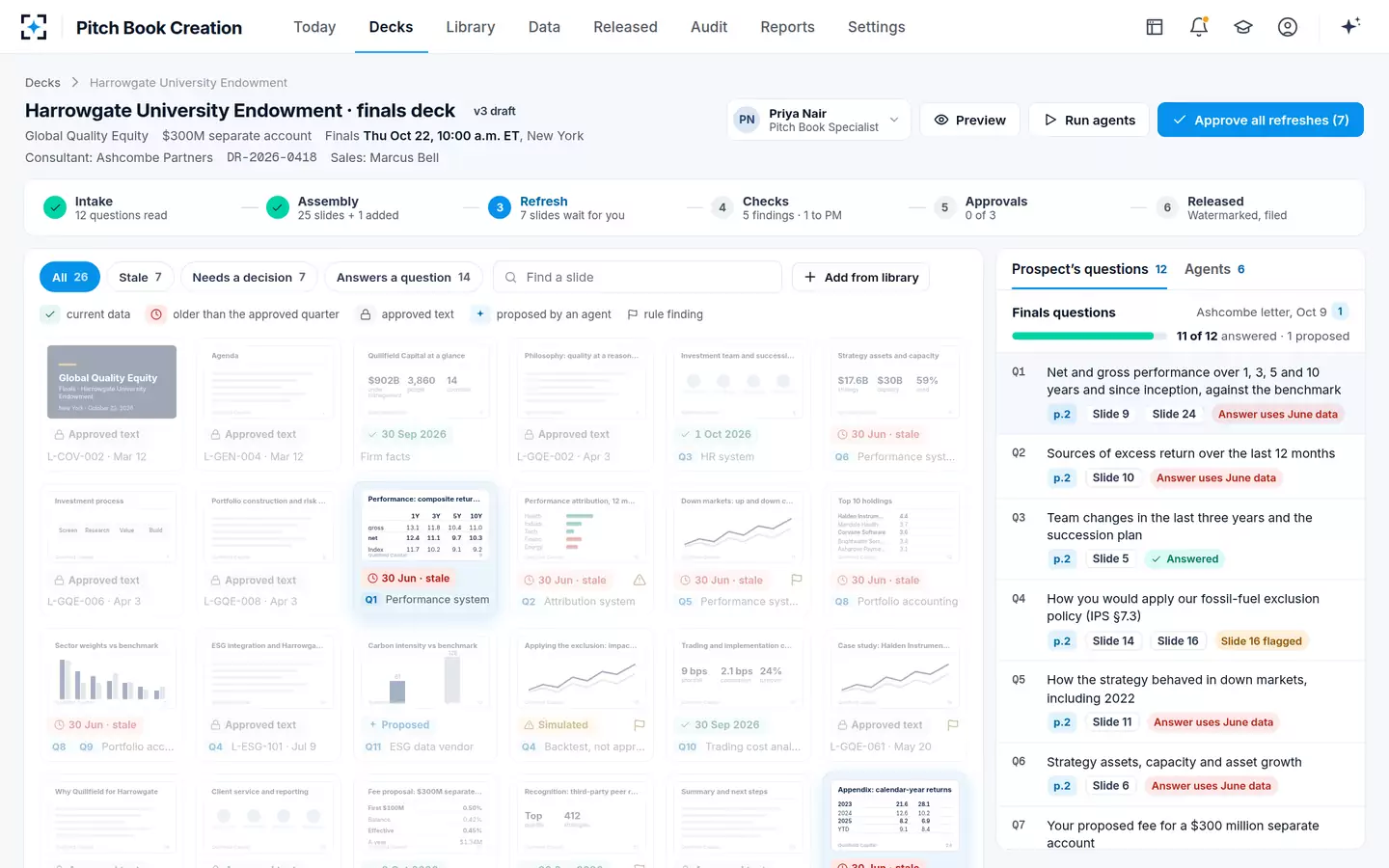
An asset manager's finals deck: every slide stamped, every consultant question mapped
Who reads an asset manager's pitch book: the fiduciary and the consultant
The asset manager's reader is a fiduciary choosing another fiduciary. A public pension plan's trustees, an endowment's investment committee or an insurer's investment office will hire the manager to act for its beneficiaries, and usually do so on the advice of an investment consultant who ran the search, narrowed the field and wrote the finals questions. The deck is read twice: by the consultant against their database and the manager's earlier answers, and by the committee in the room.
That double reading is why consistency matters as much as accuracy. A finals deck whose assets figure differs from the one in the consultant's database, or whose returns differ from last quarter's RFP answer without explanation, raises a question no slide can answer in the meeting. The SEC also treats material an adviser gives a consultant to pass on as the adviser's own indirect communication (86 FR 13024), so the consultant's copy is the firm's advertisement too. What the research says such committees actually decide on is the subject of what finals are decided on.
What a pitch book is not: the RFP response, the factsheet, the PPM
Asset managers produce several documents that overlap with the pitch book, and the differences decide who builds each and which rules apply. Treating them as one leads either to over-engineering a factsheet or to under-reviewing a deck.
The pitch book and its neighbours at an asset manager
| Document | What it is | How it differs from the pitch book |
|---|---|---|
| RFP or questionnaire response | Written answers to a consultant’s or client’s questions, often in their template. | Answers someone else’s questions in their format; the SEC said a response later made public under FOIA is not an advertisement merely because of that disclosure. |
| Consultant database profile | The manager’s entry in a consultant’s research database, updated quarterly. | Fields, not slides; read by the consultant long before any meeting. |
| Factsheet | A one- or two-page summary of a fund or strategy, refreshed monthly or quarterly. | Standard for every reader; a fund factsheet follows fund advertising rules. |
| Private placement memorandum | The offering document for a private fund. | Its terms, objectives and risks are not an advertisement, though a pitch book that accompanies it can be. |
| Client review deck | The quarterly or annual presentation to an existing client about its own account. | Performance of the client’s own account to that client is not an advertisement; offering new services in it can be. |
Pitch book software: building the asset manager's kind
Pitch book software for asset managers has to do what a banker's deck tools never needed: source every figure from an approved record, keep the required performance presentation intact, and leave behind evidence that a reviewer and an examiner can follow. Botminds' Pitch Book Creation does this with seven agents around the people who already sign. The Intake agent reads the RFP or finals letter, in any language; the Assembly agent builds from the approved slide library in the prospect's order; the Tailoring agent drafts prospect-specific text from approved language; the Refresh agent proposes the latest approved figures and stamps each slide; the Check agent re-reads every figure from source on its own; the Marketing Rule agent checks each slide and proposes fixes; and the Release agent locks, watermarks and files the approved version.
The specialist approves the refresh and the fixes, the portfolio manager confirms commentary and any figure that does not tie, the sales director approves the content and compliance approves the release, each with a reason code. For a banker, most of that would be overhead. For an asset manager, it is the job. To see it on a deck of your own, start from Pitch Book Creation, or read how the rules change for a hedge fund's deck.
Questions people ask
What are pitch books used for?
Pitch books are used to win a client's business. Investment banks use them to win advisory and financing mandates from companies; asset managers use them to win mandates to manage institutions' money; private fund managers use them to raise capital for a fund. An asset manager's pitch book is also an advertisement under the SEC Marketing Rule, with conditions on how performance is shown.
What is in an investment banking pitch book?
Usually the bank's credentials and league-table position, a view of the client and its market, valuation analysis from comparable companies, precedent transactions and discounted cash flow, the proposed transaction and buyers or investors, and the timetable. Its figures are the bank's estimates and opinions, which is the main difference from an asset manager's pitch book, whose figures are a realised record.
Is a pitch book the same as a pitch deck?
Often the words are used interchangeably. In stricter use a pitch deck is a founder's presentation to investors and a pitch book is a financial firm's presentation to a prospective client. In asset management "pitch book", "finals deck" and "presentation" all name the same regulated document.
What is PitchBook software?
PitchBook, as one word, is the name of a financial data company whose platform covers private companies, deals and funds. It is unrelated to pitch book production. Software for producing asset managers' pitch books is usually called pitch book, presentation automation or deck automation software.
Do bankers' pitch books fall under the SEC Marketing Rule?
The Marketing Rule, Rule 206(4)-1, applies to investment advisers registered or required to be registered with the SEC, and governs advertisements of their investment advisory services. An investment bank's pitch to a company for a merger or financing mandate is not that kind of advertisement, so the rule's performance conditions are not what governs its deck; the bank's own policies and the general securities laws are.
Who makes pitch books at an asset manager?
A pitch book specialist or presentation specialist in the marketing team builds them, with the portfolio manager or product specialist owning the content, the sales director approving it for the client, and marketing compliance approving the release. Performance measurement supplies the approved figures. The roles are set out seat by seat in this series' guide to asset management marketing roles.