How long a life insurance company can take to pay a claim depends on the state, but the shape is the same everywhere: the clock starts when the insurer has notice and proof, not on the date of death, and it runs in weeks. The NAIC's model rule, which states adapt, expects claim forms within 15 days of notice, an investigation begun within 15 days of proof of loss, and payment within 30 days once liability is accepted and the amount is not in dispute. Texas requires its policies to settle within two months of proof of death and of the claimant's right, and its prompt-payment statute sets shorter steps inside that. California gives 40 days from proof of claim to accept or deny, and both New York and California make a slow insurer pay interest. Behind every clock sits a claim file, and the delay is usually there, in documents being chased while the family waits. Botminds' Death Claims Processing reads that file the day each document arrives, so the examiner knows what is missing on day one rather than day thirty.
This guide is written for beneficiaries and for the claims compliance teams who answer them. It describes the rules; it is not legal advice on any one claim. The worked example is a sample claim in the solution, on fictional people and a fictional carrier.
The clocks a beneficiary can cite, in days, and what starts each one
How long does a life insurance company have to pay a claim? The short answer
Weeks after the insurer has everything it reasonably asked for, not weeks after the death. Every clock on this page starts at an event the claimant controls in part: the notice of claim, the proof of death and the forms that establish who is entitled. A certified death certificate can take days to arrive from the registrar, and a claimant statement, proof of identity and a tax form are needed from each payee. The NAIC model defines the starting document broadly: "proof of loss" means written proofs "or other reasonable evidence of the claim that is ordinarily required of all insureds or beneficiaries submitting the claims" (Model #903, section 3J).
So the practical answer for a family has two parts. The insurer's legal time runs from when it has the papers, and the fastest way to start it is to send what the claim packet asks for, all at once. The insurer's practical time is how fast it reads what arrives and tells you what is still missing, which no statute measures well.
The NAIC model's clocks: 15, 15, 30, and a letter every 45 days
The NAIC's model regulation for life, accident and health claims sets five clocks. On notice of a claim, the insurer must "within fifteen (15) days of the notification, provide necessary claim forms, instructions and reasonable assistance". On proof of loss, it must "begin any necessary investigation of the claim within fifteen (15) days." It must accept or deny liability within a reasonable time and offer payment within 30 days of affirming liability if the amount is settled. And it must answer written communications about a pending claim within 15 days.
The fifth clock is the one a waiting family can use. If a claim is still unresolved 30 days after proof of loss, the insurer must give the beneficiary a reasonable written explanation for the delay, and "If the investigation remains incomplete, the insurer shall, forty-five (45) days from the date of initial notification and every forty-five (45) days thereafter, send to the claimant a letter setting forth the reasons additional time is needed for investigation." The model is a template; each state's adopted version is the one that binds, and it may differ.
How long does a life insurance company have to pay a claim in Texas?
In Texas the steps are written into the Insurance Code and apply to life insurers by name. Within 15 days of notice of a claim the insurer must acknowledge it, begin any investigation and request the items it needs (§542.055). It must accept or reject the claim in writing within 15 business days of receiving every item, statement and form it requires to secure final proof of loss (§542.056), and if it needs longer it must say why within that period and decide by the 45th day after that notice. Once it accepts, it must pay "not later than the fifth business day after the date notice is made" (§542.057).
Two more Texas rules sit around those. Every life policy must provide that settlement after death will be made "not later than two months after the date of receipt of proof of" the death and of the claimant's right to the proceeds (§1101.011). And when a second person makes a bona fide claim to the same money, the insurer must pay or file an interpleader and deposit the benefits within 90 days of receiving all the items it asked for (§542.058(c)). Missing a deadline in that subchapter brings statutory damages of 18% a year plus attorney's fees; what that costs on a single file is worked in Texas Insurance Code 542.060.
The Texas clock on a life claim, step by step
| Step | Deadline | Starts from | Section |
|---|---|---|---|
| Acknowledge, begin investigating, request items | 15 days | Notice of the claim | §542.055 |
| Accept or reject in writing | 15 business days (45 days more if the insurer explains the delay) | All items, statements and forms received | §542.056 |
| Pay an accepted claim | 5 business days | The notice of acceptance | §542.057 |
| Settlement the policy must promise | Two months | Proof of death and of the claimant’s right | §1101.011 |
| Pay or interplead a disputed claim | 90 days | All requested items received | §542.058(c) |
| Interest on the proceeds | Accrues until the offer to pay | Due proof of loss received | §1103.104 |
How long does a life insurance company have to pay a claim in California?
In California the fair claims regulations give an insurer 40 calendar days from proof of claim to accept or deny it, in whole or in part, and 15 calendar days to give a complete response to a claimant's communication (10 CCR §2695.7, §2695.5). If more time is needed, the insurer must say so in writing within those 40 days, name the information it still needs, and repeat the notice every 30 calendar days until it decides.
The Insurance Code adds a payment expectation tied to the date of death. "Whenever possible payment shall be made within 30 days after the date of death of the insured," and an insurer that does not pay within those 30 days owes interest from the date of death on the unpaid amount (§10172.5). It also must notify named beneficiaries that interest will be paid, and at what rate. The interest rules of four states are compared, with one claim worked under each, in interest on life insurance proceeds.
New York and Florida: interest does the work of a deadline
New York and Florida make delay expensive rather than setting a payment day in the sections that govern death proceeds. New York requires interest on the amount paid, "computed daily" at the insurer's settlement-option rate "from the date of the death of an insured" to the date of payment, so every day the claim sits costs the insurer, and the beneficiary is made whole for the wait. Florida requires interest on lump-sum death proceeds from the date the insurer receives written due proof of death, at no less than a published corporate bond yield average (§627.4615).
Neither replaces the general rules on unfair claims practices that each state applies to any slow claim. Massachusetts shows how those are enforced: its examiners found that a life insurer "failed to adopt and implement reasonable standards for the prompt investigation of claims" in two files, one of which paid two of three policies in 2016 and the third in 2018, and cited the state's unfair claims statute.
“If a claim remains unresolved for thirty (30) days from the date proof of loss is received, the insurer shall provide the insured or, when applicable, the insured’s beneficiary, with a reasonable written explanation for the delay.”
NAIC Model #903, section 4G
What stops the clock: missing papers, a second claimant, a contestable policy
Three things lawfully stretch a life claim, and a beneficiary can ask which one applies. The first is missing proof: until the insurer has the items it reasonably requested, the decision clocks in Texas and the NAIC model have not started. The second is a competing claim: a second person with a bona fide claim to the same money, such as a former spouse or a relative challenging a late change of beneficiary, moves the money toward a court, and in Texas the insurer has 90 days to pay or interplead. The third is a policy inside its contestable period, usually the first two years, where the insurer may review the application before paying.
Each of these has its own page. Competing claims and the deposit with a court are followed through one case in the life insurance interpleader process. A divorce after the designation, which may revoke a former spouse's claim by statute, is covered in life insurance beneficiary after divorce. A death inside the contestable period, and what that review adds to the wait, is set out in how long a life insurance investigation takes. What should not stretch a claim is the insurer's own reading: a certificate that sat unopened, a third policy nobody searched for, an interest figure worked by hand.
What if the life insurance company is taking too long?
Ask in writing what is outstanding, from whom, and which clock the insurer says applies; the model rule requires it to answer written communications within 15 days and to explain a delay in writing. If a claim is rejected and the claimant objects, the model requires the insurer to say the matter may be reviewed by the state department of insurance and to give its address and telephone number. State insurance departments take consumer complaints; how a stalled file reaches one, and what the regulator sees, is set out in the department of insurance complaint form guide.
A useful letter is specific: the date proof of death was sent, the documents sent with it, and the question "what item is still required, and from which payee?" Many delays turn out to be one missing form from one person, and in a claim with several beneficiaries, one person's missing form should not hold up the others.
Where the days really go on one claim
On the sample claim, two of three shares were paid 28 days after the death and 18 days after proof of death arrived. Harold B. Lindqvist died on 14 September 2026; his son called on 16 September; the certified certificate, filed on 18 September, reached the carrier on 24 September. Erik and Annika Lindqvist's statements, IDs and W-9s were in by 1 October. On 12 October their shares, $318,417.30 each with New York interest, were approved and sent by ACH. The third share, $96,434.33 for Teodora Reyes, waited on her three documents.
The sample claim against the clocks: 28 days from death, 18 from proof
- Death to proof of death10 d
- Proof to payment18 d
- Begin investigating15 d
- Reasonable time to decide, then 30 days to pay30 d+
One claim, measured from the events that start the clocks
2days
from the death to the family’s first call
8days
from the call to the certified certificate reaching the carrier
18days
from proof of death to two shares paid
1of 3
shares still waiting, on documents only its payee can send
How carriers pay faster without cutting corners
Carriers pay faster by reading on arrival and by paying what is ready. The NAIC model already expects the second: "If portions of the claim are in dispute, the insurer shall tender payment for those portions that are not disputed within thirty (30) days." On the sample claim nothing was disputed, but the same logic paid two complete shares on 12 October rather than holding all three for the one payee who had not yet replied.
Reading on arrival is what Death Claims Processing does. Each document is read the day it comes in and checked against the policy, so the claim's checklist says at any moment what is still missing and from whom. On the sample claim, the examiner opened a file with 21 of 24 items done and three owed by one person; a reminder went out on 28 September, and a second plain-words letter listing the three items was drafted for the examiner to send. Botminds estimates that on a typical claim with two policies and three payees, this takes the elapsed time from about 25 days to about 13, nearly all of the remainder being the family's paperwork.
What the claim is waiting on, by person, on the day it is waiting
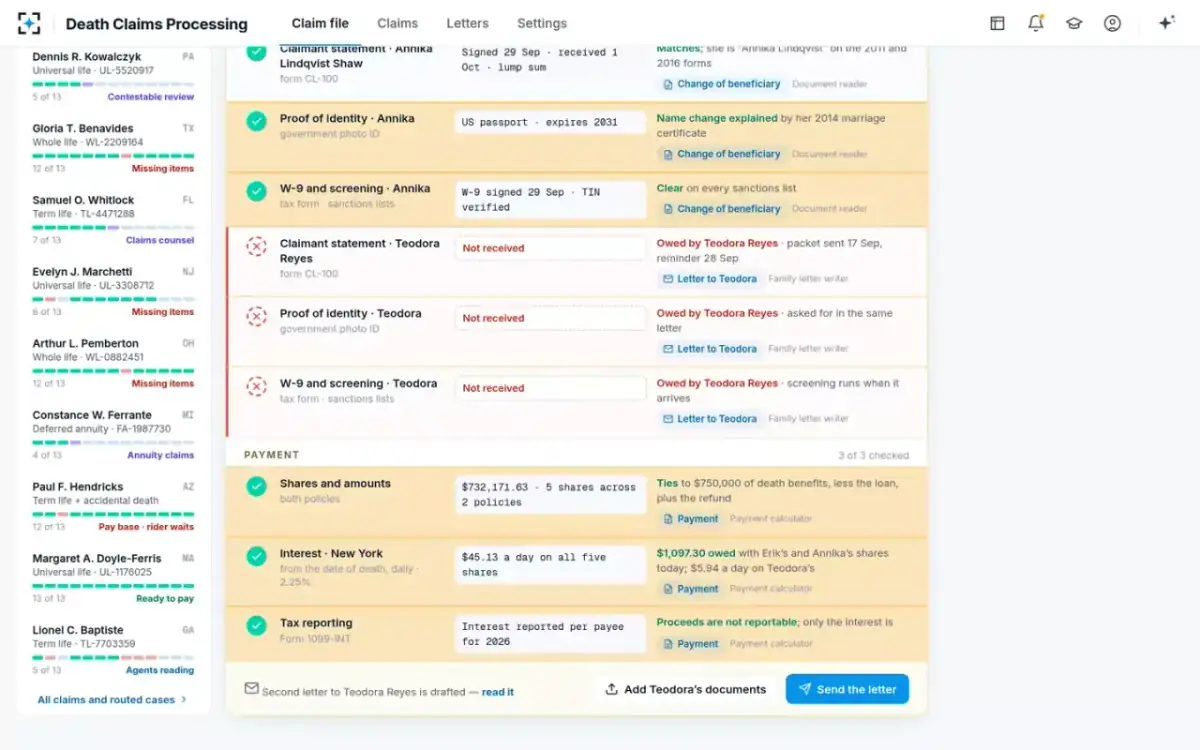
Speed has a limit the solution does not cross: no agent pays, denies or decides a dispute. The examiner approves every payment, a supervisor co-signs above the limit, and a claim with a second claimant goes to claims counsel the day the conflict appears. What a claims desk owes the family is not a guess at a date but an accurate list of what stands between the claim and payment. The examiner who keeps that list is described in the life claims examiner job description.
Questions people ask
How long does life insurance take to pay out after death?
There is no national figure from a regulator. The legal clocks run from proof of the death and of the claimant’s right, typically 30 days to pay once liability is accepted under the NAIC model, two months under the Texas policy rule, so the real time is the time to get proof to the insurer plus those clocks.
Does a life insurer have to explain a delay?
Under the NAIC model, yes: at 30 days after proof of loss it owes the beneficiary a reasonable written explanation, and while an investigation continues it must write every 45 days from the initial notification. California and Texas have their own written-notice rules when the insurer needs more time.
Can a life insurance company hold the whole claim because one beneficiary is missing paperwork?
The model rule expects undisputed portions to be paid within 30 days, and each payee’s share is usually payable on that payee’s own documents. Ask the insurer whether your share is complete; on the sample claim, two of three shares were paid while the third waited.
Does the insurer owe interest if it pays late?
In several states, yes. New York adds interest from the date of death, California from the date of death if payment takes more than 30 days, and Texas and Florida from proof of death. Texas adds 18% a year in damages if the insurer misses its prompt-payment deadlines.
Who do I complain to about a slow life insurance claim?
Your state’s department of insurance. The NAIC model requires an insurer that rejects a claim to tell an objecting claimant that the department may review it and to give its address and telephone number.