An SBA loan processor job description usually lists the same five lines: collect the application and supporting documents, order tax transcripts, key the loan into the SBA system, track conditions, and keep the file complete for underwriting and closing. All true, and all beside the point. The work that fills the week is finding out what each business owner has not sent, asking for it in words the owner understands, and proving later that the asking happened. On an SBA 7(a) loan the file has to satisfy SBA's Standard Operating Procedure 50 10 8.1, the IRS's transcript rules and Regulation B's clock at once, so the chasing is where the risk sits. Botminds' Business Loan Application Portal exists to move that chasing off the processor's desk: owners answer one plain question at a time, each upload is read as it lands, and the processor opens a file that is already checked.
The examples below follow a fictional sample bank, Orchard Point Bank, and its SBA loan processor, Priya Raman, as one application runs through the solution. The people, the bank and the borrower are invented; the rules and the labour statistics are real and linked where they appear.
Four seats carry one SBA application, and the processor's is the one that chases
Today
“I don’t underwrite — I chase.” Asks for the same tax return twice, in emails the owner does not understand.
With agents
Opens each file already read: draft returns, stale financials and missing debts found, each with its page, and one drafted message per person.
Still theirs: What is sent and when; marking the file complete, by name.
Today
“Just tell me what you need, in English.” Guesses which forms the bank means and sends what is to hand.
With agents
Answers one plain question at a time; a tax return fills the answers it can, and only the gaps are asked.
Still theirs: The truth of every answer and every signature.
Today
“One missed owner can cost us the guarantee years from now.”
With agents
Sees every owner traced to 100%, each confirming citizenship and residence with ID, before the loan number is requested.
Still theirs: The eligibility decision and the ownership list sent to SBA.
Today
Receives files that look complete and are not: a draft return, a debt the schedule left out.
With agents
Receives a one-page hand-off where every figure links to its document.
Still theirs: The credit decision, the credit memorandum and the terms.
What does an SBA loan processor do? The short answer, and the long one
An SBA loan processor turns a business owner's application into a file a lender can underwrite and SBA can rely on years later. The Bureau of Labor Statistics files the role under loan interviewers and clerks, who "interview applicants and others to get and verify personal and financial information needed to complete loan applications" and "prepare the documents that go to the appraiser and are issued at the closing of a loan" (BLS, Occupational Outlook Handbook). There is no SBA-specific occupation code; the specialist work hides inside a general clerical title.
The long answer depends on what SBA asks of the file. Under SOP 50 10 8.1, in force since October 1, 2026, the lender enters every direct and indirect owner in the SBA Loan System, and the percentages have to add up to exactly 100% (SOP 50 10 8.1, Appendix 20). Only the data on SBA Form 1919 goes into that system; the signed form stays in the bank's file. A processor therefore builds two things at once: the signed paper file the bank keeps, and the structured data SBA receives.
For a loan made under a lender's PLP delegated authority, SBA "does not review the Lender's analysis of the credit or structure of the loan" before issuing a loan number; that analysis is reviewed when the lender asks SBA to buy the guaranty. Delegated loans were 64.1% of FY2025 7(a) approvals, by our count of SBA's own loan file (SBA 7(a) FOIA data). On most SBA loans, then, the processor's file is the only version of the application SBA will ever read.
The job description most banks post, and the one the work writes
Posted job descriptions describe tasks; the work is organised around gaps. O*NET's task list for loan officers, which covers much of the same ground, includes "Contact applicants or creditors to resolve questions about applications or to assist with completion of paperwork" (O*NET 13-2072.00). On an SBA desk that one line is most of the day. The table rewrites the usual posting line by line.
The SBA loan processor job description, as posted and as done
| What the posting says | What the work actually is | The rule behind it |
|---|---|---|
| Collect the application and supporting documents | Find out which of 14 to 47 checklist items are missing, wrong or out of date, and from whom, then ask each person in plain words | SOP 50 10 8.1, Appendix 20: contents of the lender’s application |
| Order tax transcripts | Get a separate 4506-C signed for each business return type and resubmit when IVES rejects one; send a “Second Request” after 10 business days | SOP 50 10 8.1, Section A Ch. 5 Para. B; IRS IVES rules |
| Key the loan into E-Tran | Trace every direct and indirect owner through holding companies and trusts until the percentages sum to 100% | SOP 50 10 8.1, Appendix 20; Procedural Notice 5000-876626 |
| Verify information | Check that the personal financial statement is dated within 90 days and business financials within 120 days of submission to SBA | SOP 50 10 8.1, Appendix 20 |
| Order third-party checks | Run and keep evidence of the CAIVRS check and the SAM.gov exclusion search for the applicant, its 20% owners and its officers | SOP 50 10 8.1, Section A Ch. 1 and Ch. 4 |
| Maintain the file | Keep the date and content of every request, because the lender must act with “reasonable diligence” to complete the application | 12 CFR 1002.2(f), Regulation B |
Read down the middle column and a pattern appears: almost every task is a comparison between what arrived and what a rule requires. The processor is less a clerk than a checker, and the most expensive checks are the ones that fail late, when an underwriter, a closing attorney or a purchase reviewer finds what the file never had.
The file an SBA loan processor assembles under SOP 50 10 8.1
The file is set by Appendix 20 of SOP 50 10 8.1, SBA's single list of what a lender's application must contain across the 7(a) programs. For a Standard 7(a) loan it requires a signed Form 1919 for each co-borrower, whose purpose-of-loan amounts must add up to the loan request; a personal financial statement for every owner of 20% or more and each proposed guarantor, on SBA Form 413 or the lender's own form, no more than 90 days old when the file goes to SBA; three years of business financial statements or tax returns with interim statements no more than 120 days old at submission, including a detailed debt schedule; tax transcripts; and, by purpose, the lease, equipment quotes, the purchase agreement and the seller's financials.
Two features make this harder than a conventional commercial file. The age limits run to the date of submission to SBA, not the date the owner sent the document, so a statement that was current in August can be stale by the time the file moves. And the program changes the list: for 7(a) Small loans and SBA Express, some items "are required only to the extent necessary to sufficiently document the eligible uses of proceeds and to support the credit analysis". A processor working three loan types keeps three lists in their head. Why a ticked SBA loan application checklist is not a complete file works through where those lists mislead.
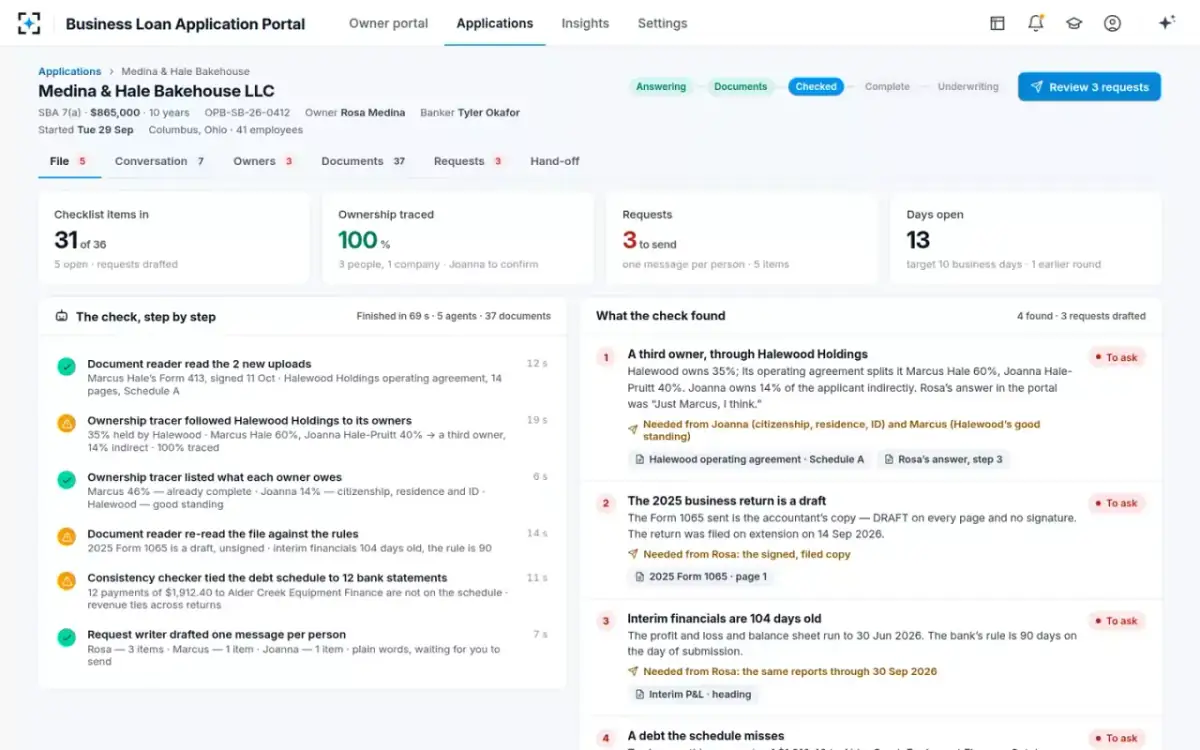
The processor's view: the file, the check step by step, and four findings with their sources
How much does an SBA loan processor make? Salary and outlook
The best public figure is the BLS wage for loan interviewers and clerks: a median of $50,020 a year in May 2025, about $24.05 an hour, with the 10th percentile at $37,330 and the 90th at $69,770 (BLS; O*NET wages). SBA specialists within that category tend to sit toward the top, but no public survey isolates them, so any figure for an "SBA loan processor salary" more precise than this range is a guess.
A clerical title, a specialist job
169,100
loan interviewer and clerk jobs in the U.S. in 2025
$50,020
median annual wage, May 2025
−2%
projected change in jobs, 2025 to 2035
711of 1,336
lenders that made five or fewer SBA 7(a) loans in FY2025
The outlook matters more than the wage. BLS projects the occupation to shrink by about 2%, from roughly 169,100 jobs in 2025 to about 165,000 in 2035, and names the cause: "productivity-enhancing technology is expected to limit demand for other clerks", loan interviewers and clerks among them. The forecast is not that the job disappears. It is that the part of the job a machine can do will stop needing a person, which leaves the question this page is really about: which part is that?
Where the week goes: chasing, not processing
Most of a processor's hours go on the gap between what an owner sends and what the checklist needs. Owners send what they have: last year's return as the accountant's draft, a profit and loss statement from the end of the previous quarter, a debt schedule that forgets the equipment lease. None of these is a refusal; each is a round of email.
What owners miss most on a first upload
Each gap costs a round. Before the portal, the sample bank averaged 3.6 rounds of requests per application; with it, 1.3. The number of rounds matters more than the time each takes, because every round restarts the owner's attention and the processor's memory of where the file stood. The owner's side is no lighter: a Federal Reserve Bank of New York survey from 2013, cited by Harvard Business School researchers, found small businesses spending about 25 hours on paperwork across an average of three banks before securing credit.
“I don’t underwrite — I chase.”
Priya Raman, the sample bank's SBA loan processor (fictional)
Chasing also carries a legal duty. Regulation B treats an application as complete only when the lender has everything it normally uses to decide that kind of loan, and puts the work of getting there on the lender, which must collect the missing information with diligence and contact the applicant promptly when more is needed (12 CFR 1002.2(f) and its official commentary). A processor's request log is the bank's evidence that it did. What an incomplete loan application obliges a lender to send, and by when sets out the notice rules in full.
Why most SBA lenders cannot build a specialist desk
Most SBA lenders make too few loans to keep a specialist busy. In FY2025, 1,336 lender names appear in SBA's 7(a) loan file; 711 of them made five or fewer loans, and only 94 made 100 or more. The ten largest made half of all the loans, by our count of SBA's data. At a lender that makes four SBA loans a year, the processor handles SBA files between conventional ones, and relearns the rules each time.
That is where the rules hurt. SBA issued two SOPs and a run of policy and procedural notices between June 2025 and October 2026; Procedural Notice 5000-876626 alone wrote the 100% citizen-or-national ownership rule into the SOP and added an applicant certification that must be attached to Form 1919 until SBA publishes a new form. A large SBA desk absorbs a change like that in a training session. A part-time desk absorbs it when a file comes back.
Loan processor vs underwriter: where the line sits on an SBA file
The processor makes the file complete; the underwriter decides whether the loan should be made. On an SBA 7(a) loan the underwriter writes the credit memorandum, which "must address all requirements detailed in the Credit Standards Paragraph for the applicable loan program", including debt service coverage and why credit is not available elsewhere. The processor never judges creditworthiness, though the processor's work decides what the underwriter judges it on.
Pay reflects the split. BLS reports a median of $76,690 for loan officers in May 2025 (BLS) and $83,510 for credit analysts (BLS, OEWS), against $50,020 for loan interviewers and clerks. The gap is a reason to keep underwriters underwriting: every hour a credit analyst spends finding a missing debt on a bank statement is an hour of the most expensive seat spent on the processor's job.
Will automation replace loan processors? What moves and what stays
The mechanical half of the job moves; the judgement and the signature stay. Banks have not automated the credit decision for small business loans in any number: the FDIC's survey found that "less than one in thirty banks use a credit-scoring system to auto-approve loans, and less than one in one hundred banks will auto-approve a loan of $250,000" (FDIC Small Business Lending Survey). What can move is the reading and comparing that precedes any decision.
One plain-words request per person, drafted, waiting for the processor
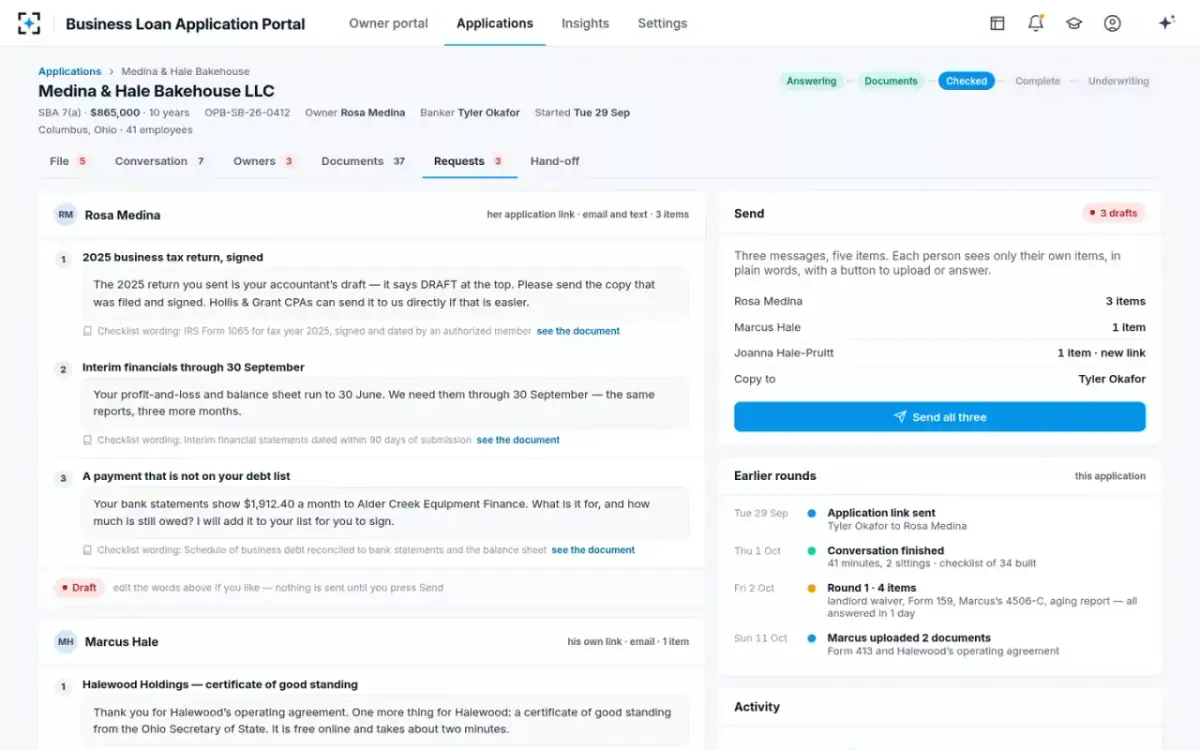
In the solution, six agents take the mechanical part. One reads every upload for type, tax year, period, signer, date and draft marks; one traces owners through operating agreements, trust certifications and K-1s; one ties the debt schedule to the bank statements and the uses of funds to the quotes; one groups what is missing by the person who can supply it and drafts a message. On the sample file the check took 69 seconds and found a third owner nobody had mentioned, a 2025 return marked DRAFT on every page, interim financials 104 days old against the bank's 90-day rule, and twelve payments of $1,912.40 to an equipment lender that the debt schedule left out.
What stays is set out as rules, not hopes. No new request leaves without the processor; only reminders for items already requested go out on their own, every two business days at the sample bank. The agents never mark a file complete: Priya does, by name, and the SBA lending manager confirms eligibility and the ownership list before the loan number is requested. Why IVES rejects a 4506-C for business shows how much of the remaining craft is still the processor's.
What software do loan processors use, and what should it check?
Most processors work across a loan origination system, the SBA Loan System (E-Tran), an IVES vendor portal, email and a shared drive, and the gaps between them are where files go wrong. Whatever tools a bank chooses, the test is whether they catch the checks below before the file reaches underwriting, and show the page each finding rests on.
Seven checks an SBA processor should never have to do by eye
- Ownership sums to 100%
Every direct and indirect owner, through companies and trusts, multiplied through; the SBA Loan System rejects anything else.
- Every signature where IVES needs one
A 4506-C with a missing signature or client field is rejected and the clock restarts.
- Ages against the submission date
Personal financial statements within 90 days, business financials within 120 days, of submission to SBA; stricter if the bank’s own rule is stricter.
- Signed, filed returns, not drafts
A draft return cannot be reconciled to an IRS transcript.
- The debt schedule against the bank statements
Recurring payments that appear on statements and not on the schedule.
- Uses of funds against the quotes
The Form 1919 purpose amounts, the quotes and the loan request should agree.
- Each request dated and kept
The bank’s evidence of reasonable diligence under Regulation B.
A processor freed from these checks does not become redundant; the job becomes the parts that need a person. Deciding whether an owner's explanation of a payment is enough. Calling the owner who has not opened a link in eight days. Knowing that the family trust question from one borrower needs the SBA lending manager, not another email. To see the checks and the requests on a file, start from the Business Loan Application Portal.
Questions people ask
How many loans does an SBA loan processor handle at once?
There is no published standard; it depends on loan size, program mix and how much of the desk is SBA. What drives the load is open files waiting on owners, not new applications: at the fictional sample bank, 12 open applications held 87 missing items between them on one day. Banks that measure rounds of requests per file usually find more capacity there than in headcount.
Does SBA check the people who process its loans?
Yes, through the exclusion lists rather than a licence. SOP 50 10 8.1 requires lenders to search SAM.gov exclusions for their own staff, agents and lender service providers once, before their first day of work on SBA business, and to keep evidence of the search. The same check runs on the applicant, its 20% owners, officers and key employees for every loan.
What does a loan interviewer do?
In BLS terms, a loan interviewer gets and verifies "personal and financial information needed to complete loan applications" and prepares documents for appraisers and closings. On SBA loans that includes the Form 1919, the personal financial statements, the 4506-C forms and the ownership details SBA requires. The title is the official one; most banks call the role a loan processor.
Is an SBA loan processor the same as an SBA loan packager?
No. A processor is the lender's employee; a packager is a third party paid to prepare an application, and SBA calls such parties Agents. Any fee an Agent charges must be disclosed on SBA Form 159, a separate form for each Agent, and Form 1919 asks the applicant directly whether it has paid or committed to pay anyone to help prepare the application.
How long does SBA loan processing take?
No official figure covers the whole process. The FDIC found that three in four banks approve their typical loan within ten business days, but that clock starts once the file is complete; collecting the file is the variable part. At the fictional sample bank, the median time from first document to complete file was 23 days before the portal and 9 days with it.